
Jacques Pépin: The Secret Wisdom of a Culinary Legend
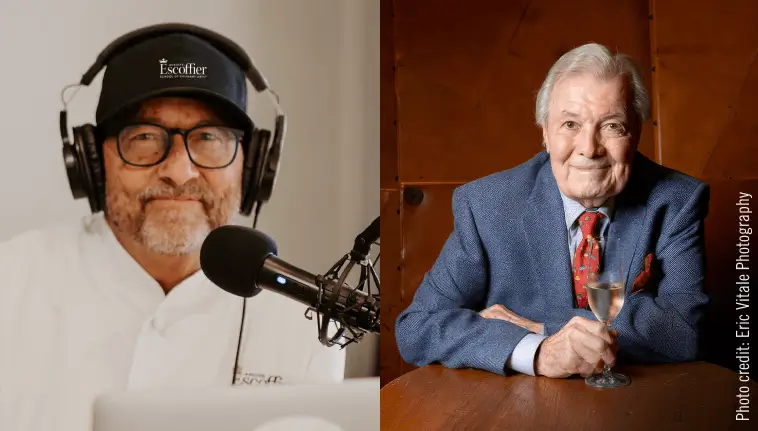
In today’s episode, we welcome Jacques Pépin, culinary icon, bestselling author, and beloved teacher whose career has shaped generations of cooks around the world.
Jacques looks back on his early apprenticeship in France, his move to the United States, and the unexpected turns that defined his career—from La Pavillon to Howard Johnson’s, from television with Julia Child to decades of teaching. He reflects on the importance of technique, the difference between professional and home kitchens, and why cooking has always been less about prestige and more about connection. He also shares the mission behind the Jacques Pépin Foundation and why passing on practical skills to those rebuilding their lives matters deeply to him.
Join us as Jacques reminds us that long after trends fade, the simplest truth remains: cooking brings people together.
Watch the podcast episode:
Don't Miss The Next Podcast Episode!
Get the latest episode of The Ultimate Dish delivered right to your inbox every week.
Email Address:
Jump to a Section
- FULL TRANSCRIPT
- Cooking Brings People Together
- The Importance of Technique
- Nothing was Planned
- Low on the Social Scale
- The Birth of a Cookbook
- Art and Menu Memories
- Accessible Cooking and Accessible Training
- Television and Teaching
- Remembering Julia Child
- Connecting and Learning with Cooking
- Jacques Pepin's Ultimate Dish
Episode Notes and Resources
TRANSCRIPT
Kirk Bachmann: Hello everyone, my name is Kirk Bachmann, and welcome back to The Ultimate Dish. Today, we have an extraordinary honor of welcoming a true culinary legend, Chef Jacques Pépin.
Born in 1935 in Bourg-en-Bresse, France, near Lyon, Jacques began his culinary journey at age 13 with an apprenticeship at the Grand Hôtel de L’Europe after helping his parents at their restaurant, Le Pélican. He went on to work in Paris, ultimately serving as personal chef to three French heads of state, including Charles de Gaulle.
In 1959, Jacques came to America, where his career took remarkable turns. He worked at Le Pavillon, a historic French restaurant in New York City, and then made an unexpected move to Howard Johnson’s as director of research and development from 1960 to 1970. During that same period of time, he earned his Bachelor’s and his Master’s degrees at Columbia University.
Jacques is the author of more than 30 cookbooks, including his seminal text “La Technique” and his autobiography “The Apprentice.” He’s hosted numerous television series, including the beloved “Julia and Jacques Cooking at Home” with his dear friend Julia Child, which won both an Emmy Award and a James Beard Foundation Award.
He’s received 16 James Beard Foundation Awards, including the Lifetime Achievement Award in 2005, and was awarded France’s highest civilian honor, La Légion d’Honneur, in 2004.
For the past 30 years, Jacques has taught in the Culinary Arts Program at Boston University and served as dean of special programs at the International Culinary Center. In 2016, he co-founded the Jacques Pépin Foundation with his daughter, Claudine, and son-in-law, [Dr.] Rollie Wesen to provide culinary training to individuals facing employment barriers.
Jacques is also an accomplished artist, showcased in his recent New York Times bestseller, Art of the Chicken. He has called Connecticut home since 1975.
So get ready everyone for a conversation with a master who has seen it all, done it all, and continues to inspire us all.
And there he is. Good morning, Chef.
Jacques Pepin: Good morning. How are you?
Kirk Bachmann: I’m good.
Jacques Pepin: [Thanks for the] introduction
Kirk Bachmann: I’m a little tired after that. Did I do okay with the French terminology?
Jacques Pepin: Yeah, that’s fine.
Kirk Bachmann: Oh my goodness. I’m beyond excited to chat with you today. Thank you for your time.
Jacques Pepin: [You’re] welcome.
Cooking Brings People Together
Kirk Bachmann: We had your son-in-law, Rollie, on the show about a year ago, and he was fabulous. He talked much about the foundation. He told us a really funny story. I hope you remember it. It was the story of the first time that he met you. He came over to the house, and it was Christmas. He thought it was a good idea to bring apple pie and foie gras terrine to Jacques Pepin’s house.
Jacques Pepin: Right.
Kirk Bachmann: Then, at some point, you sliced up one of your terrines and one of his, and he thought he did okay. He thought he did okay.
Jacques Pepin: Frankly, I don’t really remember exactly, but yes. He’s a great guy, actually. The foundation and all that was created by him and my daughter, not by me. I’ve been the lucky recipient of many of those things. I’m a lucky guy.
Kirk Bachmann: He’s wonderful. A wonderful person. We appreciated having him.
Chef, I’ve read. I’ve done a lot of research. You’ve often said in things that I’ve read that you never planned most of what happened in your life. You simply followed the work, and you stayed open to what came next. As we sit here today at this moment in your life, maybe there is not one single memory, but what feels like the single most important cooking lesson that has taught you about life?
Jacques Pepin: Oh. Cooking, without any question, brings people together. Definitely, in an area now of dissension of political problems and so forth, there is no political obligation, or racial obligation, or religious obligation, or whatever you want. People bring together and it’s a nice way of connecting and being together and learning how to be together. If I had five Republicans and five Democrats coming to my house for dinner, before they start arguing, we’d say, “We’ve got to finish these two bottles of wine first.”
Kirk Bachmann: I totally agree.
Jacques Pepin: Usually, sitting at the table, the sharing of food and wine kind of brings people together. Even if there is dissension and disagreement, it’s usually more polite, nicer than it would be otherwise.
The Importance of Technique
Kirk Bachmann: That’s beautifully said. Beautifully said.
Chef, that leads me to my next question or statement. Your work over the years has really shaped generations of cooks through “Technique,” myself included. You’ve always carried this beautiful sense of humility and humanity. When you think about [that] my father is ninety years old this year. He came from Germany, and he’s what they call a Meisterbrief there. He came to America in 1960. He knows that we’re talking today. He wanted me to ask you: when you were a young boy in France, what mattered most to you – mastering the technique of your mentors, or learning how to be the most generous person you could be in the kitchen?
Jacques Pepin: I don’t think I ever thought in those terms. By the way, if your father is ninety – I’m ninety – and came here in 1960, I came here in 1959.
Life was totally different eighty years ago during the war, at the end of the war. We didn’t have a radio at my house. We didn’t have the telephone. We didn’t have a computer. Of course, we didn’t have any of this. It’s quite a different world.
My father was a cabinetmaker. My mother was a cook, having a little restaurant. My choice in life was very easy; I’m a cook or a cabinetmaker. I never really thought further than that much.
When you get into apprenticeship at that age, when I was young, of course at the beginning there, I did a lot of killing of chickens and killing of rabbits and skinning rabbits, and breaking chickens, cleaning the floor, and especially keeping the stove working with wood, all that. There is a whole technique that you have to do so the stove is exactly really hot at the moment when you need it when the people sit down at the table. If you weren’t there, that would screw up the whole dining room. Those things don’t exist anymore, but those were really important.
I never really thought forward, just what was coming in at the time. Everything was new for me at my age.
Kirk Bachmann: Thank you for that, Chef. I’m going to mention your fiftieth anniversary edition of “Complete Techniques,” but I have to say that this is my favorite book. Can you see that? Do you know what I love about this book? One, on page twenty-three, you are there with your apron and a bottle of wine. We’ll talk about this more – every chapter features one of your paintings. Absolutely beautiful. I’ve had this book so long the pages are very tarnished and stained from the kitchen as well.
Coming back to the fiftieth anniversary edition of Jacques Pepin, “Complete Techniques,” I have another one. This one came out in 2012. The book is described as being both for the beginner home cook and for professional chefs. My question, Chef, is what do you hope a young cook just starting out will take away from your words and your recipes in this book?
Jacques Pepin: The beauty of that book is it’s still current in a way. Fifty years. It came out in ‘76. Because whether you cook Italian, Spanish, French, or American, the way you learn to peel an asparagus or slice or bone a chicken is the same regardless of what you’re going to do with it after. That’s what the idea is.
I had a very bad car accident in 1974. At that point, that changed my life, too. Although I had started writing a book, I started giving classes a bit all over the country and do a small cooking school at a cookware shop. A lot of ladies shop in the cookware shop where I did a cooking school in back. I was doing a couple of those. They said, “Can we book you for next year?” I ended up doing about thirty-five weeks out of the year going from east to west.
There, when I started, I gave classes of about three hours, very long classes. I’d peel a carrot. They’d say, “Wow! That’s how you peel a carrot.” I said, “Yeah.” It was kind of fresh to me that I decided there that basic techniques would be important to put in a book. It’s very visual. That’s basically how the book came about.
Actually, it’s interesting because in the first edition, we had a big segment in the middle with the finished dishes in color. I think the book is in black and white. It wasn’t long that it was edited, it was edited again, a second edition, and they removed that. It was too expensive, the center color. But they never removed the reference to it. I may bone out a chicken, and at the end of it, I just have the boned-out chicken on the table, and I have the stuff, and I said, “See page whatever” for the finished dish. They never removed that, but there were no more [photos.] It was kind of weird. Then it went on. It was resold. It was added. I did the second volume. I didn’t want to call it “La Technique Number Two” so we called it “The Method.” We found a synonym.
That book is probably what will remain of me because it is still [as] useful today as it was fifty years ago, even though I don’t cook. I certainly don’t cook the same way I did fifty years ago. When I say you peel an asparagus, it doesn’t really change through those years.
Kirk Bachmann: That’s brilliant. That’s well said. I think Auguste Escoffier himself would agree a hundred percent. It starts with foundations. It starts with the classical techniques.
Jacques Pepin: Yes. My life changed from being a professional cook and being really in the professional world of cooking. I moved to the home cooking world. Even at the beginning of five years ago, my daughter said, “Could you do a little recipe, like three, four, or five minutes? I want to put it on Facebook.” And I did. I did four hundred of those. She put on a different one every day. I let her take care of that. Those are stuff I had leftover in the refrigerator. This is really for home cooks. I have moved from one to the other.
To me, the technique is very important if you are a professional chef or if you learn to become a professional chef, there’s no question. It’s eleven o’clock in the morning, and at twelve o’clock, you have eighty people sitting down for lunch. Well, you have three cases of artichokes to do, you have to do them within twenty or thirty minutes. There’s speed there. The technique becomes very, very important, which is not really the case when you’re at home working a different way.
Nothing was Planned
Kirk Bachmann: That’s so well said. Great advice for both the home cook and the professional.
If we could go back a few years, you were born near Lyon. You started your apprenticeship at a very young age. I grew up in my parents’ kitchen as well – bakery. I’m curious as to some of your earliest memories of the kitchen at your parents’ restaurant. What made you fall in love? I know you had a choice – you were either going to be a cook or a carpenter – but how did you fall in love with cooking in your parents’ restaurant?
Jacques Pepin: Cooking was exciting. I have to say that Lyon is where I come from. Lyon is pretty well known for the formidable woman chef of Lyon, some three-star at the Michelin and so forth. In my family, I can count twelve restaurants in the area around Lyon owned and operated by women. I was one of the first males to go into that business. My aunt, my cousin, sister-in-law, mother, of course, they all were cooks. At some point between ‘56, ‘58, you mentioned I was the chef to the president in France. I remember, at that time, going back to Lyon for a few days, a vacation, and going to my aunt and naturally to the restaurant, getting to the kitchen. She drove me out of the kitchen! I was the chef to the president, but they weren’t very impressed. Those were my pretty terrific cooks. Lyon is known for a woman cooking very often.
Kirk Bachmann: Certainly.
So in 1959, you came to America, like you said. I’ve read a quote from you. “I never planned to stay in America.” Neither did my father. “I never planned to go to Columbia. I never planned to parent or to do that many cookbooks, or do any of the things I’ve done, but things happen and you go with it.” I’d love to hear a little bit more of your elaboration on that comment. What brought you to America in the first place?
Jacques Pepin: I wasn’t married. I was working in Paris in a good job. I love America. I love jazz. I love all of this. I think it would be great to learn the language and spend a year there or so. I didn’t really have anything planned, so I came on a student boat for a semester, a year, year-and-a-half, two years. This is sixty years later almost. I’m still here.
Life was different then. It was another world, I discovered. To start with, you weren’t working at the Pavillon. We worked with one shift. At France at that time, in Paris, we still worked two shifts. Starting at nine o’clock in the morning, finishing at two. Starting back at 5:30 until ten at night. It was a different world. Here, I started in the morning at eight o’clock, nine o’clock, finished at two o’clock in the afternoon.
I came on a student boat, and there was a professor there who spoke French. I said, “I’m going to be in New York. I need to improve my English.”
He said, “Well, you’re in New York, so you go to Columbia University, the best school.” Which of course, I’d never heard of. The week after I was here, I took the subway up, went to Columbia, find some houses, found someone who spoke French enough to direct me, and enrolled eventually in English for foreign students. That was 1959. In 1972, I proposed a doctoral dissertation on the history of food, so I stayed at Columbia fifteen years. I was working in New York. I had time.
I was probably two or three years in English for foreign students, and then I had to go into some type of validation program, because of course, I never went to high school. I had to go two or three years on that validation program. Then I was accepted in the regular program and did a BA and a Master’s in literature. Eventually, my doctoral dissertation was a history of food, but in the context of it in literature, going back to the Greek.
At that time, they looked at me. They said, “Food? You cannot write a doctoral dissertation on food. That’s too trivial. It’s not important enough.” So my doctoral dissertation was refused there, so I quit.
Eventually, with Julliard. I worked with Julliard. We set up a program at Boston University. We set up a Master’s of Liberal Arts with a concentration in gastronomy that is still going on. Things have changed in that time a great deal. There have been many, many books and many dissertations about food. But at that time…
Low on the Social Scale
Kirk Bachmann: Just fabulous stories. Can you tell us a little bit about the opportunity that presented itself to serve as a chef at the White House, but ultimately you decided to go to work for Howard Johnson’s, which was an up-and-coming, very, very large organization? What led you to make that decision?
Jacques Pepin: Well, it’s not as noble as you think it is. At that time, the world was quite different. The cook was really at the bottom of the social scale. For me, I worked with three presidents in France for two years between ‘56 and ‘58. And I served Eisenhower, de Gaulle, Macmillan, Tito, and heads of state. I never, never had a time when people would welcome me to the dining room for kudos. Are you kidding? That did not exist. I never had an interview with a magazine or a newspaper. That didn’t exist. The cook was really low on the social scale.
When I was in New York, I worked at the Pavillon, which was considered maybe the best French restaurant at the time. It was. I was offered the job for Kennedy at the White House, but again, in a sense, I didn’t realize. Because a cook was in a different position than now. I had done that. It was okay, but I was going to Columbia at the time. I was involved in other things. I didn’t want to quit that.
Howard Johnson, Howard D. Johnson, was one of the regular clients of the Pavillon. He hired Pierre Franey, the daily chef to work for Howard Johnson. Pierre really wanted me to go with him. So I did, in the commissary in Queens Village. I stayed there for ten years.
Ten years later, I left. In 1970, I opened a restaurant on Fifth Avenue in New York called La Potagerie where I did things in production. Soup. Dinner for $3.75, all included, a soup, dessert, and so forth. I was a consultant at the Russian Tea Room. Then I opened the World Trade Center with Joe Baum. We served 40,000 people a day from the commissary that I set up.
I’m saying all of that [because] I would never have been able, as a French chef, to do that without the training of Howard Johnson. It was another world altogether for me, so I did learn a great deal. I’d never done a recipe before – written down! Howard Johnson was great, and Mr. Johnson came to my wedding. He came to the christening of my daughter. He came through. He was a great guy.
The Birth of a Cookbook
Kirk Bachmann: Wow! What a wonderful story. Wonderful.
A beautiful segue to the cookbooks. So many cookbooks, over thirty, starting with “The Other Half of the Egg,” 1967, the same year that Claudine was born. Specifically, what inspired you to write that book, and how do books allow you to find mediums that other canvases don’t?
Jacques Pepin: That book was actually the idea of Helen McCully [00:22:42] the food editor of McCall’s and “House Beautiful.” I met Craig Claiborne first because he reviewed the Pavillon, came to [inaudible] and so forth. I met Craig Claiborne, who had just started at the New York Times, and he introduced me to Helen McCully and Helen, because she was kind of an older lady at the time, she kind of became my surrogate mother, telling me, “Don’t do this stuff. Don’t do this. Don’t do that.” She’s the one who pushed me into starting to write.
She spoke with James Beard every day for like an hour. Through her, I met James Beard. A few months later, whatever, she said, “Oh, I have a book here I want you to look at it.” It was the manuscript of “Mastering the Art of French Cooking.” It was Julia’s book, sent to her to review. I looked at it and said, “It’s a pretty good book.”
She said, “Well, the woman is coming to New York in a couple of weeks. Do you want to cook for her?”
I said, “Sure.”
So that’s how I met Julia a few months after I was here. In fact, we spoke French when I met her. She came back from France, and her French was better than my English at the time. The world of food was really small. I knew if you wanted the trinity of cooking in America, it was James Beard, Julia Child, and Craig Claiborne within six months or eight months after I was here. So it was another world altogether than it is now. That’s how I met Julia.
Art and Menu Memories
Kirk Bachmann: I’m just curious [about] when you started painting and how that has become an expression of your passion, just like your cooking is? You said earlier that food brings people together. Do you feel the same way about your painting, about your art?
Jacques Pepin: In a different way, but for me they complete me in some ways. It was at Columbia when I was at Columbia, at some point I had to show myself taking a few classes here and there, so I took a class in sculpture once and another one in drawing. That brought me to that world. I started doing illustrations.
I was married for fifty-five years. At the beginning of our marriage, many years ago, Gloria said, “We’re having people for dinner.” She said, “What if we write the menu in something?” So she decided, we’ll write the menu, and I kind of illustrated it. We started that. I have twelve books that thick [full] of fifty years – of more than fifty years, sixty years now – of people who came to my house for dinner, from my mother, to my two brothers, to many, many people who are gone, who were there.
My daughter, Claudine, is fifty-eight years old. She came a few months ago, and she said, “Do you know what I ate for my fifth birthday?”
I said, “Let’s look.” We found it. She drew a chicken at that point. Those books of menus are my whole life, in a sense. This is, in a sense, also I started illustrating them, and that also was part of my interest in the painting. It got bigger and bigger.
Certainly now, I may be more interested in painting than in cooking.
Accessible Cooking and Accessible Training
Kirk Bachmann: No, I love that. That’s such an amazing story.
Speaking of your daughter: in 2016 you founded the Jacques Pepin Foundation with Rollie. Why was it important, do you believe, to create that foundation? All these years later, what impact do you see that it’s making? I think it’s absolutely fabulous.
Jacques Pepin: It was Rollie and Claudine who started that. Rollie started compiling some things I’ve done on television. I did thirteen television series, and each time, I had a different book. That’s why I have so many different books because of different subjects.
I had a column in the New York Times called “The Purposeful Cook” to cook for a family of six for a limited amount of money. So I did a series on what you can make and so forth coming from that series.
I did a series on “Fast Food My Way,” showing people what to do using the supermarket as a prep cook, because as you know, in a professional kitchen, you have a prep cook come. He bones out the chicken, bones out the fish, slices the shallots, you have the mushrooms, wash the spinach. You come to the stove. Someone orders a piece of fish. You grab it there, a bit of shallot, bring it to boil. You do it in four or five minutes because you have the prep. I wanted to show people, so I took a package of the supermarket skinless, boneless breast of chicken, pre-sliced mushrooms, and within thirty minutes, I did three or four dishes, showing people other fare how to use it.
I did all of those series on television with different subjects to start with. That’s how and why I did so many books, to some extent. So many.
Your question, I forgot now.
Kirk Bachmann: No. We were just talking about how important the foundation was.
Jacques Pepin: Rollie started bringing all of those things on Instagram and stuff, extrapolating, for example, how to slice a potato, out of one show. Whatever. He extrapolated those things.
At some point, he’s a professional chef. He had a degree in journalism. He went to college, but then after that, he was hired at Johnson & Wales and did his Master’s and did a Ph.D. in education. He’s a full professor now.
At some point, he said, “You’ve been teaching people all your life doing this. What do you think you would want to teach now.” So we talked about it.
And I said, “People who have been a bit disenfranchised by life, people who come out of jail, homeless people, former drug addicts. People like this need help.”
So we work with community kitchens throughout the country to teach people like that because I feel that in six weeks, I can teach people how to wash salad and peel potatoes and poach an egg. In six weeks, if people are interested, they stay in that kitchen. Five years later, maybe that person is a chef now of that same restaurant. And they have redone their life. We need people like this without any question.
That was the reason that we started doing it in that direction.
Television and Teaching
Kirk Bachmann: It’s amazing. And I agree a hundred percent.
I was going to ask a question. Coming back to the days when you were first starting to be on television. There weren’t that many people on television. When you watch the countless television shows today…
Jacques Pepin: Yes, it’s amazing.
Kirk Bachmann: It is amazing. Isn’t it? It’s come so far.
Jacques Pepin: I don’t even look at my own shows, so frankly, if I don’t look. It’s a different world. PBS, without any question, PBS, whether it’s Lidia Bastianich or Rick Bayless or people like that, or Martin Yan. We tried to teach people. I’m sure that all the shows I’ve done, people will look at my shows and say, “That guy’s pretty boring. It’s always the same.” There is no fight. Now, a great deal of the shows are competitions and fights and all of that, which is maybe fun to look at, but really not the way it works in the kitchen or the way you learn how to cook.
In a different way. Certainly PBS was there to teach people how to [cook] and this is what I did for many years. Julia also. We had a good time doing that. It’s quite different now, I guess.
Kirk Bachmann: I’m glad you brought up teaching. Was teaching something you felt that was [important?] Was your mother a teacher when she taught you how to cook? Is it something that has always been part of you? You always felt like you needed to give back through teaching?
Jacques Pepin: I don’t know if I’d call it teaching because at the time, I don’t think I ever wrote a recipe before I came to America. It was purely a question of looking and duplicating, looking and duplicating without much explanation one way or the other. It was kind of a natural thing.
Starting when I was six or seven years old. When we came back from school, I would never tell my mother and father, “I’m bored.” They would say, “You’re what?! Are you kidding?!” There were always some potatoes to peel or [bottles to wash] to put wine in it or stuff in the restaurant. We would try to hide, my brother and I. Yes.
Kirk Bachmann: Well, we’re grateful that teaching became such a natural thing for you because we’ve learned so much.
I wanted to say, first of all, happy birthday. Congratulations on your recent birthday. Ninety. Ninety chefs. Ninety dinners. How was that experience for you? I followed you on social media.
Jacques Pepin: It was created by Rollie and Claudine. I did not go to ninety parties, but probably twenty or thirty. I went to some in New York. I went on the West Coast for three weeks to do a lot of parties. It was very rewarding in many ways, doing an extraordinary dinner, like at the French Laundry. Keller. It was like five thousand dollars, and he gave all the money to the foundation.
People in our world of food are very generous usually. It’s been very rewarding. We had ninety professional chefs doing a party, and we had ninety home cooks doing a party at home.
Remembering Julia Child
Kirk Bachmann: Absolutely fabulous.
We have to talk about your friendship with Julia, Julia Child. I was so fortunate to meet her years and years ago. You were long-time close friends. Your PBS series, “Julia and Jacques Cooking at Home” won both an Emmy Award and a James Beard Foundation Award in 2001. I read an article where Julia said she thought the world of you.
And I came across this other story that I just wanted to share today. I quote, “Jacques and Julia were doing a demo at Boston University. They were having a delightful time battling with each other in their wonderfully competitive way. Jacques had seasoned a pot, but Julia didn’t think he had used enough salt. They argued about it, and then while his back was turned, she threw in some more salt.”
What made your partnership and your relationship on television with Julia so magical?
Jacques Pepin: To start with, we were friends. It’s also, in that case at BU, she’d throw a stick of butter at me. She loved butter.
What people don’t realize, we started doing that special for PBS in the summer. In the summer, I used to do a special doing only technique. Before the computer was there and you had Amazon and all of those shows to go to, in the summer, I did a special for PBS. At some point, at BU, they said, “Do you want to do a show with Julia?”
I said, “Yeah, that’d be great.” We had four or five hundred people. I told PBS, “Do you want to film that on the special?” And we did that for a couple of years. Certainly, we kind of decided – usually Julia decided – what food to bring and so forth. We didn’t really have any recipes, and we started cooking. That was fun. That’s why we decided to do a series on television after.
I did thirteen series of television, and each time we did a series, I had a book I wrote. The manuscript of the book to give to the back kitchen and all of that, so they’d have an idea. “I’m going to do that today.”
With Julia, we had no recipe and no book. The book was done after. No recipes. It was a bit difficult for the cameraman, too. They didn’t know whether we’re going right, left.
We brought food and we started cooking without recipes, which for me, as a professional chef, is probably easier and more fun. I can throw a bunch of scallions in whatever dish it was because it happened to be on the table. I don’t have to look at a recipe.
That’s how we cooked together. Strangely enough, we’d get so many letters that she was so much more French than I was because she would always say we started cooking together. “Yeah, I started in 1949.” She came to Paris in 1949, so it was a set style of cooking and all that for the time. She was 23 years older than me. It was different.
Certainly, I remember one time, I was cooking spinach, whatever we do. I had a skillet. I washed the spinach, I took a big handful of spinach, throw it in the skillet.
She said, “No, no, no, no.”
I said, “What?”
She said, “No, we have to blanch it.”
“Yes.” When I worked in Paris at the Plaza Athenee or Fouquet’s or Le Meurice. Yes. You have that big cauldron of covered, salted water, and you’d drop the vegetable in there to blanch them, to drain them off, cool them off, and press them until you have a bowl of precooked spinach in the refrigerator. If someone ordered spinach, that’s what you took, precooked.
Still, I said, “Whoa, whoa. We don’t do that anymore. You don’t blanch it and boil.”
“We have to do that.”
“No, we don’t.” We’d argue with things like this often, which was really funny because it was all in the old style.
As I said, we had no recipes, so we did whatever we wanted. I think people liked it. It wasn’t planned.
Kirk Bachmann: And that’s what made it so incredible, that it was so natural and spontaneous, unintentional.
Did you learn anything from a technique perspective from Julia?
Jacques Pepin: Julia, certainly I learned from her. She’d say, “You are too serious. This is television. You’ve got to laugh. You’ve got to be happy.” She was right as a professional chef.
I learned from her to be more natural, maybe more simple. That was good.
I think we worked together pretty well in one way or another. Whether we agree or not, we drank a lot of wine. Julia was always so happy to be with PBS, as I was. We didn’t have the right to endorse any products. We never endorsed any products, and that’s what she wanted.
I remember one time, we had Jess Jackson. We had Kendall-Jackson as one of our sponsors, and they were very, very generous with us. She told us, “You can do French one, Italian one, whatever you want. You don’t have to use my wine only.” So it was very generous, and we did. We started always the show, I opened a bottle of white wine. We had a glass of wine and so forth.
They called me from the West Coast to say, “We want to take you out for dinner with Julia.” They came to Boston where we were filming, and they stayed in the hotel there so they can look at the show being taped. Of course, the preview starts, “Jess Jackson is there, what are you going [to do?]”
I said, “Don’t worry about it. It’s not like we don’t drink.”
Whatever we did that day, I forgot, some type of dish. We had some wine during the show, and at the end, that special dish that we did, I told Julia, “Do you want a little Merlot with that or a Cab Franc or what?” She said, “I want beer.” I want beer.
They were looking at us, “We don’t got beer.”
“We have beer.” She had beer underneath. That’s the way she was.
Kirk Bachmann: Just amazing. You know, Chef, Anthony Bourdain once said, “Jacques Pepin is the master. The undisputed authority on – well – just about everything related to food. If Jacques Pepin tells you, ‘This is the way to make an omelet or to roast a chicken,’ then for me, the matter is settled.” Such a beautiful thing to say.
Jacques Pepin: Anthony was very, very nice with me. I don’t know if you know, I have a show on the American Master, the art of craft. He’s the one who starts the show. You cannot miss the beginning because he starts the show. He said, “If you happen to have met a new man,” – if you’re a woman, not in those words – “a new woman, and spent the night together, first you have to learn how to make an omelet in the style of Jacques Pepin for the morning.” Something to that effect.
Kirk Bachmann: Priorities. Priorities.
Jacques Pepin: Really, really funny. So he was always very nice with me, certainly very generous.
Connecting and Learning with Cooking
Kirk Bachmann: What a great memory. What a great story.
Chef, when you look back on your career [and] all these years, all these honors – it’s a difficult question – but what are you the most proud of?
Jacques Pepin: I was lucky. Lucky. And lucky. Things happen at the right moment for me. I made a decision. We went there. I picked work, whether it was a show. Yes, if you’re there at the right moment, too.
But to bring people together through food is a great thing. That I realize even more and more as I get older and older. When I see young people when I go to a restaurant – I was there a few days ago – and there was a young couple, maybe thirty-five and forty, a man and woman and two kids. The four of them are on their telephones in front of them and sat the whole evening. They didn’t even talk to one another.
You have to be involved in cooking. When I was a kid, it as automatic because we worked in the kitchen. We did something when we finished school. Finished school, we’d get into the kitchen to do our homework. You had the smell of that. It was our whole life, which I tried to duplicate for my daughter when she was small, to be together this way, through food.
More and more, I think it’s important even more than it used to be at the time because people seem to have all of those ways of connecting with one another, too, and people apparently, teenagers are more lonely than they have ever been. If you take those telephones away, and put them in the kitchen, and say, “Okay. There are potatoes. They are staying there. We’re going to do something with it together,” that would help.
Kirk Bachmann: Such a great response. I was going to ask you what you believe has changed so much in the culinary world since you started, and I think you answered that. People are distracted. They’re not enjoying the meal. They’re on their phones, that sort of thing.
Jacques Pepin: There is a dichotomy. When I came to America, I lived on Fiftieth and First Avenue, between First and Second Avenue on Fiftieth Street near Southern Place. Nice area. First time I strolled on First Avenue, I found a little supermarket. The first time I went into the supermarket, I thought it was fantastic. I didn’t have to go to the fish guy, the vegetable guy, the meat guy, like in France. It was basically the whole thing was packaged, packaged, packaged. There was one salad. It was iceberg. There were no leeks, no shallots, no other vegetables. Nothing of this. That was 1959 1960 and all that. The markets are exploding now. You go to the market, it is extraordinary with the food. It’s totally different.
Do people cook better than at that time? Maybe yes, maybe no. Maybe yes. There is also more food prepared in the supermarket than there has ever been. People take lunch, dinner, with sandwiches, all prepared food, which really did not exist before. There is more of a dichotomy now with people. There are some nice farmers’ markets now, where people will go to farmers’ markets and cook and do things together. As you say yourself, the amount of cooking shows on television, the amount of cookbooks published every year, is amazing. So there are people interested in cooking.
On the other hand, there are many other people, young people, who are never exposed to cooking, never do that. As they get to be adults and get married, the children don’t know. It’s bad in some ways. It’s bad.
Kirk Bachmann: If you had to give advice today to a young cook who is just beginning their career, what do they need to know?
Jacques Pepin: I have people tell me, “I don’t cook at all.” Okay. “I want to learn how to cook.”
I say, “Do you have any friends who cook?”
“Yes, I have friends.”
“Then call the people who invite you for dinner, and say, ‘Can I come an hour ahead and cook with you?’ And then you bring a bottle of wine. Then you drink the bottle of wine. If you forget the chicken in the oven for a while, it doesn’t matter.”
Kirk Bachmann: You’ve got a bottle of wine.
Jacques Pepin: Relax and try with your friend to get involved with them, to go to the market and so forth. And to give the children a choice of food. You are in the market. Have them [choose.] It’s not easy. It used to be very natural before because the food that I had when I was a kid, nothing was prepared ahead. Nothing was under the vegetables. They were all natural. There were not foods like now. It is a different world.
Jacques Pepin’s Ultimate Dish
Kirk Bachmann: It is.
Chef, we’ve come close to the end, but I can’t let you go until I ask one very important question. The name of our show is The Ultimate Dish. So, you’ve cooked for years for so many people. It’s a very hard question, but if I ask you, “What is the ultimate dish?” what would that be? What would be that one dish that you just remember and love to cook and share?
Jacques Pepin: If I have the greatest baguette in the world, and the greatest butter in the world, bread and butter is very hard to beat.
Kirk Bachmann: Oh my goodness! Oh my goodness! And some wine?
Jacques Pepin: Oh, of course. Of course. Yes.
Kirk Bachmann: I think after a hundred and forty-four episodes, that’s the best answer I’ve ever had. Good bread. Good butter. And good wine.
Jacques Pepin: It is true.
Kirk Bachmann: I love it. Chef, thank you so much. Honestly, I’m honored. I’ve been a fan for a very long time. Congratulations on all the success, the foundation, and happy birthday. Thank you for spending some time with Escoffier.
Jacques Pepin: Thank you. Thank you for having me.
Kirk Bachmann: We appreciate you.
Jacques Pepin: I thank everyone.
Kirk Bachmann: Open a bottle of wine! Open a bottle of wine!
Thank you for listening to the Ultimate Dish podcast, brought to you by Auguste Escoffier School of Culinary Arts. Visit escoffier.edu/podcast to find any materials mentioned during the podcast, including notes, links and other resources. And if you can, please leave us a rating on Apple or Spotify, and subscribe to support our show. This helps us reach more aspiring individuals ready to take the next step toward their dream careers. Thanks for listening.