

Kristen Kish in Toronto, Canada: Why Confidence Matters More Than You Think
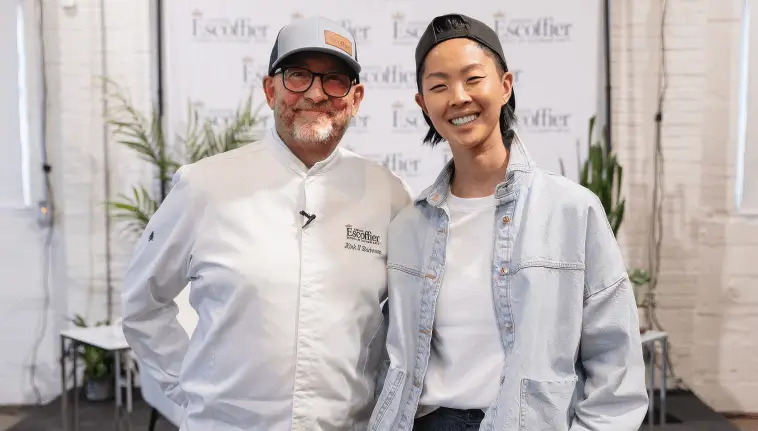
Escoffier Chef-in-Residence and Emmy-nominated Top Chef host Kristen Kish returns for a special in-person conversation in Toronto, Canada!
From her early days on the line to becoming a Top Chef winner, Kristen reflects on the moments that shaped her, from navigating self-doubt to learning to trust her instincts and redefining success on her own terms. She also shares how embracing her identity has influenced the way she shows up both in the kitchen and beyond.
Recorded at Propeller Coffee Co. on April 9, 2026, this conversation dives into handling pressure, leading with authenticity, and building confidence over time, offering honest, relatable takeaways for anyone carving out their own path in the culinary world.
Watch the podcast episode:
Don't Miss The Next Podcast Episode!
Get the latest episode of The Ultimate Dish delivered right to your inbox every week.
Email Address:
Jump to a Section
- FULL TRANSCRIPT
- Canadian Specials
- The Impact on the Future
- Food is Present; Present with Food
- Leading Better and Answering Authentically
- Choosing Culinary School
- Excited, Eager, Responsible, and Kind
- Trust Your People and Yourself
- Taste Something Different
- Loving Junk Food
- An Inspiring Chef
- Culinary School, Chefs, and Health
- Taste First, Appearance Second
- Another Kish Ultimate Dish
Episode Notes and Resources
TRANSCRIPT
Kirk Bachmann: Oh, hi, everybody. It’s been a little bit of a wait, hasn’t it? So, we’re going to try that one more time. Hi, everybody!
Audience: Hi!
Kirk Bachmann: Entertain the old guy up here! Come on! Come on!
Thank you so much. Gosh, it’s exciting – really exciting – to be here in Toronto. I am Chef Kirk Bachmann. I am the President and Provost of Auguste Escoffier School of Culinary Arts. We have a little campus in Boulder, Colorado. We have another campus in Austin, Texas. Guess what? We have about 10,000 students going to school online all around the world, including…Canada! Good crowd. There will be a quiz at the end of the night, so be careful.
Before I dive into too much, I want to say a few thank yous in the true spirit of hospitality. A big thank you to the folks here at Propeller for opening up their hearts and their shop. Unbelievable. I flew in from Denver with a tremendous crew here. A big round of applause for these folks. Our special guest flew in with her entourage. We’ll hold that applause for one moment. I have all kinds of partners and colleagues that work with us at Escoffier that are here at the back of the room, keeping me on point.
Speaking of which, that’s the tough part for me because there are a few things I have to share. One: please tag us if you post anything on social media. I am not a salesperson at all. If my wife heard me saying that, she would lock me out of the house. Please tag us as you post us. My son would say that is very “cringe.” Anyway. If you do have your phones out, please keep the volume down because – excitingly – this is the very first live podcast recording that we’ve ever done. We’re doing it here in Toronto. We’ve been doing the podcast, called The Ultimate dish – go ahead and type it into your phone. The Ultimate Dish. We’ve been doing that for about six years now. Our special guest has been on the show before, and there was no more perfect choice than our special guest to do our first live recording. So bear with us. Have fun. It’s kind of intimate.
I do want to mention – I’ve got lots of notes. More than anything, the podcast tries to focus on sitting down with chefs, restaurateurs, entrepreneurs, thought leaders, culinary leaders, not just to explain or listen or talk about what they cook, but how they think. And how they lead. And how they build meaningful careers in this industry that we love, this craft that we love that is constantly evolving. Lately, we’ve been hearing a lot, believe it or not, from aspiring chefs and many aspiring potential students and chefs and cooks, people who want to change their lives, working professionals right here in Canada. And the questions that they’re asking are, “What would it look like if I entered this craft and took it seriously? I’m a pretty good cook, but what if I took it seriously?” Another question they ask is, “Is culinary school, is culinary education possible for me?” And another question they ask is, “Can I pursue something like this without uprooting my life, upsetting my family?” And that sort of thing. These are the sorts of questions and topics we’re going to talk about tonight.
Before we do any of that, I couldn’t be more excited to introduce our special guest tonight. This person’s journey reflects so much about what this show is about. She is the twice-Emmy-nominated host of Top Chef. Shake your heads. You know. She’s the chef and partner at Arlo Grey, a beautiful restaurant in Austin, Texas. She’s an entrepreneur and a New York Times Bestselling author of “Accidentally On Purpose.” This year, our special guest chef-in-residence role at Escoffier expanded even further with new virtual mentoring sessions, campus engagements, and this international stop – first stop – on our podcast tour. So put your hands together. Please join me in welcoming Kristen Kish! Yay!
Kristen Kish: I was hiding behind glass.
Kirk Bachmann: I love it. I love it. Let’s have a seat.
Canadian Specials
Kristen Kish: Thanks. I love Toronto. I’m going to start by saying that. I love it here. I absolutely love it here.
Kirk Bachmann: That’s perfect because we lead right into it. First of all, really good to see you. Always.
Kristen Kish: Likewise.
Kirk Bachmann: I’m always out of breath when I introduce her. There’s so much. When we talked about bringing The Ultimate Dish on the road internationally, this felt like the right place to do it for many reasons. You’re not a stranger to this city. Top Chef filmed here. Before we get into anything more. Poutine. Butter tarts. Where do you go?
Kristen Kish: Well, it’s called pooh-tan. Chef. No.
Kirk Bachmann: Sorry. Sorry. Send him back to Colorado.
Kristen Kish: Both. One’s sweet, one’s savory. I’m definitely more savory. I just haven’t maybe had the perfect butter tart. I think that’s my problem because the first one I had – first and only – was cloyingly sweet. They’re usually not that. They’re sweet, but they are balanced. No? Alright. I’m going the fries and gravy.
Kirk Bachmann: What’s the drama between runny and firm?
Kristen Kish: Of what?
Kirk Bachmann: Of the tarts.
Kristen Kish: Oh, I didn’t know there was drama.
Kirk Bachmann: Is there? Runny versus firm. Runny? Oh, various. So, firm?
Kristen Kish: Interesting. Or no butter tarts? Alright. It doesn’t seem to be a crowd favorite.
The Impact on the Future
Kirk Bachmann: Oh, I love it.
What an incredible few years! Unbelievable. Hosting Top Chef, writing your memoir, building businesses, and yet you always show up for special events like this. That’s very, very appreciated. For anyone meeting you for the first time, who’s Kristen Kish right now in this season of your life, if you will?
Kristen Kish: Hungry.
Kirk Bachmann: Hungry! I am, too. A little.
Kristen Kish: Which translates to a lot of different things. Hungry as in quite literally hungry at the moment, but also hungry and curious for all the different things that are happening. I’m someone that certainly respects and honors my present moments, but not far behind that in my brain is what I’m doing right now and how that is going to impact next week. How is that going to impact a month? A year? All my decision-making and choices are made with the future self in mind. I think, obviously, there’s the saying of “live in the present, don’t let it pass you by.” A hundred percent. I absolutely agree. But I think a responsible way of thinking about it in terms of growth emotionally, professionally and personally is to presently think about how it’s going to impact your future.
Kirk Bachmann: As I hear you saying that, I think about parenting and what good advice it would be for my kids, who get so stuck in the moment. “I struck out!” Life is over.
Beyond your professional identity, what role does cooking still play for you personally?
Kristen Kish: I think I’m like everybody when it comes to cooking. Sometimes, I don’t want to. I’m too tired. Take-out is far more convenient. Sometimes, I get this wave of inspiration, and all I want to do is be in the kitchen. There are days when I’m making dinner. Two days ago, I was making my wife and me dinner. We were flying out very early to come to Toronto. I thought, “Oh, God. I cannot be bothered with making something.” So I literally took a rotisserie chicken. I put it in a pan with a nice olive oil. Obviously. Capers, lemon juice, sliced garlic, chili flakes, peas – frozen – salt. Oh! And some artichokes from a can. I put that all together with a bone broth and some white wine, and I called it a day. That was it.
Kirk Bachmann: You just whipped that up? That sounds pretty good!
Kristen Kish: Let me try that again. I took all those things, and I threw it in a pan.
Kirk Bachmann: But a chef can do that!
Kristen Kish: I was hoping that it was good. That was dinner.
Kirk Bachmann: Yeah. I’m okay with that. Who’s going to try that?
Kristen Kish: It was good. Did I want to make pasta or something else to go with it? Yeah. But was I going to? Absolutely not. I had to pack.
Food is Present; Present with Food
Kirk Bachmann: Oh my gosh.
In your memoir, you talk about winding paths and unexpected turns. Do you feel like you’re still discovering some parts of yourself through food? Maybe not that dish.
Kristen Kish: I’m learning that maybe I could give a little bit more effort sometimes.
I think through food. That’s an interesting question. I don’t know if I can honestly say I’m learning about myself through food. I think there are moments where I’m challenged or having a conversation, and food is part of [it.] It’s in the space. But I don’t know if I can connect with the idea that a certain dish is retraining my life in some way. Food is always part of the moment. I think that sometimes, hard things or challenging times are easily digestible – a little bit more [easily] digestible – pun intended, when food is present. When you’re sitting around a table around a meal, or when I’m sitting with myself eating a dish that I pulled together in five minutes because I’m just sitting there, and I have no other choice but to be with myself.
We are a family, both my parents and my brother and how I grew, and now with my wife. We’re not a watch-the-screens while food is taking place. When we are sitting down for a meal, we are sitting down for a meal. The only time the phone is ever on is if one of our family members calls. In that way, they are just part of our dinnertime. I’m very present with it.
I think yes and no is my answer to your question.
Kirk Bachmann: Remember at the beginning I talked about thought leaders? It’s such a genuine, humble answer. It’s the right answer, actually.
Kristen Kish: Yes!
Leading Better and Answering Authentically
Kirk Bachmann: It’s the right answer. Yes. That will be on the quiz. That will be on the quiz.
When you reflect on your early career, was there an experience that helped you clarify the type of chef or business owner that you wanted to grow into?
Kristen Kish: I think at different stages in life, you are looking and searching for something to validate whatever it is, or to make you feel seen or confident. I think in that way, to answer that question, I don’t think [so]. No. I think it was learning all about the things to survive that stage of life, to get through that part. And when you get through that part, you’re kind of moving on to the next.
I think the thing that carried all the way up until opening my restaurant of how I wanted to be a leader was all the ways I felt like I was not led properly or that I was a disservice to the people I was leading. Through the experience of making the mistakes or not feeling like I did it the right way. I modeled my kitchen – I don’t know if you’ve read my book, but there was a section where I talk about this very unhealthy restaurant that I was a part of, which was a complicated feeling for so many different reasons. That particular place taught me the exact kitchen that I did not want. I was miserable there. I did not feel safe or encouraged. Not “safe” in terms of my physical well being. I didn’t feel emotionally safe and protected. Those, to me, are the moments that stuck with me.
It’s kind of how it happens in life. We think back to all the things. Human nature sometimes thinks back. “This went wrong. God, this week sucked. I hated this job. That thing…blah, blah, blah, blah, blah.” And if you just stop for one second, you can pull out the goodness, but there’s also something to be said for those deep challenging moments that are fully ingrained in your memory. What are going to do with them? I think that’s what I did with them.
Kirk Bachmann: I promise this isn’t scripted. We haven’t rehearsed this. Another right answer.
Kristen Kish: I typically don’t like to hear questions before. I’m going to sidebar for a second. This is not to toot my own horn; it is just to give context. My wife’s best friend, she lives in Australia, and when we talk, she asks questions. Throwaway questions sometimes. If someone says – truly, someone that I care about and we have the time to really sit with each other – “how are you?” I’m going to tell you how I am. I’m going to tell you exactly. Not “My day is great. Fine.” Maybe to a lot of strangers I will because I don’t have the time to get into, nor do they probably have the emotional stability to deal with what I’m about to say. I’ve explained to her several times, “If you ask me a question, I’m answering with my feeling. How do I feel?” A lot of times, we get so programmed to answer the question that’s in our head, or to answer with the answer that is already in our head as opposed to feeling the question and then answering with the feeling.
Kirk Bachmann: Or what someone else wants to hear.
Kristen Kish: I’m on two ends of the spectrum. On one side, I speak in complete hyperbolic statements. I think we all do. My mom’s the best, but you’re all thinking your mom’s the best. It’s okay. But my mom IS the best. I speak in these really hyperbolic, very generalized statements, which sometimes don’t translate, especially in print or magazines. I’ve learned that from experience.
Then, there is the other side of me. I’ve got to think about the answer. This is one instance when you’re not going to get hyperbolic statements from me. So, you’re welcome.
Choosing Culinary School
Kirk Bachmann: Sometimes that answer can take time. I love that.
There may be some people here tonight – maybe not – that may be just beginning their culinary journey, or thinking about their culinary journey, or you have friends that might be. You may be considering a bold move, a thoughtful move, to come into the world of food. For some people, formal education provides structure. For others, it can be the hands-on experience they’re looking for, that kinesthetic experience. There’s no one-size-fits-all.
With that said, you chose the culinary school path-
Kristen Kish: I did.
Kirk Bachmann: – years ago. When you look back on that, did it provide a certain foundation that helped build where you are today? Or was it just a piece of the journey?
Kristen Kish: Obviously, you can see. Right? When I started the chef-in-resident program with you all, we said from the very first conversation before we decided to do this together, I said, “I’ve got to be honest. I’m never going to say that you have to do this, or that is the right thing for you to do. It is a completely individual thing.”
For me, I’ll go two steps before I started culinary school. In high school, I was okay. I was fine. I was better in creative writing and music, and different things that allowed a little creativity. I was horrible at standardized testing. I applied to three or four different colleges that all my friends were applying to. I couldn’t get in because my math, science, and whatever – geography – wasn’t good enough. I already felt defeated in traditional schooling. Keep that in mind.
Then, I went to a college that I could get into, a regular university. I was going for a four-year program, bachelor’s degree, International Business and Economics. No business doing either one of those things, but to me, it sounded good on paper. I went there, and I hated it. I hated the college experience. I didn’t want to live in a dorm. I didn’t like my shower caddy. Don’t send me with shower slippers. The whole thing was just not working for me.
After those two failed attempts at trying to be good at the thing I thought I was supposed to be good at, that’s when I decided – let me rephrase. That’s when my parents decided culinary school would be a good idea because they recognized that I loved cooking. All I did was watch cooking shows. I got in the kitchen, and I cooked. Culinary school had never really entered my mind because no one in my school was talking about going to culinary school.
So because those two attempts failed, I felt like I had to prove myself. I had to try another school. That’s why I chose to go to culinary school: because I needed to prove to myself that I could be good in this structured environment, and I needed that for me. I needed that for my confidence.
Now, is it for everybody? No. But what culinary school did for me was it gave me my confidence back. I chose a two-year program. I chose to accelerate. I think I did the double classes, so I was at school at 6 a.m. and I got done at 5 p.m. or something. I was like, “I want to be here, but I also want to get out of here, too. And get out into the real world.”
For me, all those choices of failure led me to culinary school, which then gave me my confidence back, which then helped me re-enter the world with a little bit more pep in my step. It laid a great foundation for me.
Kirk Bachmann: That’s perfect, and the honesty is absolutely lovely.
One thing you mentioned that I want to piggyback on is that everybody’s different. If someone wants to go to culinary school because they want to go to culinary school, then there are options for that. As I said earlier, we have a ground campus in Boulder. We have one in Austin, but we also have tons of students going to school online these days so they don’t have to uproot their families or move, or anything like that.
Kristen Kish: And I will say, because a lot of times, myself included, when I heard that they offered a culinary school online, I was like, “How are you going to do that? That’s crazy. I spent ten hours, every single day for two years in school. What?” You all, we all, are taking in cooking on TikTok. We’re looking at Instagram. We’re looking at watching videos on how people cook something, so you’re inspired to cook something. It gets you going. At the end of the day, it just inspires you to want to learn more. They are two different things: A professional structure, a chef instructor [who] is teaching you things. But in a lot of ways, it’s no different than watching a recipe online to make dinner for your family that night. Same-same, but different.
Excited, Eager, Responsible and Kind
Kirk Bachmann: Inspiration is the key word. Everyone learns differently.
With Escoffier, Kristen is our chef-in-residence. You’ve had the opportunity to connect with some of our students at different stages of their culinary journeys. Online, on ground, in both Austin and Boulder. When you have interviewed them and heard their stories and worked with them up close, I’m curious what those interactions have been like for you. What stands out the most? What jumps off the page when you’re talking to them?
Kristen Kish: I think they’re excited. I’m someone that – I’m sure we all can get into a little bit of a rut or overwhelm or disappointment in the state of a lot of different things. You’re in Canada. It’s a little nicer up here.
I think that they’re excited and eager. There is this unfiltered, youthful energy that I find really beneficial to me. They’re thinking about ways of taking their culinary career and doing it in brand new ways that I’ve never heard of. I’m almost like, “Wait. What do you mean by that?” I actually like hearing something that I have no idea what they’re thinking. Things are changing, ever-evolving. What better way to add value to communities- especially cooking because food and the restaurants and the businesses feed our communities – than to do it in so many different ways so more people have something to connect to. It speaks to everybody.
So, when I talk to them, they are excited, wide-eyed. They want to also, sometimes, know how they get on television. I can’t help them with that. They’re all really excited, and they’re passionate.
Something that we say in my restaurant all the time. Everyone is allowed to have bad days. Totally fine. But if you show up consistently, day after day with this angry, blah” I don’t know what you call those people. But this thing that infiltrates through the kitchen, my first thing that I – when I’m there – or my chef, he looks at them and says, “Do you want to be here? Do you actually want to be here? You can have a bad day. You can mess up a medium-rare steak. It’s okay. But do you want to be here?” If they say, “Yes.” “Then act like it.”
You are also held accountable. I’m not a parent, but I was going to liken it to being a parent. I don’t know if I should say it. I think. I want to say it correctly because I think it is important to say. We’ve gotten a little soft with how we hold people accountable. Have a bad day. Take the time you need. But also, show up and do your job. You chose to do it.
I’ve completely lost the plot. I forgot where we were going. I forgot the original question, if I’m being honest.
Kirk Bachmann: It doesn’t matter. We’re moving forward. But I love that answer, though. Super honest. Let’s take that a little further. You’ve spoken a lot about instilling kindness and responsibility – responsibility, key word – and leadership in kitchens. Can you elaborate a little bit more on that?
Kristen Kish: You can fire somebody and do it with kindness. You can hold somebody accountable and do it with kindness. You can tell someone that their steak is overcooked and send it back, but you can do it with kindness. It’s all the energy and the intention behind it.
I think the very first thing that you have to do when people show up in your restaurant – and I can only speak for mine – is that you show up and set the intention already. There’s no seance or anything like that setting the intention. It’s like, “I’m here for you. I will go to bat for you, but you have to show up for us, too. Not for me. Not for the chef. Not for their bosses, but for the restaurant. This decision that you made to be here to cook for those people out there. You’re showing up for them.” I think when you set that, you have to build the ground layer of trust.
In the heat of service when my grill cook has [messed up], I’m like, “What are you doing? I taught you how to clean as you go. Keep this tight, and let’s move.” I can look at him in the eyes and tell him, “This is a mess. You need to clean this up. If you clean this up right now in the next five seconds, your brain is going to feel better. I promise you.” It’s like a ten-second interaction. But I’m going to tell him he’s not doing a good job, but he trusts that I have his best interest at heart because we’ve laid that ground rule.
Kirk Bachmann: Again, for me, being in this industry as long as I have been, that sort of statement really, really resonates with me. It’s a good life lesson.
One of the things I admire the most about our students is that in many cases – it’s not every one – but they’re not all waiting for the perfect time. They’re building lifelong skills. Some of them are working full-time while going to school, while raising families, that sort of thing. That’s powerful. That’s super, super powerful. What’s exciting today is that culinary education doesn’t just lead down one path anymore. I still think it’s fabulous for someone to want to be the chef of an amazing restaurant.
Kristen Kish: Oh, yeah. To have that title on your jacket. It’s a good feeling.
Trust Your People and Yourself
Kirk Bachmann: It’s a beautiful, beautiful thing. But we see recipe development, content development, media. There’s endless opportunities today, specialty brands that we just didn’t see twenty years ago. I would say from your perspective – I feel like I’m always putting you on the spot here – but what would you say to someone, maybe even here tonight, that feels unsure about where their culinary path might lead, but knows they have to start something or they have to start somewhere? What’s the word of encouragement?
Kristen Kish: I don’t know if there’s one magic phrase to ignite everybody’s thing.
Kirk Bachmann: Passion.
Kristen Kish: The easy thing for me to say, and I try to say it to myself, is just frickin’ do it. Just go do it. If you fall, what’s the worst that’s going to happen? You rationalize this thing in your head. Okay. I understand what I’m saying to myself, but my body is just not moving. It’s not going.
Man. I wish there was something that could just get the engine going. Sometimes it takes time. It takes learning and trusting yourself, that you have the ability to, of course try, but also the ability and the confidence to say, “You know, if it doesn’t work, I’m going to be okay, and this is what I’m going to do after that.” That’s a harder thing to learn and to teach yourself. Oftentimes, we are the people that doubt ourselves the most.
You know what? I think I have an answer, as I’m talking it through. We’re on live therapy right now. If I think about all the choices and the moments where I was pushed well outside of my comfort zone to just entertain a different way of thinking, it is because the people around me that I love and trust [and] some people that I don’t even know. They all saw my greatness before I could see it in myself. I think when you have a community and champions around you [and] surround yourself with the right people that are saying, “You know what? I see it in you,” oftentimes, I trusted them more than I trusted myself in those moments. It happened with Top Chef the first time. Top Chef the second time. It happened with every time I ended up on television because it was never really part of the plan and something that I never wanted to do. I did a lot of therapy to be a person that could go on television. It took so many other people. I think it is surrounding and trusting the right people around you.
Kirk Bachmann: You know, I love that answer.
Kristen Kish: So if you ever doubt yourself, go to the person that is your person: family, friend, whatever, and have them give you a pep talk. Because I can do it all day long, but there is inherently going to be a distrust because you’re like, “You don’t know my life.” And you’re right; I don’t know your life. Find someone that does. Those are the people that are going to help you.
Kirk Bachmann: We’ve talked about this topic in the past. Your consistency is remarkable. The word “trust” comes up every time. Trust who you need to trust, and trust yourself.
Kristen Kish: You might mess up sometimes. I did. I trusted the wrong people, but that’s okay. That’s life.
Kirk Bachmann: Going back to your memoir, you explore themes of identity, belonging, and elaborate on those unexpected turns that shape your life and your career. Was there a particular story you chose to include because you felt aspiring cooks or chefs – or just people in general or anyone who was trying to find their way – really needed to hear that story?
Kristen Kish: Every story in there is something that you need to hear. As you were asking the question, I was trying to think of the answer. There are so many. I haven’t actually read the book in quite some time since I’ve put it out. I was someone that deeply needed validation, and I still do. I like to know if I’m doing a good job in order to feel a little bit more confident in myself. That’s okay.
Maybe this is a reminder to those of us who are bosses of people or those of us who – you don’t have to be in a professional work setting – a personal setting of encouraging someone along the way. And also question and pay attention to you and all of your accomplishments.
There’s a thing in the book where I told [my parents] that I was offered the role of the host of Top Chef. We’re in the middle of Lake Michigan – I’m from Michigan – with my family out in a sailboat. My brother is captaining it, whatever you want to call it. My parents are there, and my wife. And I told my mom, “Hey, so guess what? Padma is leaving. They are wondering who is going to be host.” My mom looks at me and she goes, “You?” I said, “Yes.”
The millisecond of reaction of my entire family was that of if I told them, when I was a child, that I got a “C” on my art project. I mean that in the most beautiful way. My entire life, and I looked back after that moment, I looked back at that moment and I realized that their pride was completely unconditional to the level of excellence of whatever I do. I never felt like I had to one-up myself, or that I had to do something more or bigger or better to get that response from them. Their response is even and it’s consistent. I trust when they are proud of me, that if I get a crazy reaction that it’s [not] disingenuous. It’s like, “Oh my God, we’re so proud of you!” They support me and they love me unconditionally. I can feel that, but they never made me feel like one thing was better and then better and then better.
When I told my mom I got nominated for the Emmy, and I went to the Emmys and Meryl Streep walked by me. Meryl Streep, she gave a little bit more of a reaction. Fine. Granted. It was the same smile, the same pride came out because, at the end of the day, I’m just her little baby doing things in the world. I think that’s an important lesson to look at as a whole: how we treat others and how people respond to our accomplishments and sometimes our challenges and our mistakes that we make. It’s unconditional, and I think that, for me, is one of the greatest things.
Kirk Bachmann: I love that world. Show of hands: chills? Come on. Did somebody get chills from that story? I got a little emotional.
Kristen Kish: It’s the Meryl Streep part. I know. I understand. I got chills, too.
Kirk Bachmann: Oh my gosh. Oh my gosh. When you were early in your career, was there a lesson that you wish someone would have shared with you?
Kristen Kish: God! Probably so many, but quite frankly I wouldn’t have paid attention anyway. How many times: “If I only knew that. If only you told me that when I was twenty-two.” I wouldn’t have heard you anyway, so there’s no point in you telling me.
I think the biggest thing was understanding what it meant to build a foundation and layer of trusting in yourself, in your decision-making, and your decisiveness, and what you want in the moment versus what you think you want versus what you know you want. I think trusting yourself, I think that’s the biggest thing. It has nothing to do with anyone else. No one else can tell me anything, and I’m not going to take it or hear it unless I know what to do with the information you’re going to share with me.
Taste Something Different
Kirk Bachmann: That’s advice that can be applied anywhere. That’s not just our industry. That’s great advice for life.
When you look ahead at this next generation of cooks, and chefs, and passionate foodies, what genuinely excites you about the future of food?
Kristen Kish: Eating something different. Truly. Tasting something different. Experiencing something different. Having a different point of view. That’s one of the greatest parts of my role on Top Chef. I get to be introduced to fifteen chefs from across the country that maybe I wouldn’t have otherwise. I get to eat their food through a series of challenges and ups and downs. I get to learn about them, truly, through their food. Other than us tasting their food and having the interaction when they’re in front of us, we don’t spend time with them. That excites me. I love when I taste something new and I’m like, “Oh, gosh!” And it doesn’t need to be this crazy, elaborate, molecular gastronomy dish or whatever. It just needs to be a different point of view or a different story behind it.
We could serve the same thing. Now, this is an experiment. I have not proven this, but I like to think that it would be proven. That I would be proven correctly. We could make the same dish, follow the exact same recipe, present it to all of you one at a time. I’m going to come up here, I’m going to tell you about the dish, I’m going to give you the reasoning and the story behind it, and then you’re going to do the same. The only difference is you’re giving it from your point of view. I swear to you, you’re going to taste it differently. You’re going to taste it differently.
Let me give another example. Oh gosh. I have a lot of foodie friends, but I was having this crazy conversation, and I will not name names, but you would recognize the names. No, it’s not Tom and Gail. They are two highly-regarded professionals in the industry. One was back of house, and one was more on the media side. They’re going on and on, and on and on about this restaurant.
“Oh my God, you have to go to the restaurant.” I said, “Well, what’s the best thing you ate?” They’re like, “Oh, this beautiful thinly-sliced mortadella with a little drizzle of honey and some…blah…blah…blah…blah…blah.” All very basic ingredients. Granted, I’m sure they were great. Going on and on. They’re like, “You’ve got to go. The waits and the lines and the reservations.”
I stopped for a second, and I said, “So. Mortadella. Delicious. With a little bit of honey and some summer fruit.” I was like, “You could take that dish, the exact same dish, and plop it in a mom and pop unmarked restaurant around the corner that doesn’t have all the bells and whistles, and all the accolades, and the media response, and you’re not going to talk about that dish the same way. I guarantee you, it is everything else that’s wrapped up around that simple dish.” Therefore, you do taste it differently. That’s how I’m going to prove my point.
Kirk Bachmann: I love it. I love it.
Kristen Kish: I also just forgot what that question was. Did you?
Kirk Bachmann: Truth be told, so did I!
Kristen Kish: I was on track, and then I go a little sideways.
Loving Junk Food
Kirk Bachmann: You’re on fire tonight, though. I love it.
Perfect timing. We have a little section where we received some questions in advance.
Kristen Kish: From them?
Kirk Bachmann: From them! Yeah. These are fun. These are fun.
Kristen Kish: Are you sure? You all did. Is Kirk just asking all his burning questions?
Kirk Bachmann: No! No! I do what they tell me to do. Come on. Come on.
These are great questions, and I love the very first one. It could have been the last one, but I made it the first one. What’s your go-to, late-at-night snack?
Kristen Kish: That’s easy. Easy. Chicken fingers.
Kirk Bachmann: We all know. We all know what it is.
Kristen Kish: We know the answer. If I ever change…listen. I’m going to expand. Chicken fingers is my number one. It is my Ride or Die. If it’s my last meal, I love a chicken finger. But, I also love Totino’s Pizza Rolls. I haven’t had them in a very long time. Oh, man.
Kirk Bachmann: You heard it here.
Kristen Kish: When you bite off the corner, you let the steam out, and then you squeeze out the filling. You know what I’m talking about. No? No one?!
Kirk Bachmann: Are you going to be okay? It’s a lot.
Kristen Kish: I’m not…You’re Canadian. Maybe that’s it. I don’t know. In America –
Kirk Bachmann: She’s in shock there.
Kristen Kish: We have this processed food called pizza rolls. That is not good for you. God, I love it. Anything quick, dirty. Oh, a walking taco. Have you had a walking taco? I see a couple yeses and a lot of nos. You take a bag of Fritos – you have Fritos here. Thank God. Okay. You put seasoned taco meat. Not the authentic Mexican tacos. You’ve got to go. You know what I’m saying. Ground beef and a seasoning packet. You put that in the bag with the Fritos. They get a little steamy, and you top it with sour cream, cheese, green onions, and hot sauce. You shake it up, and you eat it with, ideally, a spork. It is so good.
Kirk Bachmann: I had no idea this was coming.
Kristen Kish: I told you at the beginning of this that I was hungry! Did I not? Oh, ice cream sandwiches. I love an ice cream sandwich.
Kirk Bachmann: I’ll go with that.
Kristen Kish: But not – but not one with that homemade cookie and stuff. Those get a little too hard.
Kirk Bachmann: Straight up ice cream sandwich. It sticks to your fingers.
Kristen Kish: Because, the thing with the ice cream sandwiches, when people go too fancy, they’re using a beautiful cookie recipe. It’s got too much sugar in it, and it’s got too much fat in it, so then when it freezes, it gets too hard. Yes. Great ice cream. If you want to go fancy and a little bit less processed, you use a molasses cookie because the brown sugar never really fully freezes. Yes. Yes. Culinary school, thank you.
An Inspiring Chef
Kirk Bachmann: You heard it here. You heard it here in Toronto.
Here’s kind of a serious one. For someone ready to level up their skills, what chefs or cookbooks have inspired you the most?
Kristen Kish: Cookbooks inspire me by way of the pictures. I rarely read a cookbook. I read it for the stories and the person behind it. I am inspired by people doing what they do with a firm grasp on who they are and what they love to do.
In that way, so many people. I typically look to my friends. It’s great when you have friends in the culinary world and some of the greatest chefs in the world, country. I look to them because what inspires me the most is not about what they’re cooking; it’s about how they’re cooking and why they’re cooking. I will call out one of my [friends]. I just Face-timed with her this morning. Mai Lin. She was the winner of Top Chef Boston, Season Twelve. Her food is just – how she cooks it. I cannot explain it. I cannot pinpoint. It is a very specific style, and it is so perfect to me, I think. When I see her food on a plate, food is never perfect, but this is pretty dang close. It’s amazing.
Kirk Bachmann: A lot of people felt that way about your food, too, by the way. Just FYI.
Kristen Kish: Thank you very much. Thank you.
Culinary School, Chefs, and Health
Kirk Bachmann: This next one we can split. This is a longer one. Does Escoffier offer a program that covers health and nutrition and what does that curriculum look like? That’s a big question.
Kristen Kish: I feel like that’s a question for you. Yes. And then your turn!
Kirk Bachmann: I’ll attack that. This will be your part. Do you see chefs of tomorrow playing a role in addressing modern health challenges through how they cook? For example, using things like spices not just for flavor, but for functional benefits?
I’ll go with the easy. Yes, we have a very health-conscious program. In fact, we have a full holistic nutrition and wellness program. I’d like to think that we are conscious of health for all of our programs. It’s important that our students learn the science behind everything, how their bodies use the food that goes onto their plates and into their bodies. It’s about creating food that is not only nourishing but craveable, desirable, that you really, really, really want it.
Chef, what do you think about chefs playing a role in addressing modern health going forward?
Kristen Kish: if that’s what your goal is, one hundred percent. This is a wild thing to come off of after I just talked about pizza rolls.
Kirk Bachmann: I wasn’t going to say a word.
Kristen Kish: Balance. A little of this, a little of that. You’ve got to live life, too.
When I’m cooking for my wife and me at home, I’m not making us pizza rolls for dinner. I’m making something delicious. She has a couple dietary restrictions that I abide by usually when we’re at home because I’m not going to cook two different meals. It’s very simple: not a ton of dairy. I can’t do a ton of dairy either, I just choose to do it. Then certain forms of grains will mess with her stomach, and she won’t feel comfortable, which is totally fine. I pay attention to that.
And also because of how we move through life. If I eat that pizza roll, I’m not doing anything afterwards. I feel a little lethargic and down. Because of my schedule, how I work, the go-go-go everywhere, I do like to feel my best. Because of that, I do that a lot with food. Food is the first thing because oftentimes I’m not inspired to go to the gym, but I can choose the right thing at lunch. Instead of having – today’s lunch was not a good example. Horrible example. I’m looking at my manager; we had lunch together. I feed myself for how I need to feel, and that can be different for everybody.
Kirk Bachmann: In many ways when I heard you saying that, to me – and it could be for anyone – that’s the power of a chef. I just love that.
Kristen Kish: God. Maybe I should say it. You know what one of the greatest pre-workout snacks is? Nerds. Oh my gosh. I eat them before I go on a six-mile run. I take a handful of Nerds, and midway through, have a couple more. Man. Fuels my runs. And then I read that true marathoners do the same thing. I’m like, “I’m a marathoner!” I’m an athlete. No.
Kirk Bachmann: Okay. No Fritos, no pizza rolls.
Kristen Kish: No, listen. For as much as I talk about my love of junk food – I love it! – I don’t eat it every day.
Kirk Bachmann: So the next question is when you’re creating a new dish-
Kristen Kish: Every other day.
Taste First, Appearance Second
Kirk Bachmann: When you’re creating a new dish, what’s the most important decision that shapes the final result?
Kristen Kish: Taste.
Kirk Bachmann: How about that?
Kristen Kish: Enough of how it looks. This era of Instagram restaurants for the clicks and for the likes and for the photo wall, all that. I went to a fabulous restaurant last night. I tried to take pictures of the food, and the lighting was not working – and I kind of loved that because it wasn’t about that. But there are so many restaurants now – this is a much larger conversation.
I think Eater just put out an article about it. I barely read it, but I got the gist of it. Restaurants are having a hard time and they’re not sustainable because we’re trying to fuel this thing that people want. And the thing that people want isn’t always sustainable. You want this moment, a certain kind of food, a certain kind of decor. It’s got to look a certain way. The lighting has got to be a certain way because you’ve got influencers coming in. If they don’t take the right picture?
I run into this problem all the time. In my restaurant, people take pictures of the food. I’m like, “God, my food looks ugly. That’s a horrible picture.” But I’m not going to change my lighting, or the shadow, or to put this to make that look better for you. I’m just not going to do it. One, it costs a lot of money, and restaurant margins are already really tight as it is.
Again, I forgot the question. I feel like I start on the right track. Did you all remember the question? No.
Kirk Bachmann: Do you guys have plans? We’re just going to hang out. We’re going to order some pizza in and we’re going to try to get through the questions.
The most important question of the night. We have a few things to share because I’ll forget, and I just remembered. Noelle will kill me if I don’t remind you. You have these little spatulas. Before we run out of here, we’re all going to take some selfies with the spatulas, waving them around.
Kristen Kish: You signed up for it.
Kirk Bachmann: Deal. Come on. For me. Deal? I don’t ask that.
Kristen Kish: Do it for him.
Kirk Bachmann: Do it for me. Do it for me.
Kristen Kish: He is feeding the young culinarians of the future.
Another Kish Ultimate Dish
Kirk Bachmann: The best question: the name of our show is the Ultimate Dish. Kristen and I have had different chats before. It will probably be a different answer. It will not be a Frito answer. What is [the ultimate dish?]
Kristen Kish: Ah, I have a good answer, because I’m going to eat it tomorrow.
Kirk Bachmann: Oh. What’s the ultimate dish?
Kristen Kish: I think the first time you asked me that question, I said chicken fingers. I think the second time you asked me that question on the podcast, I think I said meatloaf, maybe.
Kirk Bachmann: You did.
Kristen Kish: My mom’s meatloaf.
Kirk Bachmann: Yep.
Kristen Kish: So for this time, it is sarma. Stuffed cabbage. It’s pork and beef with rice inside sour cabbage leaves that’s cooked in a tomato-based paprika sauce. I love when things make all the sense in the world to me. My grandmother would cook that all the time. Hungarian-German. Obviously. She would cook that for every family gathering. I love it so much. I won’t even try to say the name in her language. It’s a stuffed cabbage.
Then I adapted it for my cookbook, and I added a little bit of a spin to it. Instead of pre-made sausage, I did homemade sausage. Then it got adapted again and again and again for several different reasons. Then eventually, I met my wife. Her mom, they’re from Macedonia. Her mom makes their version of sarma. Tomorrow, I convinced my wife to convince her cousin to make it for me because they live here. We’re going to go over to their house for dinner and have sarma. I’m so excited. I love it. It is truly home cooking to me.
Kirk Bachmann: That’s beautiful. Your homework tonight is to think about that. The ultimate dish. It doesn’t have to be a recipe. It can be a memory that’s connected to something that your grandmother made or your grandfather made. By the end of the weekend, you have to ask someone what the ultimate dish is.
Kristen Kish: He’s going to call every single one of you. Did you know when you signed up to be here, you gave away all your personal information.
Kirk Bachmann: I am. I am going to call you.
Kristen Kish: You’ll be hearing from him.
Kirk Bachmann: Before we say our thank yous, and we stand up and we wave the things, I’d be remiss if I didn’t mention that if you know someone who is pursuing or thinking about pursuing a culinary education, this day in age you don’t have to relocate. You don’t have to pause your life. You don’t have to delay your dreams. You can start right where you are. Take a chance. Invest in yourself. See what’s possible. To those listening to the podcast later when it airs, we’ll include links to the show, and you can explore our programs and see what the next step is. Sometimes the path to where you want to be isn’t perfectly straight. Sometimes it falls accidentally on purpose.
Kristen Kish: On purpose. Oh, look at you!
Kirk Bachmann: How about that? Huh?
Kristen Kish: Take a bow.
Kirk Bachmann: I had to set that up.
Kristen Kish: I didn’t know that was coming.
Kirk Bachmann: I’m not a salesperson, but I had to bring it home. I had to bring it home.
I don’t need a script for this. Thank you for who you are, how genuine you are, how honest you are, how wonderful you are. You’re so patient with me. Thank you, truly.
Kristen Kish: Honestly. When I tell you again, this wasn’t in the script. This is my second year as Escoffier Chef-in-Residence. The first year, I felt like I was doing a service to the students. This year, honestly, I feel like I’m taking on more. I’m also whole-heartedly benefiting. I think having that time with the students in person and having those conversations. Of course, they’re getting whatever they’re getting out of it, but my gosh. At this point in my career, to be able to have those conversations and that kind of mentorship, it’s been a while. I have a restaurant. I’m not there every day. I don’t see my cooks every day. I don’t interact with them every day. To have all these different ways of being inspired by and impacting other people’s lives, I think culinary school and beyond, that is the purpose of life.
Kirk Bachmann: That’s beautiful. Very well said.
One of the students that Kristen met with, her name’s Asia, she’s still a student in Boulder.
Kristen Kish: Oh, yeah. She’s amazing.
Kirk Bachmann: She comes by every other day. She’s like, “Did KK ask about me?”
Kristen Kish: I will forever remember her because when she showed up to do our student one-on-one thing, which eventually, I’m sure it will be somewhere. She showed up with the most beautiful full-face of makeup ready to go. I was like, “Dang! And you’re going to go into school after this?!” Her energy was so mature, and it was well-poised. How she spoke and why she’s in culinary school. I was like, “I don’t know how old you are, but definitely I’m at least two decades older than you.” To have that head on her shoulders. If that’s the future, we’re going to be okay.
Kirk Bachmann: Yeah, we’re going to be okay. We are.
More than anything, thanks for coming out tonight. It’s so, so great to be in Toronto.
Kristen Kish: No, no, no. Tor-ON-noh.
Kirk Bachmann: Tor-ON-noh.
Kristen Kish: You don’t say the “t.”
Kirk Bachmann: How did I say “poutine” wrong?
Kristen Kish: Well, it’s a French word. The Americans, pooh-teen. Pooh-ten.
Kirk Bachmann: I just tear everything apart.
Kristen Kish: Is that right? Pooh-teen. Someone validate me. I only see one.
Kirk Bachmann: Is she right?
Kristen Kish: I need everyone. No. Okay.
Kirk Bachmann: This is not a cliche. I’m a big Maple Leaves fan. Always have been. You’re sticking your tongue out! You don’t like the Maple Leaves? Come on. Come on. They do need to win the cup. Okay, can we get everybody to stand up and wave the…. Otherwise, I’m in big trouble.
Kristen Kish: You have one job. This is it.
Kirk Bachmann: This is it.
Kristen Kish: You’ve gotta. Yeah. Here, do that.
Kirk Bachmann: Look at you. Look at you. Okay, wave away. Wave away! Yay!
Kristen Kish: Yeah, well done, everyone.
Kirk Bachmann: Well done! Well done. Thank you. Thanks everybody.
Thank you for listening to the Ultimate Dish podcast, brought to you by Auguste Escoffier School of Culinary Arts. Visit escoffier.edu/podcast to find any materials mentioned during the podcast, including notes, links and other resources. And if you can, please leave us a rating on Apple or Spotify, and subscribe to support our show. This helps us reach more aspiring individuals ready to take the next step toward their dream careers. Thanks for listening.