

From Lockheed Martin to Culinary School
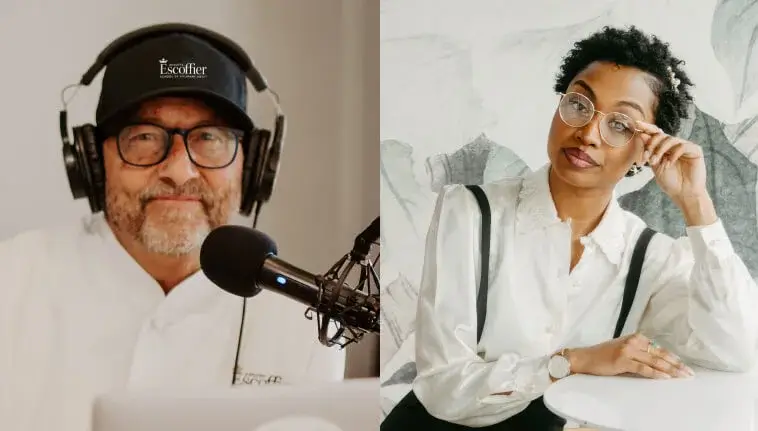
In today’s special episode, filmed at Escoffier’s Boulder campus, we sit down with Asia Geeslin, Escoffier student and U.S. Marine Corps veteran.
Asia shares the journey that brought her here, from serving five years as a Cyber Intelligence Analyst in the Marine Corps to working in cybersecurity at Lockheed Martin, and later exploring more creative paths through youth programs and styling. Each chapter reflects a willingness to evolve, ultimately leading her to pursue her long-time goal of attending culinary school.
This conversation is about following curiosity, embracing change, and building a path that feels true to who you are.
Watch the podcast episode:
Don't Miss The Next Podcast Episode!
Get the latest episode of The Ultimate Dish delivered right to your inbox every week.
Email Address:
Jump to a Section
- FULL TRANSCRIPT
- Calling out the Nerves
- The Art and Craft of Asia
- Sharing Ancestry and Understanding Through Food
- When the Sound Dies Down
- Dishes that Define
- Escoffier and the Dream
- Good Intel Matters in the Military - and in the Kitchen
- Transitions to Civilian Life
- Culture Jam
- A Voice from the Past
- Asia's School Shout-Outs
- A Role Model's Lessons
- Youth Empowerment with Culinary Arts
- Asia's Ultimate Dish
TRANSCRIPT
Kirk Bachmann: Hello everyone, my name is Kirk Bachmann, and welcome back to The Ultimate Dish. Today we’re joined by a very, very special guest. She’s right here next to me! Asia Geeslin. Give me some five. Yeah.
Asia is a United States Marine Corps veteran who served for five years from 2015 to 2020 as a Cyber Intelligence Analyst. That’s a big word right there. I’m going to say that one more time: Cyber Intelligence Analyst. After completing her military service, Asia started working for Lockheed Martin as a Cyber Systems Security Engineer for nearly four years. In that role, she supported cyber training and policy efforts.
In 2024, she took another turn in her journey, stepping into a more creative and community-focused role as a camp counselor at Culture Jam in Oregon, an arts-based youth empowerment program.
Today, Asia is based in Denver, Colorado, where she’s working as a fashion stylist while pursuing her long-time dream of becoming a chef here at Escoffier’s Boulder campus.
Her story is one of curiosity, courage, and reinvention, moving across industries, disciplines, and identities in pursuit of something meaningful.
Asia, welcome to the show.
Asia Geeslin: Thank you for having me.
Calling out the Nerves
Kirk Bachmann: Are you ditching class today to be here? Hmm. That tells me a lot.
Listen. I’m so, so excited. I don’t want you to get nervous. You are the first, not only student, but person to do an in-person podcast here on the campus. How does that make you feel?
Asia Geeslin: That is so special. That’s so exciting. I feel a little a little nervous about that. Maybe just a little.
Kirk Bachmann: Don’t be nervous. Don’t be nervous. We’re honored.
Asia Geeslin: I’m very excited.
Kirk Bachmann: We’re honored.
While we’re on that subject, tell me, what did it feel like today? You got up, and you thought, “I’ve got to do this thing tonight with Chef Kirk?” What did that feel like?
Asia Geeslin: I just wanted to be ready. I wanted to be ready.
Kirk Bachmann: Mise en place. Mise en place.
Asia Geeslin: Exactly. Everything in its place.
Kirk Bachmann: I love it. I love it.
Asia Geeslin: I was wondering why I was even nervous because I know what we’re talking about; we’re talking about my life. I lived my life.
Kirk Bachmann: That’s right.
Asia Geeslin: I think at first I started out a little bit nervous, but I’ve gotten to the point where it’s just like, “You know what? Just be you and it will be fine.”
Art and Craft of Asia
Kirk Bachmann: Well, that’s a perfect segue. I think our listeners would love to hear not only what a day in the life of Asia feels like, but what does a day in the life of Asia as a culinary student feel like, look like, sound like?
Asia Geeslin: I think a day in the life for Asia is working as a stylist from nine to one and then making sure all of my things are in order at home. I live a very routine and calm life in this season. Then, as soon as two o’clock hits, I’m right at Escoffier. Things get loud, a little bit chaotic, but all in the best ways. Being in the kitchen is amazing. Being able to learn the craft of my dreams is incredible, too. I do that every day.
Kirk Bachmann: I love that you say “craft” because that can be applied to a lot of things. Tell us – tell me – more about being a stylist, and how does that relate to the craft of cooking?
Asia Geeslin: Absolutely. I’m a fashion stylist. I style women primarily. It’s an incredible thing to be able to do. It’s one hundred percent an art. Being able to be a stylist as well as learn how to be a chef. I’m an artist all around, and I’ve always wanted to live a life like that, and I found a very cool and niche way to do it.
Kirk Bachmann: If you had to style me, I’m not good with vertical stripes. I’m just going to stay with solid colors. Is that a deal?
Asia Geeslin: Well? Before we make that deal, I think that what I would say to that is that vertical stripes have a different effect than horizontal stripes.
Kirk Bachmann: I’m not sure horizontal is going to work for me either.
Asia Geeslin: You never know. I won’t say “deal.” I’ll say, try it first. Let’s see.
Sharing Ancestry and Understanding Through Food
Kirk Bachmann: That’s fair.
Just to warm things up a little bit. When you’re not in class, you gave us a little sneak peak into that. Talk about your love of cooking. What are you thinking about? What are you thinking about preparing for that evening? Not for class, not for assignments, but for Asia.
Asia Geeslin: I love that question because when I’m cooking is when I feel most in tune with myself and my life and my communities that I represent.
Kirk Bachmann: Do you cook for friends a lot?
Asia Geeslin: Oh, often. Very, very often. I need people to try my stuff. It’s mutually beneficial.
Recently, I’ve been thinking a lot about my grandmother and what food means to her and what that means to our family. The way I view myself cooking, especially when I’m cooking the cuisines that she raised me on, it’s this conversation that I’m having with her. It’s memories of foods and textures and things that I didn’t quite understand as a child. Being able to recreate those foods now, it’s very much me saying back to her, “Okay. I understand now.”
Kirk Bachmann: I love that response for so many reasons, and it’s not on the script. When you think about food, it often is accompanied with memories. Sometimes good, sometimes sad, usually satisfying. Is there a time where maybe you were at school and you were asked to do a specific technique, and all of a sudden – think “Ratatouille” – this emotion, these memories came rushing over you?
Asia Geeslin: Yes.
Kirk Bachmann: I love that. I love that.
Asia Geeslin: I love that question. Okay. I was in a class taught by Chef John. It was amazing. I can’t quite remember what we were focusing on that day. Oh, actually, we were making banh mi. I decided to make a version of banh mis that my grandma has only ever made for me or that I would get from a Vietnamese restaurant somewhere in Portland, just a mom-and-pop shop. It’s this banh mi that’s made with pork meatballs. I made those meatballs in class.
Kirk Bachmann: Oh really?
Asia Geeslin: Yeah. It wasn’t according to our recipe, but it felt right in the moment. I was a bit taken emotionally by that experience because it was the first time I could bring my ancestry and my people into the kitchen with me.
Kirk Bachmann: That is so beautiful. I love that.
Asia Geeslin: It was amazing to share that with my class.
Kirk Bachmann: The fact that you were shown that grace to go down that path. That’s good. Good on us.
This is sort of random, but we have Portland, Oregon, in common.
Asia Geeslin: We do.
Kirk Bachmann: Different decades, but we have Portland, Oregon in common. When I think about Portland, Oregon, I think about my daughters, and I think about food. I think about the Benson Hotel where I worked. I think about the University of Oregon three hours down the road where I went to school.
Asia Geeslin: Yeah. Is that the Ducks?
Kirk Bachmann: That is the Ducks! Let’s go Ducks! That is the Ducks. I have to be careful, though. I’ve got one Duck daughter and one Beaver daughter and son-in-law, so I’ve got to be very careful with that.
Asia Geeslin: Tough.
Kirk Bachmann: But when I think about Portland, and I think about really classic restaurants like Zefiro and the London Grill where I worked, and Jake’s, Newbern’s and just classics, I know that we cross over a little bit with Le Pigeon.
Asia Geeslin: That’s right. Yep.
Kirk Bachmann: Over on the East Side. What about Kann?
Asia Geeslin: Ah. Kann
Kirk Bachmann: Okay. That’s a newer, beautiful, Haitian style restaurant.
Asia Geeslin: Absolutely.
Kirk Bachmann: Tell me what your thoughts are on that. I love Portland, by the way. I absolutely adore Portland.
Asia Geeslin: Portland is truly, truly an amazing place. There are so many things that go on in that city, and no matter what changes, it’s always going to be such a beautiful food mecca, at least in my opinion. I love Kann so much because it’s highlighted such a beautiful cuisine that I don’t think gets enough credit. I think what Gregory Gourdet, their head chef, what he’s done to represent his culture and his people and to share beautiful Haitian cuisine focusing on Pacific Northwestern ingredients – which is no easy feat at all! It’s gorgeous.
Kirk Bachmann: I’ve tried to get him on the show a few times, by the way. He’s busy. He’s very busy.
Asia Geeslin: Please come.
When the Sound Dies Down
Kirk Bachmann: Maybe you could lure him in.
You know why I love the way you answered that so much is because you’re a student and yet you have that kind of perspective. Bravo. Bravo you. Bravo, Asia. Keep going.
You come from a multi-cultural background: African-American, Vietnamese. Can you share a little bit more not only about your childhood and your upbringing, if you will, but how did food show up? You’ve already started talking a little bit about your grandma, but how did food show up for Asia growing up?
Asia Geeslin: Yeah. I love that question. How did food show up?
It was there all the time in abundance, these incredible smells, flavors, sounds. When I think about my family cooking in the kitchens, I think about Vietnamese New Year. I think about a celebratory dish called Thit Kho. It’s a braised pork belly, usually cooked in a stone pot. My grandma just whipped it up on the stove, real home-cooked style. I remember the sounds of her. She’d have newspaper on the kitchen floor. She’d be sitting there with her cutting board and her huge knife, like a cleaver. She’s just going at chopping up these meats and everything. It was always loud, but you knew that once those sounds died down, it was time to eat. It was incredible.
Kirk Bachmann: I’m getting such chills. I’m there with you. I’m experiencing that. I don’t know that I’ve ever heard anyone explain it like that, the sound of the newspaper. It takes me back. We don’t talk about sound enough, do we? And this idea that once the sound dies down, it’s time to eat. That is beautiful. Another high five right there. That was really good.
You’ve already talked about dishes that bring back memories and help you remember moments in time. Tell me about dishes that define you. Another tough question.
Dishes that Define
Asia Geeslin: That is a tough question. Can I turn that question back on you, actually? I would love to know how you answer that.
Kirk Bachmann: I am happy [to do that.] You are such a student.
I’m going to tell you a couple stories – and I’m talking way too much. The producer is going to get upset. Dishes that define me. I grew up in a German household. Same thing. I knew when the sauerkraut was almost ready. I could smell it. Lots of pork. Lots of braised items. Schnitzels and things like that. I love the sound of whatever the protein was hitting the pan. I loved the sound of a crepe coming off of my mother’s pan onto our plate. But I have to tell you a different story.
This took place in Sweden. I was traveling around. I was in Stockholm. I was at an indoor farmers’ market, if you will. I happened upon one chef by himself. He had one pot, and in that pot was new potatoes with dill. The only thing he was preparing was fillets of fresh cod. I was naive. I was young. I’m like, “Cod?” I don’t know that I’ve ever seen fresh cod. Beautiful, beautiful fish. All he did was saute that cod in a hot pan with some butter and probably some oil, squeeze of lemon, onto my plate, new potatoes and some lingonberries.
When you ask the question, “What dish defines you?” I want that dish to define me. Simple, elegant, unique, unknown to many people. That dish. I was probably in my twenties, and now I’m not.
So now you go.
Asia Geeslin: Yeah. Wow. I think the dish that defines me. You might laugh.
Kirk Bachmann: Or cry.
Asia Geeslin: Or cry, I don’t know. I’m going to say chicken and waffles defines me. Truly, but with a twist. In Vietnamese cuisine, there’s a fried chicken that’s coated in a very sticky fish sauce. I absolutely love that so much. There’s also a dessert in Vietnamese cuisine as well. It’s a pandan flavored waffle. Having those two items together, which I’ve workshopped a couple of times, I think that dish defines me. Because it’s chicken and waffles, which in America is a very African-American kind of dish –
Kirk Bachmann: And familiar. Super familiar.
Asia Geeslin: And familiar. Super familiar. It’s approachable and friendly. But when I put the Vietnamese twist on it, it’s home.
Kirk Bachmann: I love that.
Asia Geeslin: It’s my two cultures coming together. It’s my dad becoming acclimated to the Vietnamese palate and learning to appreciate it. It’s looking at all of my siblings across the dining table and knowing that this is where we converge.
Kirk Bachmann: Have you done this before?
Asia Geeslin: No. But I love food.
Kirk Bachmann: That will not be your ultimate dish though. We’ve got to come back to that.
Asia Geeslin: It’s not.
Kirk Bachmann: Okay. It’s going to get tougher, right? How do those different facets, everything we just talked about, show up? It’s probably an unfair question. How do they show up in your food today?
Asia Geeslin: Can you ask that one more time?
Kirk Bachmann: Think about what you just said to me. You took something very familiar – chicken and waffles – you added your heritage – Vietnamese twist to it, if you will. Spicy. That’s a memory. That dish defines. How does that dish that defines you show up in almost everything you do today? I’ll help you with that. When I think about that cod hitting the pan and what happened when I squeezed the lemon – I added acid to that – that is something that shows up in all of my food today. If it’s a salad that needs pomegranate squeezed on it, or it’s a hummus dish that’s got to have a little lime right before it goes out, I need that acidity. You go.
Asia Geeslin: Fish sauce.
Kirk Bachmann: Perfect.
Asia Geeslin: A really good, potent fish sauce.
Escoffier and the Dream
Kirk Bachmann: And not everyone can hang with fish sauce. It’s not easy. That’s a good answer. I’m going to go easy on you on that one.
Food memories. We’re on this, and they stay with us. You’ve shared that you wanted to attend Escoffier. You’ve had an incredible career, but you wanted to attend Escoffier since you were young.
Asia Geeslin: Yeah.
Kirk Bachmann: Do you remember? This is for our students out there because a lot are going to watch this.
Asia Geeslin: Hi guys!
Kirk Bachmann: Do you remember…. Yeah, say hi! Do you remember when that dream started?
Asia Geeslin: Yeah! I wanted to cook my entire life. I didn’t know early on that it was a possibility for me. Looking at the career paths and decisions of my family members and things, it just never occurred to me that I could do this as a career. But when I turned sixteen or seventeen, I remember different representatives from different schools coming to my high school and talking to us. I heard about Escoffier and what was possible and what was offered. It felt a little bit more tangible, like something I could see myself doing. I didn’t actually realize how real that could be until I got into the military.
I would say it started around sixteen, seventeen.
Kirk Bachmann: That’s great. That’s great.
Was there something that stood out specifically about Escoffier? I’m genuinely curious. I’m not the sales guy. I’m really curious because you’re astute and you’ve done your research. You were in the military. You did incredible community work in Portland – Eugene. Go Ducks. There must have been something that pulled you this way.
Asia Geeslin: I would say the high level, the high standard of excellence was always really important to me. I think achieving and putting myself in places where I could reach a high standard of excellence or even just have the opportunity to was always really important to me. I trust my gut. I think I always have since I was really young. I would see things about Escoffier, or about having a culinary experience and just feel internally, “I could do that. I can see myself doing that.” That realization only ever came alongside the thought of Escoffier. There’s not another school that I thought about going to.
Kirk Bachmann: That’s awesome. That’s great.
What’s really interesting as I get to know you and what is actually compelling is that your story is anything but linear, right? You’ve explored different careers and engaged in different careers. Do you feel like you’ve always been someone who is comfortable? Some people get really anxious or nervous if they change direction real quickly or need validation to be able to go a different direction. Has it always been really comfortable for you to go with the flow or go a different direction? Because if it is, you’ll do really well in the culinary industry!
Asia Geeslin: To be honest with you, it hasn’t always been comfortable, but it’s always been the right thing to do and a lot of times, the only option for me. Growing up, we moved around a lot. We had a lot of really dramatic and quick changes that happened all the time. It wasn’t always the most comfortable thing, but as I grew into my adulthood and started to learn how important it is to really bet on yourself. As hard as it is, because it is always easier said than done. Any opportunity I have to bet on myself, I take it.
Good Intel Matters in the Military – and the Kitchen
Kirk Bachmann: A good friend of ours who we’ve chatted with in the past refers to that as trusting ourselves, right. That’s our secret.
Thank you for your time in the military, by the way. Five years in the marines. Cyber Intelligence Analyst. You know what I’m thinking right now, don’t you? Tell us what you do in that role?
Asia Geeslin: As a Cyber Intelligence Analyst in the Marine Corps, I did that for five years. My job was to do a lot of research. It could have been adversarial research, it could have been pre-deployment research, anything I could do to build a package of information to present to my higher-ranking officials.
Kirk Bachmann: I love that. I’m now going to have you connect that to our industry. What did that experience teach you about – you hear these words a lot in our industry – discipline, teamwork, resilience – the ability to bounce back? How did that set you up for those attributes if you will?
Asia Geeslin: The first thing that I will say is that good intel is everything. In the Marine Corps, good intel saves lives. In the kitchen, good intel gets us to the W. We have to be communicating.
Kirk Bachmann: Totally writing that down.
Asia Geeslin: We have to be communicating while in the kitchen. We have to be communicating the right information in the kitchen, being prompt and moving with a sense of urgency because details matter. All of the details matter. At the end of the day, your win or your loss comes down to what details you missed, in my opinion.
Kirk Bachmann: You answered my next question, so I’m going to move to the next one. For veterans that are listening who might be considering a career in the food service or hospitality industry, what would you want them to know?
Asia Geeslin: They have so much of what it takes already. This is such a great opportunity to lean in and see what else you’re made of. That’s really exciting for me because I learned about myself in the Marine Corps that I’m incredibly tough. I’m not afraid to lead. I’ve got a voice. The things I have to say, they matter. What I’m learning about myself here after having learned all that in the Marine Corps is that all these skills are transferable. The kitchen needs leadership. Veterans can lead. The kitchens need clarity. Veterans can clear up a mess like nobody’s business. I would just say that we have what it takes; we just need to believe in ourselves.
Transitions to Civilian Life
Kirk Bachmann: I love that. I was going to ask you what strengths the military brings to the kitchen, and you answered that.
Transitioning out of the military, I imagine, can be a big shift. What was that experience like for you, and when did you realize styling, the industry, worked at the camp in Eugene, when did you realize you wanted to go more of a creative route away from the military?
Asia Geeslin: Transitioning out of the military was tough. Tough. No matter how good you had it in the military, transitioning out is a whole different beast. It is very much learning how to be human again. Rediscovering your new interests, maybe revisiting your old interests, learning how to be a civilian again, which you kind of forget along the way. It was tough, but I figured it out.
I think in figuring it out, I learned that I’m meant to be an artist of sorts. Growing up, I’ve always done poetry. I’ve always loved to cook. Fashion has always been a thing. When you’re in the military, your whole life is decided for you. You just do what you’re told.
Kirk Bachmann: You’re preparing for the next thing.
Asia Geeslin: Preparing for the next thing because there’s always going to be a next thing. When you get into the civilian space, there’s always a next thing, but there’s not as much clarity. You’re not really sure where or when or what. Approaching it through an artist lens has helped me be okay with that change. I think that’s when I decided, “Okay. Being an artist is really for me.”
Culture Jam
Kirk Bachmann: I’m glad you did. I’m glad you did.
Tell us what Culture Jam is all about. First of all, it’s in Eugene, so I love that. It’s all about a youth empowerment approach program. Super, super exciting. I looked it all up. I had to know more. Tell us more.
Asia Geeslin: Absolutely. Yeah. Culture Jam is incredible. I love Culture Jam. As you said, it’s a youth empowerment summer camp for youth ages fourteen to eighteen. It’s all about empowering these kids through art and different art mediums. We have incredible camp counselors from all over the world –
Kirk Bachmann: Really?
Asia Geeslin: Oh, yeah, from all over the world. This last iteration of camp, we had an incredible artist from Egypt that came. We had an incredible writer from the UK. We had an incredible hip-hop artist from Canada as well that came down. We bring all of our different art mediums to this camp. We create this on-the-fly curriculum of how we can bring these children into these sometimes unknown forms of art that they’ve not experienced before, kind of teach them the basics, and then let them run with it. From start to the end of camp, these children transform. It’s insane.
Kirk Bachmann: Is some of that experience still locked in your DNA when you approach the stove every day?
Asia Geeslin: Absolutely. That experience changed my life in a major and so permanent way.
Kirk Bachmann: If someone was listening to us chat today, what advice would you give them if they were on the verge of changing their life?
Asia Geeslin: I would say – and this may sound cliche because I think we hear this often – but the journey itself is the most important part. That’s where all the good stuff is.
Kirk Bachmann: It’s a good cliche.
Asia Geeslin: But it’s so true. I would hear that a couple years ago and roll my eyes and be like, “Yeah, right.”
Kirk Bachmann: Until you experience it.
Asia Geeslin: Until you’re experiencing it – and I’m very much smack-dab in the middle of that type of experience where I’m just in the getting-to – and it’s incredible. It’s not easy, but it is incredible. There’s so much magic in the in-between.
A Voice from the Past
Kirk Bachmann: I’m going to read something to you. Very powerful. It’s going to be emotional. I’m not going to tell you who it’s from yet, but here’s the quote. “I don’t really know how to describe Asia or boil it down to a few sentences. She was a senior in my high school creative writing class, but she blew us all away from the first sentence. Even though she calls me ‘Mom’” – You’re going to make me cry. I’m going to make me cry. “She’s really just as much my teacher, mentor, nurturer, as I am for her. Asia has fought so hard to find her own voice and herself in this world full of pushy people who demand she conform to their expectations. She has found her voice and she is unstoppable. Her talent is so immense, she actually exudes unicorns and rainbows. She is the only person I know who has a real-life Midas Touch. There is not a single thing this sweet, amazing, daughter-sister-bestie of mine cannot do. She has earned it all.” This is from Miranda.
Asia Geeslin: Yep.
Kirk Bachmann: Take a minute. Now you’re here at Escoffier. She’s proud. Pursuing your dream. What has your experience been like so far? You’ve been an open book to us. Miranda gave us a lot. What’s this been like for you here at Escoffier? No script.
Asia Geeslin: Wow.
Kirk Bachmann: Are you soaring? Are your wings out? Do you feel like the expectations you have for yourself are being met?
Asia Geeslin: I feel I am meeting the expectations for myself, also exceeding them in some ways.
Kirk Bachmann: Good answer.
Asia Geeslin: Yeah. It’s so cool to be at this place in my life, especially here at the school because I am actually living my dream. Living the day-to-day of what it means to be building my dream life. I don’t have to hide any part of myself in order to do that. I show up every day as my full self, no matter what that means on any given day. This is all of me, which is such a freeing experience.
I feel like my wings are stretched real wide, like I’m soaring, but not in a way that I would be soaring too close to the sun. Not in an Icarus type of way. Definitely, I trust myself, and I trust the journey. It’s good.
Asia’s School Shout-Outs
Kirk Bachmann: You trust yourself.
More of a fun question: Tell me about some of the techniques or even certain classes that you’ve really, really enjoyed.
Asia Geeslin: I loved restaurant operations.
Kirk Bachmann: Really?!f
Asia Geeslin: I really did. I really did. The part that I loved the most about it was building out a restaurant concept. One thing I really enjoy about this school is the way that a lot of the curriculums [sic] are set up. One thing that we are building builds into the next class we take. Building out the restaurant concept was so cool because I’ve always had these dreams in my mind of a restaurant I would open or a pop-up I would do, something cool as a chef, but I’ve never had the tools to plan it all out. It was cool to see my dreams come to some sort of fruition in that class. That was awesome.
Kirk Bachmann: Other than your favorite president, shout out to any chef instructors?
Asia Geeslin: Definitely. Definitely. The list is long. The list is long.
Kirk Bachmann: That’s safe. That’s super, super safe.
Asia Geeslin: It’s safe. I certainly will shout-out Chef Scalia.
Kirk Bachmann: He’s going to love that. He’s going to cry.
Asia Geeslin: Chef Scalia is such an awesome leader. Such an awesome leader.
A Role Model’s Lessons
Kirk Bachmann: He is. He’s tremendous.
I want to go back to Miranda a little bit. Really powerful words. Unscripted. Anything that you can share – how do I say this – changes you’ve seen in yourself since you were the person that Miranda had in class?
You didn’t know this was going to be so tough, did you?
Asia Geeslin: Wow.
Kirk Bachmann: Give her a script, and I’m going to change it.
Asia Geeslin: I’m a little caught off guard, but it’s good. It’s good.
I would say this, and I’ve said this to her so many times in so many different ways, and she always just goes, “Alright.” She really did save my life in so many ways. She taught me how to believe in myself. She taught me the proper, healthy language for self-talk. She taught me how to trust others.
Kirk Bachmann: Did she help you become a good mentor for others?
Asia Geeslin: She did. She did. She really was my role model in that way. I remember being in her classroom and feeling a little bit alienated and quiet and finding ways to hide myself. She would not let me do it. She would not let me do it. She would always give me opportunities or gently push me into different experiences that would help me learn to trust my artistry, my skill, my voice more.
Kirk Bachmann: A little nudge now and again is not a bad thing.
Asia Geeslin: Oh, and she’s been giving me little nudges ever since.
Kirk Bachmann: Every step of the way.
Asia Geeslin: Absolutely.
Youth Empowerment with Culinary Arts
Kirk Bachmann: You’ve shared a dream of opening a youth empowerment program. Tell me about that vision. What does that look like?
Asia Geeslin: Chef, strap in. We’re going on a ride.
The youth empowerment program. I am so excited about talking about this. I don’t have a name for it, but when I tell you that Culture Jam changed my life, it really did. It made me believe in what it is I could bring to youth and helping them meet their needs and things like that. My dream is to have a summer camp that is also arts based, but I want there to be a strong focus on culinary arts. Because I think that food is such a conversation between different cultures. It’s a sacred place, and it’s common ground between opposing opinions and all sorts of things like that. I think over food is a neutral and safe space to have really hard conversations, which young people today do need to have. They’re growing and they’re figuring out what their futures look like. I think it’s important to give them a space to figure out what their futures look like together.
Kirk Bachmann: Food, like at the holidays with family, it opens conversation. It starts conversation. It’s a perfect medium for your camp, which will be called Camp Asia.
Asia Geeslin: Oh no. It would not be centered on me at all! But I’m very, very excited about it. I’ve got this vision of children from all over the country, at some point from all over the world, coming together and bringing their cultures with them. “Okay, so-and-so.”
Kirk Bachmann: That should be a criteria. I love that.
Asia Geeslin: Where are you from? What did you grow up eating? Okay, cool. Let’s make this for everybody and let’s talk about it.
Asia’s Ultimate Dish
Kirk Bachmann: Awesome. Awesome.
Speaking of talking about, we’ve come to that point in the show. You’ve done really well, by the way. Really well.
Asia Geeslin: Thank you.
Kirk Bachmann: But I can’t let you go until you tell us – you’ve talked about food a little bit – but the name of the show is The Ultimate Dish. What is it? What is the ultimate dish?
Asia Geeslin: Chef, the ultimate dish is Ca Kho. It is.
Kirk Bachmann: You knew! You knew right away. Tell us.
Asia Geeslin: Ca Kho is a Vietnamese dish. It originates, I believe, somewhere near the Mekong Delta. What it is is braised catfish. It’s cooked traditionally in a stone pot. What I love about braised Vietnamese food is that you create this caramel sauce first, and then you get it all nice and savory and umami with fish sauce, which I mentioned I love. You add your chilies, lime, whatever you want. It’s such common and practical and simple ingredients, but the flavor is out of this world. It’s out of this world.
Kirk Bachmann: I’ve read Vietnamese food: simple, layered flavors.
Asia Geeslin: So layered. And so unique. I think that’s something that the Vietnamese people have done incredibly well. So beautiful.
Kirk Bachmann: Have you done it? Have you made it?
Asia Geeslin: I have. I did.
Kirk Bachmann: And it turned out good?
Asia Geeslin: It was wonderful. I grew up on the dish. Yeah.
Kirk Bachmann: Awesome.
You did well. You did well. Thank you for being here today. Thank you for the story. Thank you for the passion. Keep on going. Don’t skip class tomorrow. Promise?
Asia Geeslin: I promise.
Kirk Bachmann: Oh, yeah. There you go. Good job.
Asia Geeslin: Thank you.
Kirk Bachmann: Really good job. You did it. And that’s a cut.
Thank you for listening to the Ultimate Dish podcast, brought to you by Auguste Escoffier School of Culinary Arts. Visit escoffier.edu/podcast to find any materials mentioned during the podcast, including notes, links and other resources. And if you can, please leave us a rating on Apple or Spotify, and subscribe to support our show. This helps us reach more aspiring individuals ready to take the next step toward their dream careers. Thanks for listening.