
Listen to This Article:
If you’ve never experienced a tasting menu before, imagine settling in for a meal where you don’t quite know what will arrive next. One course might be delicate and bright, the next rich and deeply savory, with each plate revealing another piece of the chef’s idea for the evening. It is a chef-curated way of dining that can feel a little like being taken on a culinary journey, one small course at a time.
The format can also raise a few practical questions before your first dinner. How many courses should you expect? How long will the meal take? Are wine pairings required? And how much say do you have in what arrives at the table?
Ahead, we’ll walk through how tasting menus work, what you can expect from the experience, and why chefs often find the format so creatively appealing.
What is a Tasting Menu?
A tasting menu is a fixed, multi-course meal where the chef chooses what you eat and in what order, rather than you selecting dishes off a menu. Instead of an appetizer, entrée, and dessert built around your own preferences, you receive a sequence of smaller plates designed to be eaten together, often with a shared theme or point of view carrying through the meal.
The format traces back to the French tradition of menu dégustation (“tasting menu”), which developed as a way for chefs to showcase a range of techniques and ingredients within a single sitting rather than limiting a guest to one or two dishes.
That tradition has since spread well beyond France, and restaurants around the world now build entire concepts around it, from Dominique Crenn’s poem-driven tasting menu at Atelier Crenn in San Francisco to Fernando Olea’s nine-course Sazón menu in Santa Fe, built around the flavors of Mexico.
Course count varies widely depending on the restaurant. A neighborhood spot might offer five or six courses in under two hours, while a destination dining room can stretch to fifteen or twenty courses over an entire evening.
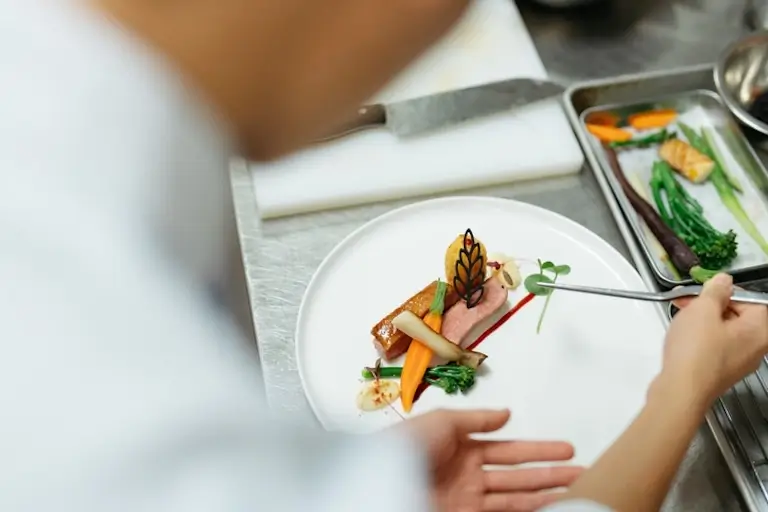
Tasting menus often give chefs room to focus closely on composition, balance, and presentation from one course to the next.
Tasting Menu vs. À La Carte
The clearest way to understand a tasting menu is to compare it with how most restaurants normally operate. À la carte dining puts you in control: you choose your courses, set your own pace, and decide how much or how little to order. A tasting menu shifts that control to the kitchen, trading flexibility for a more curated, guided experience.
| Tasting Menu | À La Carte | |
| Course selection | Chosen by the chef, often with little or no substitution | Chosen by the diner from a full menu |
| Pacing | Set by the kitchen, typically slower and more deliberate | Set by the diner, faster or slower as you choose |
| Price structure | Fixed price per person, sometimes with an add-on for pairings | Priced per dish, total varies with what you order |
| Flexibility | Limited; dietary needs usually require advance notice | High; order as little or as much as you want |
| Best for | A guided, immersive experience built around the chef’s point of view | A faster meal or more control over what you eat |
A tasting menu also differs slightly from a prix fixe menu. Both may be offered for one set price, but prix fixe menus commonly let diners choose from several options within a smaller number of courses, such as an appetizer, entrée, and dessert.
A tasting menu generally includes more courses and follows a more carefully planned progression by the chef. Each dish has to work on its own while also making sense in relation to the courses that come before and after it.
How to Become a Chef: Get the Career guide!
Have your sights set on wearing the chef’s hat? Discover the steps that may be required to start your culinary career and earn the title of ‘chef’.
Structure and Pacing: What Happens During a Tasting Menu?
Although there’s no set formula for a tasting menu, many are designed to unfold gradually, starting with lighter, more delicate dishes and building toward richer, more substantial courses before finishing with dessert. The exact order can look a little different from one restaurant to the next, depending on the cuisine, the season, and the chef’s style.
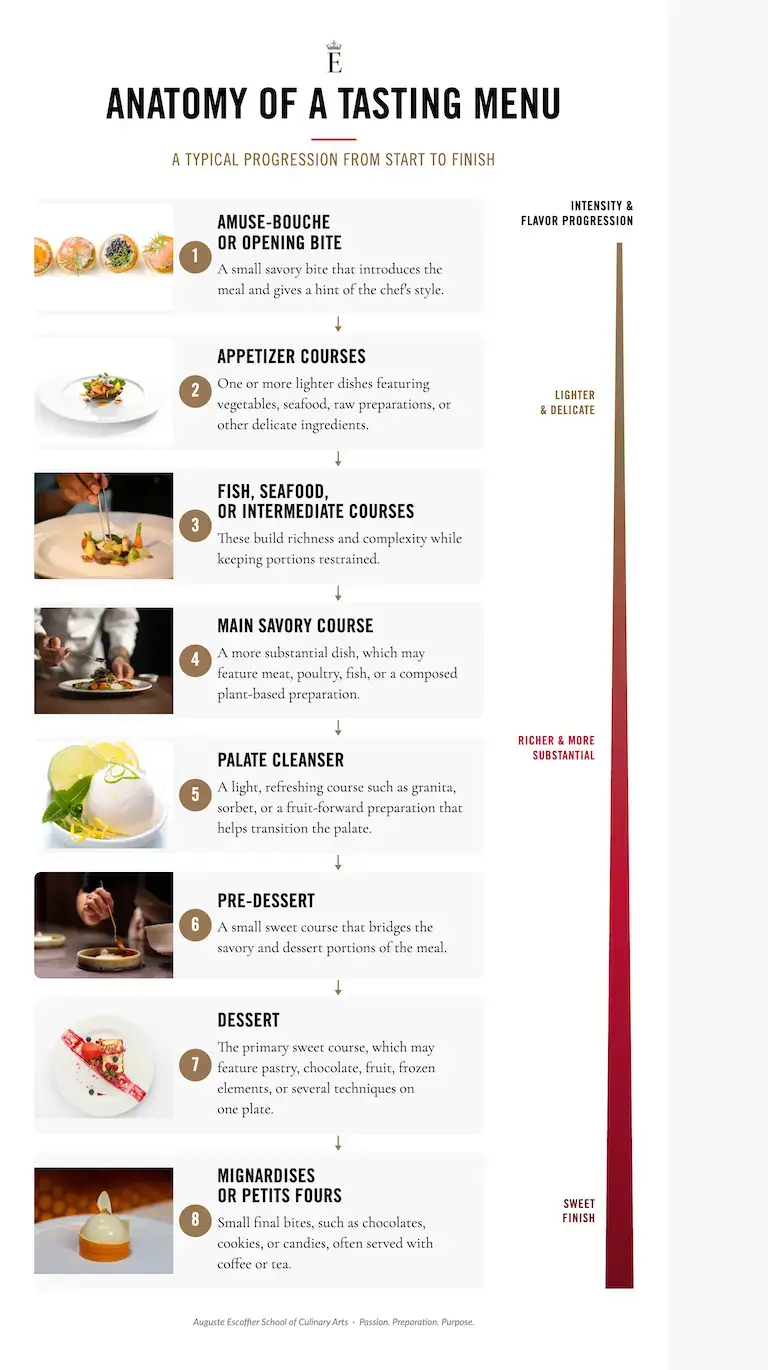
A typical tasting menu might look something like this:
- Amuse-bouche or opening bite: A small savory bite that introduces the meal and may offer an early glimpse of the chef’s style.
- Appetizer courses: One or more smaller dishes featuring vegetables, seafood, raw preparations, or other lighter ingredients.
- Fish, seafood, or intermediate courses: These often begin building richness and complexity while keeping portions restrained.
- Main savory course: A more substantial dish, which may feature meat, poultry, fish, or a composed plant-based preparation.
- Palate cleanser: A light, refreshing course such as granita, sorbet, or a fruit-forward preparation that helps transition the palate.
- Pre-dessert: A small sweet course that bridges the savory and dessert portions of the meal.
- Dessert: The primary sweet course, which may feature pastry, chocolate, fruit, frozen elements, or several techniques on one plate.
- Mignardises (French for ‘sweet treats’) or petits fours: Small final bites, such as chocolates, cookies, or candies, often served with coffee or tea.
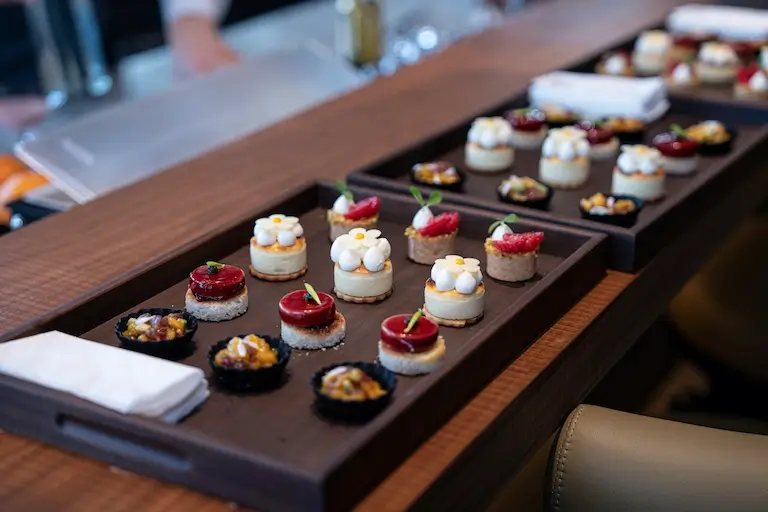
A tasting menu may include several small bites and petite courses, allowing diners to experience a wider range of flavors and techniques throughout the meal.
Some tasting menus include just a handful of courses, while others stretch the experience out with snacks, breads, pasta, cheese, or more than one dessert. Many contemporary menus also play with the traditional progression, especially when they’re built around a particular cuisine, ingredient, season, or idea.
At Blue Hill at Stone Barns in New York’s Hudson Valley, for example, chef Dan Barber’s team builds the menu around what the farm is producing, so the dishes can change from one visit to the next.
Because so many individual dishes need to be prepared and served in sequence, tasting menus also tend to unfold more slowly than a typical restaurant meal. A full experience may last around two to four hours, depending on the number of courses and style of service.
That pacing gives the kitchen room to finish each dish at the right moment while allowing diners to appreciate one preparation before moving to the next. It also helps chefs manage the overall arc of the meal, balancing richness, portion size, temperature, and intensity so that the menu builds without becoming overwhelming.
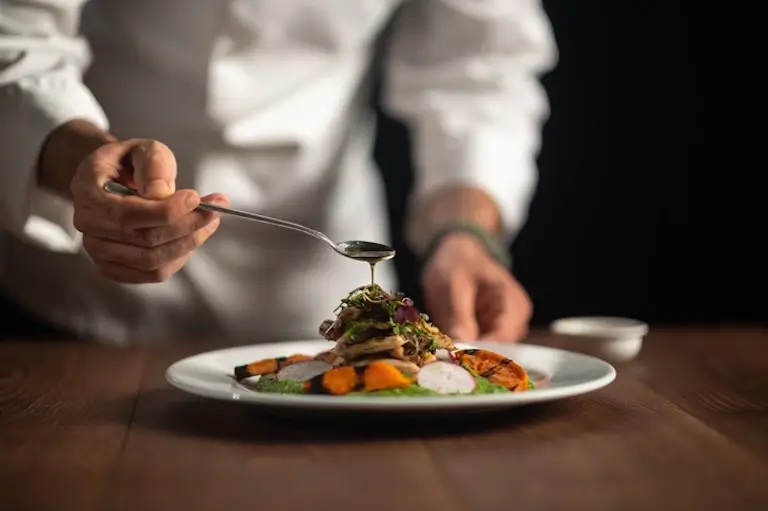
Precise saucing and last-minute finishing can help bring a tasting menu course together just before it reaches the dining room.
If you’re wondering how this pacing happens, it’s often in part to the talented servers and front of house team. An observant server will monitor the table, reading cues like how full a glass is, whether cutlery has been set down, and whether conversation still has momentum, to judge when the moment is right for the next course. The person managing the floor also stays in close communication with the kitchen, holding or firing dishes based on how each table is actually moving rather than a fixed schedule.
As a rough guideline, many kitchens aim for around fifteen to twenty-five minutes between courses, though that window flexes depending on the table.
Do You Need a Wine Pairing?
Many tasting menus also offer an optional wine pairing alongside the food, with a different pour selected for each course rather than a single bottle for the table. The idea is similar to the menu itself: instead of choosing your own wine, you hand that decision to the restaurant’s sommelier, who selects pairings meant to complement the specific flavors, acidity, and weight of each dish as it arrives.
Pairings usually come at an additional cost on top of the tasting menu price, and portions are smaller than a standard glass, often just a few ounces per course, so you’re tasting rather than drinking a full pour with each dish. Some restaurants offer multiple pairing tiers, such as a standard selection and a reserve or premium option built around rarer bottles.
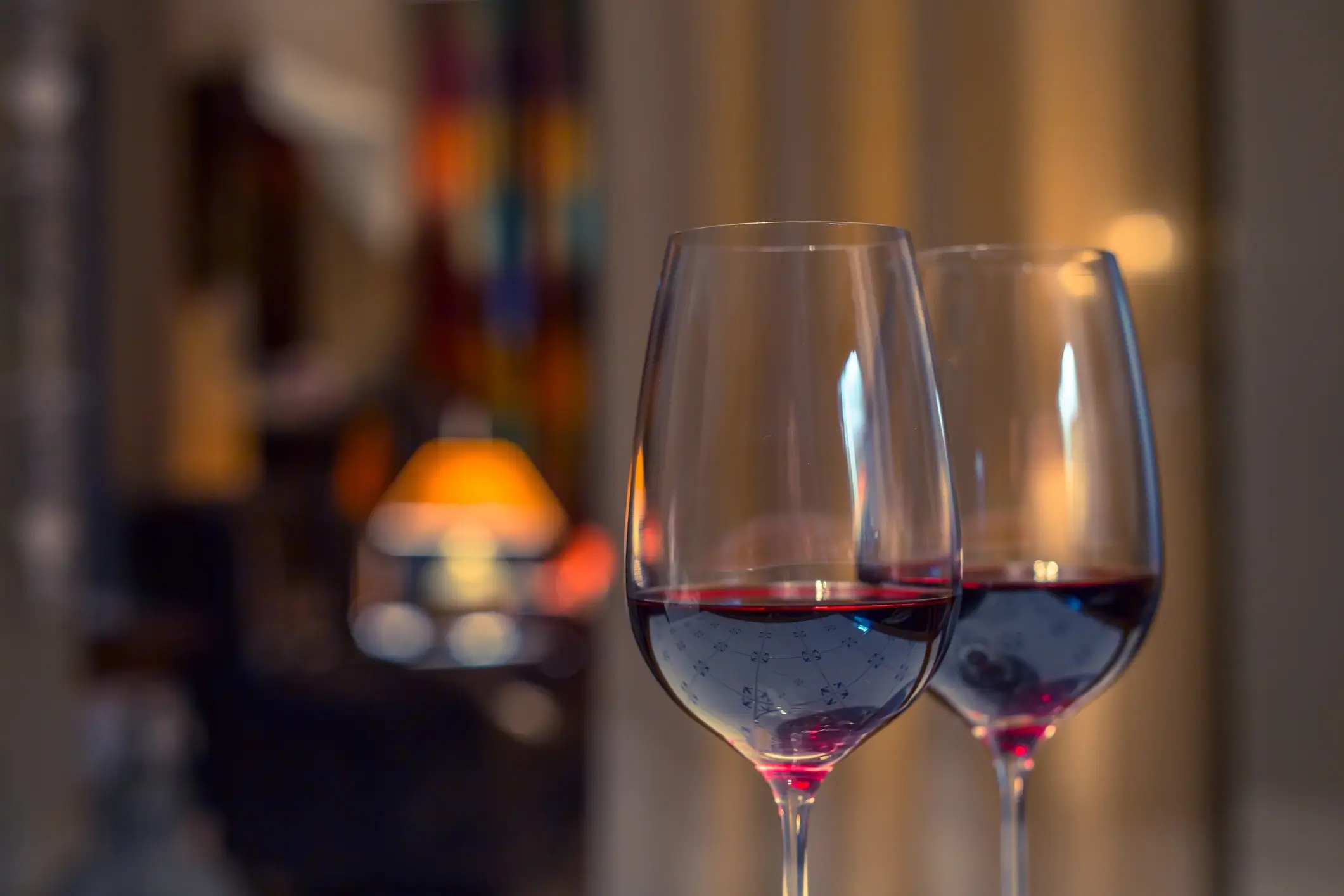
Optional wine pairings can add another layer to a tasting menu, with each pour selected to complement a particular course.
Wine isn’t the only route. Some restaurants build pairings around a different spirit entirely, based on the cuisine or region the menu draws from. At Sazón in Santa Fe, chef Fernando Olea’s nine-course degustación menu centered on the flavors of Mexico comes with an optional tequila, mezcal, and wine pairing, reflecting the menu’s roots rather than defaulting to a European wine list.
Other restaurants may offer sake pairings alongside Japanese-influenced menus, or build non-alcoholic pairing menus using house-made sodas, teas, shrubs, and juices for guests who prefer not to drink.
Pairings are almost always optional. If you’d rather order wine by the glass, stick to non-alcoholic drinks, or skip beverages altogether, most restaurants can accommodate that.
What to Know Before Your First Tasting Menu
Most tasting menu etiquette comes down to communication and timing, and none of it is meant to be intimidating. A little advance planning goes a long way toward making the evening feel easy rather than formal.
Reservations are typically required, and many restaurants take a deposit or charge the full menu price upfront, since the kitchen plans its purchasing and prep around a fixed guest count. Cancellation windows tend to be stricter than at a typical restaurant as a result, so it’s worth checking the policy before you book.
Dietary restrictions and allergies are best flagged as early as possible, ideally at the time of reservation rather than at the table. Because the menu is fixed and prepared in a specific sequence, last-minute changes are harder for the kitchen to accommodate than they would be at an à la carte restaurant.
Some restaurants build flexibility into the format itself. At Eleven Madison Park in New York, guests choose between a fully plant-based tasting menu or one that incorporates select animal proteins, so dietary preference becomes part of the reservation rather than a request made once you’re seated. A quick note when you book saves everyone a scramble later.
At the table, a few friendly norms tend to hold across most tasting menu restaurants:
- Everyone at the table typically orders the same menu. Because courses are timed and plated together, tasting menus are usually an all-or-nothing experience for the whole table rather than something you order individually.
- Let the kitchen set the pace. Servers are watching the table to judge when to send the next course, so you can relax and settle in rather than flag anyone down to speed things along.
- Dress codes vary by restaurant. Some destination dining rooms lean formal or business-casual, while chef-driven neighborhood spots are more relaxed. When in doubt, a quick look at the restaurant’s website or a short question when you reserve clears it up fast.
- Photography norms differ. Some restaurants love seeing their food photographed, others prefer phones stay tucked away. Worth a quick check ahead of time if it matters to you.
- Tipping in the U.S. generally follows standard practice, though some restaurants build gratuity into the fixed price. A glance at your bill or the menu itself will tell you which applies.
The short version: give the restaurant what it needs to know ahead of time, and let the kitchen and service team take it from there. That’s really all a tasting menu asks of you.
Why a Tasting Menu Can Be Worth It
Tasting menus can be expensive, but they also give you a closer look at how a chef builds an entire meal. You get to experience how flavors, textures, temperatures, and portions change from course to course, and how each dish sets up the next one.
For culinary students and serious home cooks, that can be especially interesting. Paying attention to the pacing, presentation, and progression of the menu can give you new ideas for how to build your own meals with more intention.
Why Chefs Love Tasting Menus
A fixed menu might sound like the opposite of creative freedom, so why do chefs like it? After all, there are no last-minute substitutions, no building a dish around whatever a guest requests, and the same sequence of courses are served to nearly every table on a given night.
But for many chefs, that structure is exactly what makes the format appealing.
Cooking the same dish for every guest, night after night, gives a chef room to refine it in a way an à la carte menu rarely allows. A dish gets served dozens or hundreds of times in a single run. Each service becomes a chance to perfect seasoning, plating, or a technique until it’s exactly right.
The format also gives chefs more control over the practical side of running a kitchen. When you book a tasting menu, the kitchen already knows what your table will order. That makes purchasing, prep, and portioning far more predictable than an à la carte menu with dozens of possible combinations, which helps reduce food waste and keeps costs more consistent from night to night.
Smaller, more controlled covers, meaning fewer tables seated at a time, let a kitchen focus its attention on fewer, more complex plates rather than managing a high volume of varied orders at once. That’s part of why the pacing you experience at the table feels so deliberate.
From Tasting the Menu to Creating One
A tasting menu can show you how much thought goes into every part of a meal, from the balance of a single dish to the way several courses work together. Learning to make those decisions yourself takes practice with flavor, cooking techniques, mise en place, plating, timing, and menu development.
Students in Escoffier’s Culinary Arts programs can have the opportunity to build these foundational skills while exploring how professional chefs approach the kitchen. If you’re interested in developing your own culinary point of view and gaining a deeper understanding of how memorable meals come together, contact us to find out more about Escoffier’s Culinary Arts programs.
HUNGRY FOR MORE? TRY THESE ARTICLES NEXT:
- The Modern Sommelier: How Wine Experts Are Breaking Barriers and Making Wine More Approachable
- The Geography of Chef Pay: How Location Shapes Culinary Salaries
- What Is Korean Cuisine? A Complete Guide to Flavors, Techniques, and Traditions
FAQs
Pricing for a tasting menu varies widely by restaurant and course count. A tasting menu at a one Michelin star restaurant averages around $165 for the food alone, and destination restaurants with longer menus or premium ingredients can run well beyond that. Beverage pairings are typically priced separately on top of the menu itself.
A tasting menu gives a chef room to guide the entire meal rather than just a single dish, building flavor, texture, and pacing across a full sequence of courses. For diners, it’s a chance to experience a restaurant’s range and point of view in one sitting, often through dishes you wouldn’t think to order on your own.
Most tasting menus run two to three hours, though a shorter menu can finish in under two hours while an extensive one, especially past 10 courses, can stretch to around four.
Course counts typically range from six to twelve, though some menus go as low as five or as high as twenty, with many fine dining restaurants landing around eight to ten to balance variety against portion size.
Allergies can often be accommodated if you flag them in advance, ideally at the time of reservation. General preferences are harder to accommodate, since tasting menus generally aren’t built for course-by-course customization or substitution the way an à la carte menu is.
Not usually. Standard tipping practice still applies at most tasting menu restaurants, though some restaurants build gratuity into the fixed price. Check your bill or the menu itself to see which applies before adding an additional tip.
Dress codes vary by restaurant, from formal to fully casual. When in doubt, checking the restaurant’s website or asking when you reserve is the simplest way to know what to expect.