

Chef Eric Skokan: How Black Cat Farm Is Redefining Farm-to-Table Cooking
In today’s episode, we sit down with Chef Eric Skokan, James Beard Award finalist, author of Farm, Fork, Food, and chef-owner of Black Cat Farm Table Bistro and Bramble & Hare in Boulder, Colorado.
Eric shares the journey that took him from studying history at the University of Virginia to working in kitchens across the country before finding his home in Colorado. He reflects on how a small backyard garden sparked his passion for farming, eventually growing into an organic farm where the harvest determines what’s on the menu. Eric also discusses why grasping technique gives chefs creative freedom, the importance of letting exceptional ingredients shine, and how his commitment to sustainability, curiosity, and teaching the next generation continues to shape his work.
This conversation is about trusting nature, following your curiosity, and discovering what happens when you let the ingredients lead the way.
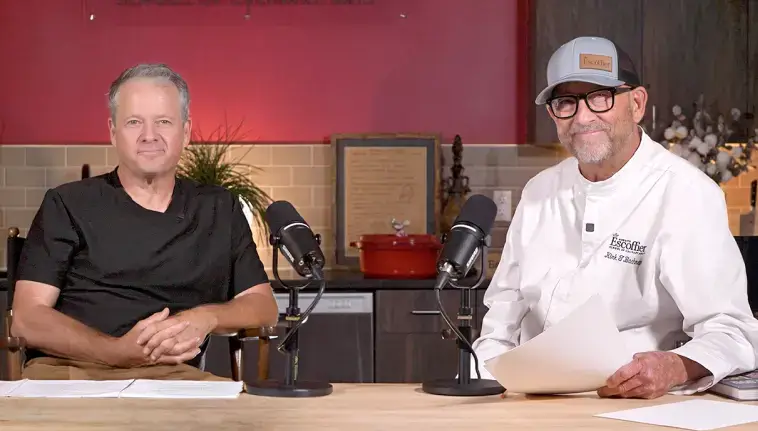
Watch the podcast episode:
Don't Miss The Next Podcast Episode!
Get the latest episode of The Ultimate Dish delivered right to your inbox every week.
Email Address:
Jump to a Section
- FULL TRANSCRIPT
- From UVA History Major to the Kitchen
- The Farm: Growing 250 Varieties at 5,800 Feet
- From Field to Plate: The Restaurant, Menu Philosophy & Escoffier Partnership
- Looking Back & The Ultimate Dish
Episode Notes and Resources
TRANSCRIPT
Kirk Bachmann: Hello, everyone. My name is Kirk Bachmann, and welcome back to the Ultimate Dish. Today’s episode is a very special one because we’re not only recording in person here at Escoffier, but we’re sitting down with someone who’s a dear friend, a longtime partner of Escoffier, and one of the most respected names in our backyard. Please welcome chef, farmer, restaurateur, Eric. There he is. There he is. Eric was born in San Diego, California, raised in Virginia, and studied history at the University of Virginia. But it was in Charlottesville that he caught the cooking bug, apprenticing under the best chef in town in what he calls the hardest thing he’s ever done, and we’ll talk about that today. From there, he cooked his way across the country, running kitchens in Charlottesville, Washington D.C. and San Francisco. Before a weekend trip to Colorado changed everything, he came out to interview for a chef job with no intention of taking it. Hope you didn’t tell him that, and he fell in love with the place almost instantly. In 2006, Eric and his wife Jill opened Black Cat Farm Table Bistro in downtown Boulder, followed by Bramble and Hare next door in 2012. But what makes Eric’s story remarkable is what grew alongside those restaurants, quite literally, what began as a backyard garden where he realized the peas and carrots he grew himself kicked the pants off. Anything he could buy has become Black Cat Farm, a 425-acre organic operation growing 250 varieties and and and raising heritage sheep, mule foot pigs, and heritage poultry. We’ll talk about all that today. Today runs one of the largest full-scale farm and restaurant operations in the country. He’s a James Beard Award finalist, the author of Farm, Fork, Food, and importantly for us, a cherished partner of Escoffier’s Farm to Table program. We’re so many of our students, our Boulder students, have spent time learning on his land. His food is a pure expression of the place, the forests, the fields, and the mountains of the Colorado Front Range. Welcome to the show, buddy.
Eric Skokan: Thank you so much.
Kirk Bachmann: How are you feeling? Hey, let me. I raised the book here for a minute, but I get emotional right off the bat. I save a lot of things. You, this was what 10 years ago or so, 2013.
Kirk Bachmann: 2013, and here’s what you said when he handed it to me. Sometimes the dreams of a chef are just a few steps outside the kitchen door. Here’s to all who dream and aspire. How about that? Wow! Still feel that way?
Eric Skokan: I do. I feel lucky every day. Walk around the farm, take in the the scenery, which is really spectacular. Take in all the little details and and pinch myself. It’s insane that I get to do all the things that I get to do,
Kirk Bachmann: and it’s legit. It brings brings me back to another story. It was probably 2015 or so graduation over at CU. You were the guest speaker, the keynote speaker. Everyone on the edge of their seats, waiting for you, and where’s Eric? Where’s Eric? Where’s Eric? You’re running late. You came in, had your boots on. They were a little soiled. I’m gonna say, and you jumped over. Said sorry, sorry, pigs got out. What do you want me to talk about? And I don’t know if you remember, but I said, “Talk about that.
Eric Skokan: Yep,
Kirk Bachmann: talk about that, and that’s what you talked about.
Eric Skokan: Indeed, it’s I can’t tell you how many times, right in the middle of the service, I’ve gotten a call from the from the sheriff saying, “Hey, Eric, your sheep are in the highway, or you know what? Whatever the crisis is, is it’s it seems to always happen, not always happen, right? But life is very unpredictable for me.
Kirk Bachmann: Yes, it is, and the key is how you pivot, right, and how you react to it.
Eric Skokan: Indeed.
Kirk Bachmann: I’m super super excited that you’re here today. This is so kind of serendipitous for me. There’s a script and all that, but I hope we can just have a chill conversation, as my son says. You know, I’d like to start with something that you’ve said that struck me. You describe your morning. You started to talk about this a little bit today. You describe your mornings as walking down into the fields with a coffee in your hand, nipping off pieces of whatever is growing. I love that tasting as you grow, creating new dishes right there in the dirt. I would probably say soil, but we’ll call it dirt for today. Can you tell our listeners? About that morning walk, what are you looking for? What did your walk look like today?
Eric Skokan: Yeah, yeah, yeah. So, you know, I mean, there there are some days when the restaurants are super busy, and there’s there’s not a there isn’t time to to walk through the fields and and and whatnot, but but it’s a I try to make try to carve out this time to push the restaurants away, push the you know all the staff away, have some quiet time, walk through the fields, and it it is the thing that has drawn me to combining a farm and a restaurant together since the very very beginning, I figured this out, or I discovered it, or right right at the very beginning when the farm was still a garden. So, and if you don’t mind, I’m gonna go way back in 2006 when we, you know, when Jill and I started the restaurant, starting a restaurant is manic. It is-it’s absolutely nuts. No sane person in the world ever starts a restaurant, and everything that can go wrong in a restaurant does, especially when it’s new and you don’t know what you’re doing. You’re trying to figure everything out. So every afternoon and every evening, you know, you know, as a both the chef and the entrepreneur starting a restaurant, you know, it’s like watching popcorn pop. It’s just like all over the place, explosions happening all through the kitchen or whatever. So, for me, wake up in the morning, and so picture that time, right? So I wake up in the morning making coffee. It’s perfectly quiet. I’m not in the restaurant yet. I’m not surrounded by staff asking questions. No disaster has happened yet. Damns coming in. Yeah, exactly, right. It’s nice and calm, and I’m walking through the garden, and there are these gorgeous little baby carrots, and there are these you know sugar snap peas that sing. There are you know flowers and herbs and all that kind of stuff, and I have this quiet time to nip off a piece of mint and taste it for what it is, and it’s almost like it’s almost like because it’s out of the context. I think about this a lot. The things that I taste out at the farm, they’re not on the line. They’re not in the restaurant, and they’re not just about to be put on plates. They’re and because they’re not surrounded with all the normal stuff, all the associations that go like how I would normally deal with mint or peas or whatever, none of that comes into play, and I can think about mint for what it is. And it turns out that in that
Kirk Bachmann: moment, in that moment, right?
Eric Skokan: That’s a big. It’s a big deal. So I, I mean, I cherish that. Walk through the fields. I’m doing a bunch of things now that the farm is really big. I am. I’m thinking about all the things that need to happen. Sort of creating the work lists for what’s going to come later in the week. I’m taking stock of the things that are growing, where they are in their growth cycles. I’m thinking about like, well, you know, I’m harvesting fava beans right now, and we’re just about done, so those have to come off the menu. But you know, these, you know, whatever rattlesnake beans are looking really spectacular, and they have to go on the menu because, I mean, look at them-they’re just freaking gorgeous. That-that’s you know they-they deserve to be on the menu. So all of those things are you know going through my head, and then all at the same time I’m snipping off pieces of whatever it is today, when I was in the field, I was nabbing radishes and thinking about new little dishes. So you know, I’m thinking about putting doing a little hors d’oeuvre with fresh radishes and nori and pickled maitake mushrooms, and I don’t know, maybe koji infused butter or something like that. I don’t know. That’s kind of where my head was this morning as I was walking through the fields.
Kirk Bachmann: I just love that. I love the concept of being in the moment. Gonna date myself, but going all the way back to the 80s when I had a restaurant on the western slope, you know, we tried to do some fresh soups every day, but we never called it soup of the day. We called it soup of the moment, and it was yeah, it was probably my inexperience. Like I don’t know what I’m going to put on the menu, but I’m just going to figure it out. Are there times when you head out to the field? Kind of with an idea in mind, and then all of a sudden, boom, pivot. I’m going to change.
Eric Skokan: Man, I mean that happens. That happens all the time. So when I first started the farm, I you know I approached menu writing pre pre farm time. I approached menu writing like all chefs do. If you research a lot and think about things that are going to happen in this next season coming up or whatever, and then you know sketch out dishes and then try to pull in all the ingredients from wherever blah blah blah. And what I so I when I started the farm, that’s how I was writing the menus, and I would plant all these things that I wanted in this menu that would be coming up in the next three months or whatever, and it turns out that that nothing I would plant would ever come in at the right time. You know, if I needed four ingredients in order to make a dish, two of the four would be ready, and the other two wouldn’t be. I could never pull off a dish that way. So I I threw all that away and you know realized that I needed to walk out into the fields and really just take stock of what I have today, and and look at what is inspirational like these rattlesnake beans or these radishes, which were this is one of the best radishes I’ve ever had was the was was this morning. It was nuts, but you know, and then let that be the north stars because if this ingredient that I’m pulling out of the field is just drop dead gorgeous and just insanely delicious, then the ingredient has done most of the work for me. All I really have to do is not goof up, you know, not destroy it in the kitchen.
Kirk Bachmann: Do as little as possible. Do as little as possible.
Eric Skokan: Let it shine…and and right. And so that that I’ve learned, you know, over the years is you know it’s better. The guests like it more. It’s and it’s impossible. I don’t know. Maybe there’s a better chef. I mean, sorry, a better farmer out there who can get all those things to come together. I’m not.
Eric Skokan: I’ve only done it for 20 years. I’m still new at it. I don’t know.
Kirk Bachmann: I mean, I can validate some of or all of what you’re saying. I can remember the first time. I can’t remember if I was in Black Cat or Bramble and Hare because they were next to each other, but I can remember the first time I dined there. That was the narrative from the server. You know, tonight we’re featuring carrots because Chef Eric thought we should feature carrots tonight because that’s what he found this morning, and it was yeah was one of the first times that I really felt like wow, this is farm to table. I mean, this is. I don’t know what this menu. Do you remember years and years and years ago where you’d have to go to a print shop to? I used to drive my parents crazy because I spent more money in the print shop than I did in the restaurant because you know I was changing the menu. It was so great that you know the internet showed up and kind of helped us with that. I don’t even think there was a menu. To now that I think about when I was there, they just told me what you were serving that night. It was the first time I had ever experienced anything like that.
Eric Skokan: Yeah.
Kirk Bachmann: Yeah. Here’s a fun. We’re kind of warmed up already. I was going to use this as warm up, but because I understand that that that your farm raises everything from the mulefoot pigs to the to the geese to the you know heritage sheep of all the animals and the 250 or so varieties of vegetables out there is there one ingredient you kind of mentioned radishes right now this very season that you’re just a little bit obsessed with
Eric Skokan: So you are asking me, Eric, which is your favorite child?
Kirk Bachmann: Ttried to spin it a little bit differently. Yeah, no, yeah.
Eric Skokan: All right. So here’s the thing. Like you know, the vast majority of everything that I eat comes from the farm. Just you know, we live on the farm, and that’s what we’re surrounded with, and things come and go, and there are peak seasons where things are just like electric and and and wonderful, and then you know then they slowly die off, and they’re really pretty mediocre, right? So I am always excited about the new thing that’s just about coming back into season. Here, I was explaining this to one of the cooks in the kitchen. You know, I was like, so have you ever had a peach that’s just miserable that tastes like cardboard?
Kirk Bachmann: I think we all have. Yeah, and they’re like, yeah, yeah,
Eric Skokan: of course,
Kirk Bachmann: sure.
Eric Skokan: And I said, you know, the last time I had a really terrible peach was like 10 or 15 years ago, because I don’t eat peaches until they’re ripe. When peaches are ripe, and you know they’re so ripe that the juice squirts out of them, you have to stand over a sink in order to. You know, right? That’s a perfect peach. So I just wait for that next vegetable. Right now, these radishes are just insane. They’re so so good, and then you know, and then the next thing is going to be coming. You know, whatever three weeks down the road or whatever. So, yeah, it’s just one inspiration after the other, and so the seasons are always changing, so that you know it’s like this never-ending you know sort of you know new ingredient coming, and it’s kind of like you know I’ve now grown peas for a long time. When the first peas come back, it’s kind of like seeing old friends again that I haven’t seen for a long time. Like, man, I haven’t worked with peas in a full year. This is going to be so much fun.
Kirk Bachmann: So the answer I heard there is that your favorite ingredient is the one that’s in the moment. That’s a nice little theme for our chat today.
Eric Skokan: Indeed.
From UVA History Major to the Kitchen
Kirk Bachmann: Let’s talk about you. Your path is not the same path that that that many people have taken. You’re now one of the most ambitious farmers, chefs, you know, in the country. You studied at University of Virginia, great school. Where did food come in, and what made you take that walk down to that Charlottesville kitchen, and I got to hear a little bit more about this chef, this best chef in town.
Eric Skokan: Yeah, yeah. I’ve always always loved food. You know, when in the home. Yeah, in the home. My grandmother was really spectacular. Both my grandmothers are really spectacular cooks. My mom just lights out, just really spectacular, great cooks, and and I was always fascinated by it. Incidentally, all of them, all three of them, would not let me in the kitchen. I was way too messy, way too all over the place. Yeah, so strict kitchen. Somehow, my mom knew whenever I walked into the kitchen, she would hear it or whatever on the other side. Get air, get out of the kitchen, right? Yeah. Anyway, but I’ve always loved it, and you know I worked my way through college, and you know I did a bunch of different jobs, kind of like everybody does, right? Had a bunch of different jobs or whatever, and when I when I was I found that when I was working in restaurants that I I not just loved the work I loved the work it was you know cooking just really spoke to me I knew so I you know, I found that the the working my way through college was much more engaging than the college part. You know, and I did well in college and all of that, but but the passion was really in the cooking, and so I took a year off from school to see if I really wanted to do it, right, and so I went to the best chef in town, this you know gorgeous you know country inn, and I had you know been cooking for a little while, and he took me on as a as an apprentice, and and holy moly, it was tough. It went from you know it was like regular food and regular restaurants into this really high-end, exacting, precise, and and then a menu that just spanned the the globe. And so the amount of information that I was taking in during this apprenticeship was just overwhelming. It was really really intense, and I and I loved it. I discovered that I had not just a passion for food, but a passion for learning about food, and I and I still do. I learning about new things. Wow, man, I I love that.
Kirk Bachmann: Well, and and and the fact that you said it was the hardest thing you’ve ever done, but that you loved it, you know. When I think about any vocation whatsoever, you know, a job can be very very hard, and even harder if you don’t love it. But you love. That’s the message here: is that you loved it. You absolutely loved it.
Eric Skokan: Oh yeah.
Kirk Bachmann: And you stuck with it. And what was it about those early days that hooked you, rather than scaring you off? You kind of mentioned the learning part, but were you able to manifest that learning into getting excited about what you are executing, you’re like, oh my God, I can do this.
Eric Skokan: Yeah, there’s a couple. I mean, there’s several things that all sort of you know come in together that all bring it into focus. You know where you have those three circles and they overlap, and there’s that one point where they all come together. Like that’s that for me. What this is like, so my love of food and tasting things that are just drop dead delicious, right? That part is great. Then learning, you know, brand new things, but then the other part is creativity. Like you know, when I have an idea, and that is just in my imagination, right? It’s just in my head. Being able to turn something like that into something physical, that then also is delicious. Like I get goosebumps when I still get goosebumps when I you know, think up something, and I’m,
Kirk Bachmann: And you said delicious a few times. That’s a word we don’t hear enough, right? It’s beyond just executing and using the best ingredients, but it’s got to be good.
Eric Skokan: What is the point in cooking if it’s not if it’s not delicious, right? Right. I am. I’m driven. I’m driven by deliciousness, you know we eat for sub, you know for sustenance. Like I, you know, you have to survive. I have to survive, and we can all eat oatmeal for the rest of our lives. Yeah, like I’m nothing but scrambled eggs, right? Pretty boring, but you could do it. But what’s the point? And you know, throwing something that gives you goosebumps-it’s so good that it erases every thought in your head and makes your whole world collapse into this thing that you’re tasting right now-is you know is powerful.
Kirk Bachmann: Our students are going to love hearing that, right? So sometimes you’re just looking for, like, what’s the motivation? What’s the reason? That’s a good reason.
Eric Skokan: I talk about this, what we’re talking about right now. I talk about this with cooks and students in the kitchen all the time. That our purpose, like what we’re doing at our level, is to create oh my god bites.
Kirk Bachmann: Yeah,
Eric Skokan: That’s what we nickname them. Yeah, like we know you cook something that tastes so good that when a guest eats it, they say oh my god, right. And if we can create a meal where someone has strung together 3,4,5,6, oh my god bites in different dishes.
Kirk Bachmann: That’s a moment.
Eric Skokan: That is that’s the gold standard. That’s what we’re shooting for.
Kirk Bachmann: So then, for you, chef, next was kitchens in D.C.
Eric Skokan: Yep,
Kirk Bachmann: Busy place. Vegetarian restaurant in San Francisco in the 90 s. San Francisco in the 90s was crazy. Food was at the pinnacle. Stars. I mean, there were Jeremiah Tower.
Eric Skokan: : That’s why I went.
Kirk Bachmann: Did you go to Stars? You worked there? No, no,
Eric Skokan: no, no. Sorry, that’s why I went. That’s why I went to San Francisco. I was going to say. Got it. Yeah. Yep. Yeah.
Kirk Bachmann: Yeah. But then you finally made that fateful trip to Colorado for a nice weekend, and you ended up staying for a lifetime. Do you believe that that kind of instinct, that gut feeling, sort of shaped your career? You followed your instinct, and that did that shape your career? Because you’re still here.
Eric Skokan: Yeah, absolutely. And but there’s a little bit more to it for me than that. The thing that’s really driven me and still does my whole career whole life has been a pursuit of happiness. For me, happiness is a couple of things you know together. And I and I made the bet that taking this job in Colorado versus San Francisco was going to lead me more towards happiness than staying. So one part of it is this discovery that I love learning, and so I wanted to see new things. I wanted to expose myself to things that were, you know, completely new, and then learn my way through them. I wanted to have the chance for creativity, and that absolutely was given to me in this job. It was being the chef of a spa and resort at 9000 feet, like that’s so that’s a unique you know position. With and then when you think about what the food should look like in an environment like that, there’s not that many places like that, right? So that’s, you know really really cool. So you know you put those things together, and I’m sure that if I had stayed in San Francisco, I would have been happy. But you know the ability to be able to learn and the ability to have you know creativity and be able to apply that in it. New and fundamental ways that
Kirk Bachmann: And that takes some acclimation too, right? Water boils at a different temperature. Baking’s a little different. That I mean, it’s not a common elevation, right?
Eric Skokan: No, no, no, no, not at all. And let me throw out…
Kirk Bachmann: Even here, mile high, right where we are. Yeah, everything’s different. Everything’s
Eric Skokan: To throw another sort of idea, this sort of pillar for me, and I think that you know at a at a higher level, when you when you stop thinking about food as just eating and sustenance, when you’re thinking about it at at this you know more cultural broader scale, high end scale. You have to ask yourself, what should food look like in the region that you’re in? And if you don’t mind, I’m going to tell you a little bit of a story. So I was in college. When I was in college, I was taking an architecture class, and the professor was talking about Frank Lloyd Wright and Louis Sullivan, some architects who turned architecture on its head by asking the question: What should buildings look like in the place where we’re building them? And that struck me as an incredibly worthy question to ask, and so I still ask myself that all the time when I’m walking around through the field. I’m like, what should the food? When a guest comes to the farm, what should the food look like? What are they
Kirk Bachmann: Expecting it? What that’s exactly right
Eric Skokan: and so for me, going from inner city San Francisco to 9000 feet out in the middle of a national forest, isolated from absolutely everything, I thought to myself, “Wow, what a challenge coming up with food that should look like it should be here. Wow, that’s an intellectually that’s a crazy problem to solve, and it gave me you know I don’t know I was there for 10 years, gave me 10 years to work on that.
Kirk Bachmann: I love that story. You know what I love even the most about that story? You just you brought me back to this whole idea that chefs love architecture. Kareem loved architecture. I love architecture. I struggled with it in school. I just couldn’t draw like a screw or a nail or anything. But architecture is the foundation of so many things that we think about on the plate or on the canvas or or whatever. Do you also like motorcycles and rock and roll and stuff like that? These are all common denominators for chefs, right?
Eric Skokan: I love it all.
Kirk Bachmann: You love it all. You love it all.
Eric Skokan: Yeah.
Kirk Bachmann: Let me ask you a question, and this is, you know, maybe this is more of a statement, a really good lesson for our students. It’s okay if it’s a winding road, right? You might have an idea of what you want to do. You knew what you wanted to do. You tried D.C. You tried San Francisco. You ended up going straight up the mountain, and you started in a classroom. So that’s okay for students too. You might start in a classroom, but end up ending up exactly where you’re supposed to be.
Eric Skokan: Yeah, you know the road having the expectation that the road is linear. You’re going to go from A to B to C. Sure. That’s a trap. I think that’s a bad expectation. I am on my road. I mean, we all know what chutes and ladders look like, right? That board game from when we were kids, my road is curvier than the chutes and ladders board. Right, it’s all over the place. The part that I I feel really fortunate that I knew early on was what was important to me and what was not important to me, and and you know, having a north star, having these things I really fundamentally care about, and then and then being willing to take just garbage jobs, making no money, or you know, you know, incredibly challenging or stressful or whatever it was, I was willing to do all of those things if I was able to make it. If if that was going to be one of the steps along the way…
Kirk Bachmann: On that winding road, Chef, did you find that you gave yourself grace on occasion when you needed to? You took the garbage job, but it still you needed to do it to get of course to the next place.
Eric Skokan: Of course**,** I realized at one point that I was a a pretty poor line cook, so I took a job in a diner flipping pancakes to learn to be fast. Yeah, right. It was a hard and miserable job. And did I learn anything about, you know, making souffles or high-end wine pairings and tasting men? No, I learned nothing, except for being a really good cook. Right. Yeah, and that was an important skill. Sure. Right. So you know, I kept in, I kept you know the North Star. Like this is where I want to be. This is what I want to do. And I was pretty brutal, brutally honest with myself. I’m excellent at this. I’m terrible at that. All right, now fix it. Right. Yeah. Figure out what I’m not good at.
The Farm: Growing 250 Varieties at 5,800 Feet
Kirk Bachmann: I love it. Such great lessons. Let’s talk about the farm. Let’s talk about you, because this is where your story becomes quite different than almost anyone I’ve ever met, and it started with a simple backyard garden, right? You’ve said that peas and carrots, the peas and carrots that you grew, sang with flavor. How beautiful is that? They sang with flavor compared to what you were buying, right? Said that there was no comparison. Take us to that moment. When did a when when did the chef’s garden become a 425 acre world?
Eric Skokan: So it didn’t happen instantaneously, right? I’m. I’ve been doing this for a long time, and all along the way, I, you know, I had my north star out there, trying to make the best possible decisions. And one of the really important things at the beginning was realizing how much better the food coming out of the garden was than what was available. So I remember in the garden, the restaurant had just opened, tasting English peas, and each individual English pea in the pod pops and it sings and it’s just like it-it’s vivid with just ridiculous, delicious pea flavor. And then, and I don’t, but I only have a garden full, right? I only have enough for maybe three customers or whatever it is. Go into the restaurant. We’re serving peas there. I think I had it on like a halibut dish with peas and lemon, mint, whatever, blah blah blah. And the peas that I had in the restaurant to serve to everybody were like cardboard. They were pretty mediocre, and just did
Kirk Bachmann: like the cardboard they came in. Yeah, yeah, yeah, exactly.
Eric Skokan: So I remember thinking, as at first I was like, “Wow, these suck. These peas are terrible, and they’re the peas I’ve served my whole career. Damn, that’s a bummer. And then I remember thinking, “Oh, I’ve got an idea. Why don’t I just yank out everything in the garden and I’ll only plant peas, so I’ll have enough peas that I can serve everybody these peas because everyone needs to taste these. These are ridiculously delicious. So, and of course, that’s you know that’s not realistic, and you know and whatnot. But but that was that was really the nugget that that you know, I had this idea that if I had these amazing peas, that all I would have to do is warm them up a little bit and serve them to people, and that I wouldn’t have to do my life would be so simple if I had you know all these peas coming out of the garden. It turns out that starting a farm is not so simple, and that’s fine. So I had this drive to make the farm bigger, mostly because I wanted to be able to supply guests in the dining room with things that tasted really really good. So we started farming outside of town. Then, and then I realized I loved driving tractors. All right, I bought a tractor. I started this farm, and I realized you know I didn’t know what I was doing, and so you know a couple things happened. One, the process of farming, I found to be absolutely fascinating. Two, I realized I had jumped into the deep end of the pool of an area I didn’t know anything about, and so I was surrounded by things I needed to learn. And I’m a learning fanatic. I love learning, and when I discover I don’t know how to do stuff, I have a hard time going to sleep at night until I have read everything I can about it, and and so now I’m surrounded by, you know, how to fix tractors and how to build irrigation systems and blah blah blah, and so I was just enamored. So I had these quiet mornings. I had amazing produce. I had things to learn. I had this unlimited, you know, bank of creativity. And then the last piece of the puzzle is that my wife Jill absolutely loves animals. She wanted to be a vet when she was young, and so we start raising animals. And then my partner in life falls in love with the farm as well, and we’re on this amazing journey together. Right? It’s really all these things, and I didn’t know.
Kirk Bachmann: What was Boulder like back then, 20 years ago, I mean, we’re 125,000 people now, so fewer people. How did they respond to this bounty of beautiful food that was always here, but nobody was serving it to them?
Eric Skokan: Yeah, you have to remember that at the time there was no the the phrase farm to table hadn’t been coined yet
Kirk Bachmann: Yeah
Eric Skokan: And so I remember standing at the farmers market you know we have bunches of carrots all over the place and arugula and tomatoes that are whatever guests would come up to the farmers market and and I knew from a businessman you know point of view that I needed to get these farmers market customers into the restaurant. So we would make tastes of things, a carrot terrine, a you know gazpacho, you know whatever it was. Highlight these vegetables. We’d hand the tastes off to the guests. They would taste it. I would say, “This is incidentally, we have these carrots for sale, and I would hand them a menu in my restaurant. This is what I’m cooking with these same carrots that you’re just about to buy.
Kirk Bachmann: Come on down, right?
Eric Skokan: Come on down, and then you would see it was that was so novel, right? Nobody in the country is doing that at the time, and you would see you’d see people’s faces. You could read them. They’re like, “What the heck is going seriously tonight? Like, you mean dinner with this? And and then you know people went from astonishment into being lifelong customers in the restaurant.
Kirk Bachmann: I knew it. Yeah, yeah.
Eric Skokan: And you know business in the restaurant just skyrocketed. It was nuts.
Kirk Bachmann: That’s amazing. That’s amazing. This next part, I I think our students will love this. You you have a farm at 5800 feet, cold mountain air flooding the fields every single evening, you have you have a USDA seed importer’s license that allows you to bring in varieties from all around the world. Can you talk a little bit about, I guess, finding the round pegs right for the round holes? What actually thrives in the Colorado climate, and what fights you every single day.
Eric Skokan: Yeah, so you know, round peg to round hole. Like you know, we talked about architecture. What should the food be like, right? And that this is part of that. Why fight Mother Nature? Let Mother Nature direct you into what’s going to be good, right? So there are a lot of things that love growing here, beets and carrots. The carrots that we grow are some of the sweetest, most delicious carrots in the history of mankind. They’re just fundamentally delicious. Our spinach is so sweet in the winter time. I literally will tear off stems of the spinach, the part that we normally get rid of. Right, I hand it to customers at the farmers market and say, try this, and they look like you’re a nut job, Eric, but they’ll they indulge me. They’ll chew on it, and then you see their face light up because it’s so stunningly better than all the spinach they’ve ever had in their life, and then they’re like, “How in the heck did you do that? I’m like, “I’m just growing the round peg for the round hole. Spinach at this time of the year is just like this. It’s that it is that good. So you know, spinach, carrots, things that we associate with being sweeter or whatever, parsnips, parsley root. They’re all really wonderful here. Our celery is the best celery ever that comes off of the farm. That’s because we have these super cold nights, you know, hot during the day, cold at night. That stimulates plants to put on sugar instead of just growing. Right, sugar is a response to cold. That the plants are thinking just like antifreeze in a car, right? Sure, sure. Keep sugar in the stems keeps the stems from freezing. That’s how the plants defend themselves. There are other things that I really would love to be able to grow that you know we’re just not quite you know maybe they’re oval pegs for a round hole, right? They’re not quite there. I grew up. I’m from Virginia. I grew up eating brandy wine tomatoes, really, really big ones. Each tomato is like two pounds or three pounds, right? You one slice covers the whole plate, kind of a big, gorgeous, perfectly ripe tomato. For the life of me, I can’t grow them. They’re so hard to ripen. The plants grow big. The plants produce a ton of fruit. The tomatoes sit green for months and they never ripen up. So I’ve learned, like, just you know, don’t. It’s too. It’s too cold at night. The plants don’t like it. They want these tomatoes. Want it to be 85 degrees during the day, 85 at night. You know, they want to be they want it to be Mediterranean in climate. But we don’t we don’t have that. So you know. So I can like a dummy. I guess I always grow one or two with hope, but literally just one or two out of the 10,000 tomato plants that I grow every year, I usually grow one or two with the off chance that maybe this year will be different. It never is.
Kirk Bachmann: You’ll fix it eventually. You’re also certified USDA organic. You know the students will love this too. The only operation of its kind at this scale, so for students who don’t know, what does organic farming actually involve, and why did you commit to that?
Eric Skokan: So part of it is because I feel like organic cult Organic agriculture, and when you’re following those principles, you end up with food that is dense and rich in flavor. And for me, it’s all about these oh my god bites, right? And flavor comes often from a bit of struggle. That if you know you think about a tomato that has everything that it wants in the world, it just throws out bazillions of tomatoes, and it and it dilutes its flavor, its you know strength among all of them, but if in organic agriculture and the yields are smaller, the plants put they only have so much energy, right? They put all of that into a smaller number of tomatoes or peppers or whatever it is. Things taste better, so that’s all. Like that’s one really important reason, but the other thing is that, in the end, I want to cook food because I want to take care of people. I want people to have this sense of relaxation and this feeling that they have liter they have been taken care of. I mean, that’s the whole. That’s what hospitality is: taking care of people.
Kirk Bachmann: And as Escoffier said, that too. It nourishes them.
Eric Skokan: Absolutely. That’s a fundamental thing. It’s for me. It’s not about just cooking. It is about taking care of people. And so you know, and this is a little bit you know a little bit political or whatever, but restaurants are our industry. Unfortunately, we are spectacular consumers of materials to burn up things on the planet for the purpose of making people happy, and that strikes me as not good, right? I can’t, I can’t do that. I can’t make people happy and at the same time destroy my community and my planet. It, I, I will never be a good you know I don’t know like an amusement park right yeah like what’s the point in I don’t know the the long and the short of it is that it’s important to me to to make people happy and at the same time use that process to cure the planet instead of destroy it, and we can do that in farming. That’s what regenerative agriculture is. It’s using the same or similar processes of farming to make the world a better place instead of a worse place.
Kirk Bachmann: I love that transparency and honesty. And then there are animals. You mentioned the mulefoot hogs, the sheep. You’ve said famously that you use the mule foots for everything but the squeak. Right, everything but the squeak.
Eric Skokan: That’s an old farmer’s farmer’s term, and you know pigs are just so beneficial. A, they’re delicious, right? Good, good pork is just so good. You know, but there’s so many things that we can do with hogs, and it and so farmers have this joke: you can use everything except for the squeak or whatever. So we raise this breed of pig that’s called Mulefoot, and the backstory on that is I typed into Google what’s the best tasting breed of pig. I mean, if I’m going to raise animals, then I, you know, I’m looking for these oh my god bites, right? So is there an oh my god breed of pig out there? And it turns out that it’s this breed that we raise that’s called mulefoot, and they are they’re slow growing, they’re calm, they’re jet black in color, they have black hair, so they don’t look like the prototypical, you know, pig, the the pink or white pig. They thrive well here.
Eric Skokan: Absolutely, they are a really great pig for our environment. Incidentally, a little side note: white pigs and pink pigs are albino. They sunburn in Colorado. They are pigs that historically have always been in woodland areas, so they’ve always lived in the shade. We don’t have a lot of shade in Colorado, and and so these those pigs are pretty miserable outside. And I suppose I could raise them and then put you know sunblock on them every day.
Kirk Bachmann: Sure. Yeah.
Eric Skokan: Nah, I’m not going to do that. Better are the pigs.
Kirk Bachmann: Doesn’t feel like your style.
Eric Skokan: No, no, no. That’s not my style at all. Anyway, so you know these pigs are are fatty. They’re rich. The meat is red. It’s not white.
Kirk Bachmann: Yeah,
Eric Skokan: It’s rich in flavor. You roast whatever cut. You taste it.
Kirk Bachmann: Was that ever a challenge in the restaurant? Kind of educating the public, like you’re going to have some pork, but it’s red.
Eric Skokan: Sure I guess, but but really, the first bite of the hogs that we raise is so good that people are willing to let that go instantly. They’re like, oh, I get it.
Kirk Bachmann: I get it.
Eric Skokan: This is different, and it is that much better.
Kirk Bachmann: You know, from a student’s perspective, chef, I wonder, raising your own heritage breeds, what does that teach you as a cook, that buying, you know, protein, you know, from a vendor or whatever, could never teach you?
Eric Skokan: Man, I mean, number one, respect for life. That’s it. It’s such a big deal. In the kitchen, I make mistakes. We all do. You know, you overcook something, you burn something, you’re carrying something, it falls on the ground. You know, whatever. Like bad stuff happens in kitchens, right? When you’ve raised these animals and you know that they have given up their lives for you, and you see that it’s really direct, it’s really there’s no hiding it in our farm. The level of responsibility for doing a good job, and it’s one thing to make a mistake, right? That’s fine, but it’s if you’re negligent, like that’s wrong. Don’t do that. So the cooks in our kitchen take this as a solemn responsibility to create an oh my god bite out of each one of these animals, it’s really important.
Kirk Bachmann: It’s such a good lesson, and not only do I love your commitment to using everything, I appreciate it. You compost not just for your own restaurant, but nine other restaurants, a couple of Whole Foods, and I believe the school district as well through EcoCycle. Where does the no waste, preserve everything philosophy actually come from? Is that something that you learned along the way, or is that just inherently, Chef Eric?
Eric Skokan: You know, a lot. Of it is a lot of it is is me you know they being fascinated by how things were done 100 years ago or 200 years ago right I’m a history I was a history major that’s what I graduated in in college yeah okay yeah and so I find that sort of thing, you know, fascinating just in and of itself. But when I’m gonna, if you don’t mind, I’m gonna answer that question in a little bit broader. So we have all these seasons when we’re growing things in the summertime. It’s really easy to be a farm-to-table restaurant, but what do you do in the winter, right? When you know, it’s when it’s a struggle to grow things. It turns out that preserving, like our great grandparents did, that’s one of the main pieces to make it all happen. So now we talk about preservation and and and things like that in terms of no food waste, and that has some you know cachet to it or whatever. But when your mission is to have everything or almost everything on the menu coming from the farm, you really need to be good at preserving. It’s a fundamental piece of it, and it turns out that I love it. Right? It’s it’s it it the things are delicious. I find it really interesting. It serves this greater purpose all at the same time.
From Field to Plate: The Restaurant, Menu Philosophy & Escoffier Partnership
Kirk Bachmann: I want to get into the kind of practicality of everything. This is the information that people probably don’t think about when they sit down what went on all day long. So we’re going to bring the feel to the plate, if you will. You’ve created this unique restaurant experience, and as you put it, the menu begins on the farm. The harvest comes in around noon. The cooks break it down by 1230. The menu changes almost every single day. What does that daily rhythm demand of your cooks that a traditional restaurant never would, right? And what kind of cook or chef thrives in that environment?
Eric Skokan: There are a couple of things. You know the reality of farm to table restaurants is that the food comes in beaten up. Sometimes it looks gorgeous, but there’s so much more prep work. There’s so much more cleaning that needs to happen in order to make things. It’s not
Kirk Bachmann: always as consistent as. Oh, and it’s right.
Eric Skokan: It’s all over the place. Think about like a bed of carrots. You put the seeds in the ground. They’re little itty bitty carrots, and then they’re slowly getting bigger and bigger and bigger. If you’re only buying bags of carrots and then cooking them, all of the carrots look for your career look exactly the same. Yeah. But the carrots on the farm they are little, and then they’re bigger, and then they’re bigger. Like you’re harvesting them throughout this you know the continuum of time, and that means that the flavor is changing. That means that the diameter is changing. That means that the number of carrots you need changes. That means that all the recipes fundamentally have to change along with the carrots. So it turns out that no one is fast enough at writing recipes, proper tested recipes, and then training the staff on those recipes in order to keep up with
Kirk Bachmann: And maybe redesigning a menu item because that carrot has changed the complexity of its own profile and no longer matches what you had it.
Eric Skokan: Yeah, yeah. So for us, number one, it’s what we do is harder on a daily basis.
Kirk Bachmann: Yeah.
Eric Skokan: And then number two, just in terms of washing and prep, then number two, because everything is so dynamic, everything’s changing all the time. We can’t rely on recipes. We have to rely on cooks who know techniques, who know how to cook, and so you go into the kitchen, and we basically don’t cook with recipes. In pastry, there are some you know fundamental recipes for doughs, different bread products, but we teach technique and we teach flavor.
Kirk Bachmann: And I wrote that down because that quote will go to the students tomorrow. Cooks who know technique, period.
Eric Skokan: Technique sets you free. It really does. You have when you master anything, risotto or you know whatever. Braises.. Once you master them, then it doesn’t matter what the ingredient looks like when it comes in. You’re able to make the adjustments that you need in order to produce something that’s oh my god delicious at the end. You can do it.
Kirk Bachmann: So some of these crops have a very very short season, right? Literally some a week long, yes, right? Maybe asparagus in the spring. So you celebrate that dish as it arrives, and then out it goes. How do you design a menu and lead a kitchen when your ingredients are that fleeting and that and that brief?
Eric Skokan: So yeah, keep in mind that I’ve been doing this for a really long time now, and instinct, instinct. For me, I’ve learned a lot of lessons along the way, or and I’m always learning new things, but I’ve learned a lot of things that I should not do. Maybe that’s the best way to say that, But the cooks that we have in the kitchen learn like they learn in building blocks, and cooks who have been in our kitchen these you know these chefs are – think of each building block as Legos, right? And initially, you only have three Legos that you get to work with, and and and so on. That’s maybe on your first day or whatever. But some of the chefs that were in the kitchen have been with me for years, and their Lego pile is huge. They know a lot of things.
Kirk Bachmann: Do you give them some freedom too?
Eric Skokan: Oh, absolutely, absolutely.
Eric Skokan: Yeah, you know I’m a huge believer that we are smarter than me. That’s a principle. If everyone in the kitchen were on their first day, I would I would probably would not…
Kirk Bachmann: Yeah yeah you know keep the reins on you got yeah yeah
Eric Skokan: but you know a lot of the people in the kitchen have been with me for years and they in many ways they know more stuff than I do and the the people who are really interested in learning they tend to and experiencing new things and growing they tend to be really successful and and part of that for me is knowing that I need to keep stoking the fire of learning and if I rein in on everybody all the time well then that defeats..
Kirk Bachmann: Are there days, I always envision that moment when you run into the kitchen because you just found that radish or you found that carrot, and you just everybody get over here, get over here. Always look at this. I always love that.
Eric Skokan: Always, always.
Kirk Bachmann: That’s what it’s all about. You’ve described chef your food as deliberately unfussy, wanting Bramble & Hare to be a place someone goes on a Tuesday night, just because it’s Tuesday night, and where a plate might have only a few ingredients, but each one is chosen for a reason and treated with enormous care. How do you strike that balance between elevated and approachable, and restraint, doing less to you. You mentioned this earlier. Doing less to a really, really, really great ingredient. And is it really hard for a cook to learn that? Because they want to do more. They want to do more. They want to do more. Yeah. How do you teach that?
Eric Skokan: Yeah. So part of that, you know, comes from experience. Sure. Part of that comes from you know having had mentors along the way who said the right thing at the right time. So, for example, when I was in San Francisco talking with a friend of mine, chef named Greg, and you know he was recounting. He learned to cook in Italy, and he was recounting. You know, some conversations there. He said, “You know, interestingly, in Tuscany, they don’t ask what can I add to this dish to make it better. They ask, ‘What can I take away to make it better?
Kirk Bachmann: Isn’t that something, right?
Eric Skokan: Yeah, and it’s a fundamental. And you know, it’s the first time anybody had ever said that to me, and I was like, “Huh, interesting, wow. And so I, you know, I think about that, I think about that a lot. There’s, you know, there’s a role for fusion, taking one cuisine and blending it in with another, but at some point there you can fall into confusion. Right? It doesn’t. Oh, it doesn’t always work. And another way of saying that is just because you can put two things together doesn’t mean you should put two things together.
Kirk Bachmann: It’s kind of like relationships, right?
Eric Skokan: Yeah, yeah, yeah. I mean, absolutely, absolutely, that’s the case. The balance for me is that dishes need to have visual impact, but they also need to have flavor impact. And putting, for example, three things on a dish that all serve the same purpose, let’s say sourness, for example, doesn’t benefit. It doesn’t really help. I think it is confusing. Do you want someone to have the most vivid lime experience, or just you know a whole bunch of acidic flavors?
Kirk Bachmann: Yeah, yeah.
Eric Skokan: I don’t know. I kind of want someone when they taste an ingredient that came from the farm to say, “Oh my God, that’s the best parsnip I’ve ever had in my life. So I want that vivid, “Oh my God! reaction, you know, for these ingredients.
Kirk Bachmann: Are you having fun? This is fun, right? The more we keep talking about, like why didn’t we bring some wine? Why didn’t we, you know, bring some of the pig? Next time we’ll do that for sure.
Eric Skokan: You bet.
Kirk Bachmann: I need to read something to you. This is from Jessica Benjamin, who I love, by the way. She produces First Bite for Boulder County Restaurant Week. This is what she said about you. Eric has long been one of the top-rated chefs in Colorado, but I think his dedication to his values, his nimble pandemic pivots, I recall, and creativity as a restaurateur are what make him stand out even more. That word, values, values, feels to me and Jessica obviously central to virtually everything you do. How would you describe the values that are at the heart of Black Cat?
Eric Skokan: I mentioned it before. You know this idea of hospitality being genuine to me. It is one of the North Star you know principles making people feel taken care of and really taking care of them and taking care of the environment all of that all at the same time. So I’m a dad. I have four kids, and I love my kids, and I take my responsibility of being a dad really seriously. So you know, as my kids were growing up, they’re little toddlers all around in this new restaurant. They, you know, they my kids turned table 16 into their fort. Right, that was their that was their clubhouse before you know before dinner service or whatever, and you know, so they’re they’re there all the time, and I’m looking at them while I’m while I’m cooking, and and I realize how important it is that I model good behavior for them. I know that you know that parenting the most powerful part of being a parent is being the model for your kids. You need to behave how you want them to behave in the world, and it just struck me as disingenuous to you to trash their future world so that I could make my current world, you know, easier or better or whatever. I think about them. I think about the future of my community all the time, and I want to make sure that I’m a good, responsible person along the way.
Kirk Bachmann: as a parent for kids as well. If I have grandkids now, I appreciate that very much. Next, I’d like to talk about something that’s very very sort of personal for me, having been involved with Escoffier for a long time. You’ve opened up the farm to our students for many years, and really helped our farm to table program and course, you know, take off. You work really closely with Chef Chris and Eugene and so many chefs over the years, and I love it. And and and our students have spent. I mean, you’ve kind of set the bar, you know, you know, for other experiences that our students have. I’m, I’m just really curious. It’s an odd question, but a really important one for me. You know, number one, you know, why, why, how, and why did you find the time to partner with us, and and how much does. Teaching that next generation really matters to you. I know what it matters to your family, but you know every every Tuesday you have a group of strangers that that come and and I’ve seen you, you know, talking about everything from the fields to some of the equipment that you use to the to the help that you have in the kitchen and you know I’m just so thankful, but also curious why that’s so important to you.
Eric Skokan: I mentioned it before. Happiness, pursuit of happiness for me is critical, and I mean it is what drives me. I discovered along the way, sort of second half of career, how much I just really enjoy on this really deep level teaching, teaching, explaining, and then having the opportunity to you know explain you know what happens when a seed germinates, or whatever the whatever the thing is that we’re talking about at the farm, and seeing the light bulb go on for an for a student is just amazing. I love it, and I just feel so lucky to be there to share that moment with some of the students. I mean it’s an absolute gift to be able to show all the things that I get to show to the students, and then the other part of it is, you know, I talked about me feeling deeply responsible, and I do that. And I’m very clear with all the students who come out to the farm that my goal in having them out to the farm is to brainwash them completely into thinking that this farm and farm and restaurant operation is really, you know, the direction that they should be, you know, heading in. That it is a fundamentally better, more difficult but fundamentally better way, and maybe they’re not going to do what I do, and they’re not going to drive tractors and blah blah blah. But my hope is that I’ll have created value for them, that they’ll be able to see their roles in the industry and the positive or negative effects that they’re going to have for the rest of their careers.
Kirk Bachmann: Would that be those values and their approach to cooking? Would that be that one thing that you hope they all take away from visiting with you for you know a half a day?
Eric Skokan: Oh absolutely. Yeah, you know, I’m driven by what makes me happy, and I hope that my kids are driven by what makes them happy. I’m hoping with all the students that come that they are going to be driven by what makes them happy, and that if I expose them to this, you know, the values that we have. That some of them, my value system is going to attach to some of them, and they’ll be able to carry that forward.
Kirk Bachmann: Well, and I’d have to say that not just the experience that you have with your students, but I’d like to think that Escoffier and Chef Eric are very, very well aligned and connected. You know, you really can’t truly understand food until you understand where it comes from, right?
Eric Skokan: It’s crazy.
Kirk Bachmann: And that’s, I mean, slash teacher, I think, is what we should add to your resume. For students that are listening to us tonight, who really has a desire to cook with this sort of integrity? What’s the first mindset that you encourage them to have beyond everything that we’re talking about? What’s that mindset feel like?
Eric Skokan: I think number one is curiosity.
Kirk Bachmann: Great word.
Eric Skokan: : Just you know, and for me, it’s this drive to learn, right? When I discover something that I don’t know, I latch onto it. I love that. But for anyone and anything, when your chef shows you a new technique in the kitchen, you know. Be the person to say, “Huh, I wonder why that works that way. Right? Being that person opens millions of doors, and that’s the you know that’s the thing. Being the person who asks that question creates the chutes and ladders board game path, and for me that’s been lovely. That’s been great.
Looking Back & The Ultimate Dish
Kirk Bachmann: You know, chef, you’ve spent a couple of decades, well more than a couple of decades, building building something really really special that I imagine a lot of people would say was impossible to to achieve a true farm-to-table operation at scale at this climate and run in the way that that you insist that it’s run. When you look at the whole of it now, the farm, the restaurant, the students who’ve come through your kitchens and through your fields, what are you most proud of? And the second part, is there a next chapter? What are you thinking about next? And what does that look like?
Eric Skokan: I am taking stock of the time that I have at the farm, these sort of quiet moments, being able to spend time writing, creating new dishes, writing menus, teaching-I’m taking stock of all of those things. They-they are, you know. There’s so many metaphors. They’re the wind in my sails, or or whatever. But none of it is lost on me that I get to do these things. I hop on a tractor and think, oh my God, I get to drive a tractor. I’m driving a tractor. That’s this is so cool.
Kirk Bachmann: That is cool, by the way. Not everybody can do that.
Eric Skokan: Yeah, indeed, indeed. So I hope that everybody else out there gets to create a world like I have, where they can discover new things, they can, you know, follow their passion and whatnot. I’m so fortunate.
Kirk Bachmann: Yeah. Well, we’re fortunate to have you in our world and our lives. Wow, what a great chat. Before I let you go, the name of the show is The Ultimate Dish, so I can’t let you leave until you tell me what is in your world the Ultimate Dish, and it could be just one moment. It could be just one moment.
Eric Skokan: Yeah, sure. So again, you’re asking me which of my favorite, which kid is which favorite is your favorite? Yeah, yeah.
Kirk Bachmann: So I could be Italy. Could be Italy.
Eric Skokan: Yeah, it could be. All right. So hands down, my favorite dish is this tradition that we have in our house. You know, all my kids grew up with a chef or a dad, right? And so we make things as you know as a whole family, and so we make pasta, and we have you know we have a pasta extruder, and our our sort of goal, my goal, is to get everybody you know mixed in you know to the whole thing. And so when all the kids, as they’re growing up, we had them making pasta with us. And how we would do it, we would run the pasta through a sheeter until it was a couple feet long, and then we’d make a loop out of it, and then I would have all four of my kids. We’d make this this loop longer and longer and longer and longer until it made it all the way across the kitchen, all all going through this sheeter, and then we would end up with these like I don’t know, 20 foot long fettuccine noodles that we would everybody would get three noodles, and that’s you know that would…That’s all you need, right? And suspending time with kids in the kitchen, all cooking together, that for me is the center of the bullseye.
Kirk Bachmann: Yeah, the ultimate dish can certainly be a beautiful memory. I love that. Yeah, chef. Absolutely.
Kirk Bachmann: Thank you, buddy.
Eric Skokan: Thank you.
Kirk Bachmann: So good to see you.
Kirk Bachmann: Eric Skokan, chef, farmer, restaurateur, and friend of Escoffier. Thanks for joining us today. Thank you for listening to the Ultimate Dish podcast, brought to you by Auguste Escoffier School of Culinary Arts. Visit escoffier.edu/podcast to find any materials mentioned during the podcast, including notes, links, and other resources. And if you can, please leave us a rating on Apple or Spotify and subscribe to support our show. This helps us reach more aspiring individuals ready to take the next step toward their dream careers. Thanks for listening.
