


Listen to This Article:
It was 1:00 in the morning, and Daniela Peregrina was researching culinary schools online after 25+ years teaching ESL in the classroom. Peregrina was sure she wouldn’t be accepted but she applied anyway, ready for a change. To her surprise, she was accepted. Today, she’s enjoying a career as a culinary professional specializing in plant-based cooking.
Maybe you can relate. Whether you’re decades into a career that you don’t want to do anymore or you’re starting to get worried about your job being replaced by AI, the culinary industry may be a great landing place for you.
Many adults have found switching careers mid-life to be just the change they were looking for. Below, we break down current culinary career options, the field’s durability against AI, and practical steps to transition smoothly.
What Does a Culinary Career Look Like?
Chefs and head cooks usually stand for long periods in a fast-paced environment, often working early mornings, evenings, weekends, and holidays. Lance McWhorter enrolled in August Escoffier School of Culinary Arts’ online program at 39 years old after four years in the Army, four in the Navy, and a decade in firefighting and security work.
“You’re out there with 22-year-old kids who are really good and 10 to 20 years younger,” McWhorter says. “I’ve worked with some line cooks that were half my age and terrified me to work around.”
Since graduating, McWhorter has opened his own restaurant, competed on Food Network’s “Chopped,” and won a heritage-pork cooking competition against chefs half his age.
“I’m already winning contests and built my own restaurant,” he says. “I kind of fast-tracked myself. And I really feel like Escoffier was a huge part of that.”*
Restaurant ownership is one path, but it’s far from the only one. Culinary training opens onto a wide range of paths, some active and team-based, some solo, some working at a desk. Whatever combination of skills, schedule, and pace fits your situation, there’s likely a path in this list that fits it.
Culinary Career Paths Beyond the Line
Here is how common culinary paths may align with your schedule, physical preferences, and background:
| Career Path | Lifestyle & Physical Demand | Transferable Skills From Other Careers | Best Fit If You… |
| Restaurant Chef/Executive Chef | High physical demand
Nights, weekends, holidays |
Leadership, high-pressure decision-making | Want a traditional kitchen environment and thrive under pressure |
| Pastry & Baking | Moderate to high physical demand
Often early mornings |
Precision, patience, attention to detail | Prefer exact, methodical work over fast-paced line cooking |
| Catering | Moderate to high, in bursts
Event-based, weekend-heavy |
Event planning, logistics, client service | Enjoy variety and adaptable schedules over a daily routine |
| Private chef | Moderate physical demand
Flexible, client-driven schedule |
Organization, interpersonal skills, client management | Value autonomy and direct client relationships; don’t mind an inconsistent schedule |
| Food Entrepreneurship | Variable physical demand
Long initial hours early, eventual flexibility |
Business management, sales, operational strategy | Have a unique food concept and can navigate startup risk |
| Hospitality & Restaurant Operations Management | Lower physical demand (more oversight)
Structured, but may include evenings/weekends |
Team leadership, HR, budget management, operations | Want to lead teams and manage systems rather than cook every shift |
| Corporate/
institutional dining |
Moderate physical demand
Predictable weekday schedule |
Volume planning, compliance, administrative coordination | Prioritize consistent hours, benefits, and work-life balance |
| Plant-based culinary arts | Moderate physical demand
Varies by setting |
Wellness, nutrition, health-adjacent knowledge | Want to align your career with specific dietary philosophies |
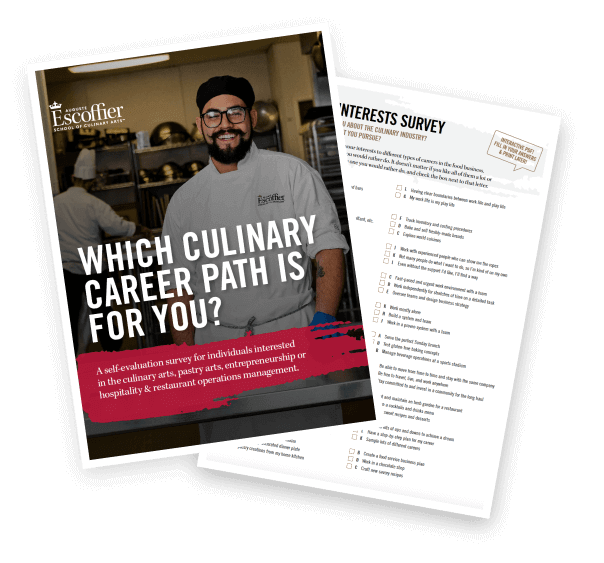
Take the Culinary Career Survey
We’ve compiled a checklist of all of the essential questions into one handy tool: career options, culinary interest surveys, educational opportunities, and more.
Are Culinary Jobs Safe from AI Replacement?
Research suggests that white-collar jobs are more susceptible to being replaced by AI than blue-collar and trade careers. Many blue-collar and trade jobs require hands-on tasks that computers aren’t able to handle. According to Pearson, generative AI could automate roughly 30% of white-collar tasks, compared with less than 1% of blue-collar and trades tasks.
Culinary careers routinely make the lists of AI-resistant careers. Cooking requires taste, smell, and physical movements that AI is unable to replace at this time. Even when the technology is used for menu development, recipe creation, or pricing, the cutting, searing, seasoning, and tasting still require a human touch.
And the culinary industry is expected to grow. According to the U.S. Bureau of Labor Statistics, chef and head cook job growth is projected to grow by 7% through 2035, while the outlook for all occupations is only 3% (as of September 2026).
How Culinary School Can Help You Make the Switch
While it is possible to learn cooking skills on the job, culinary school could give you the immediate foundation needed to step into higher-level roles faster. Instead of learning only one restaurant’s way of operating, formal training connects you with multiple Chef Instructors who bring a wide range of industry techniques and perspectives to the table.
Beyond traditional kitchen roles, culinary school can introduce you to a wide spectrum of career paths, whether you envision yourself as a sommelier, brewmaster, pitmaster, or food and beverage director, to name just a few.
Culinary school also goes beyond kitchen fundamentals to teach critical industry-related business skills, such as food costing, menu development, plating, and marketing, that could prepare you for higher-level management positions.

Escoffier graduate Michael Fields left a career in finance to become a cutter and pit room cook at Franklin Barbecue.
How an Externship Bridges Classroom and Kitchen
Changing careers mid-way through your working life often brings a familiar catch-22: you can’t get hired without experience, and you can’t get experience without being hired.
Culinary school can help you bridge that gap. In addition to your coursework, Escoffier requires students to complete at least one hands-on industry externship, during which you work in a professional culinary industry setting to apply the skills you’ve been studying at school.
You might make industry connections that could lead to a potential job offer down the line, and you can leave with experience to include on your resume.
Attending Online While Still Working and Supporting Your Family
College and trade school might seem easier for young adults because they tend to have fewer responsibilities to manage. But you can still complete culinary school even if you have to continue working a full-time job in order to support yourself and your family while you work on changing careers.
Online culinary programs can allow you to fit your schooling into a schedule that works for your life. You can watch cooking demonstrations on your lunch break, complete baking assignments after dinner, and interact with classmates online on the weekends.
Shifting your daily routine to make room for coursework takes effort, but online culinary programs are structured specifically to help career changers and others weave training into their everyday lives.
Program Options at a Glance
| Program | Online Diploma | Online Degree | On-Campus Diploma | On-Campus Degree | Locations |
| Culinary Arts | 60 wks | 84 wks1 | 30 wks | 60 wks | Online, Austin, Boulder |
| Baking & Pastry Arts | 60 wks | 60 wks | 30 wks | 60 wks | Online, Austin, Boulder |
| Plant-Based Culinary Arts | 60 wks | 84 wks | 42 wks | Not offered | Online |
| Food Entrepreneurship | 60 wks | 84 wks | Not offered | Not offered | Online |
| Holistic Nutrition & Wellness | 60 wks | 84 wks | 42 wks | Not offered | Online |
| Hospitality & Restaurant Operations Management | Not offered | 60 wks | Not offered | Not offered | Online |
1Can be completed in as little as 24 weeks for students who’ve already earned the diploma.
What Does Culinary School Cost, and How Can You Pay for It?
The total program cost for culinary school will depend on which credential and format you choose. Across Escoffier’s programs, total program costs as of October 2026 fall somewhere between $20,757 for a diploma and $41,795 for an associate degree.**
A diploma could help get you into the field faster and costs less. A degree takes longer but goes deeper. Neither one is the “right” choice, just the choice that fits where you’re at or where you want to go.
**Costs are subject to change. Visit Escoffier’s tuition page for current figures before enrolling.

Financial Aid, Scholarships, and Grants for Adult Learners
Going back to school later in life doesn’t limit your options for funding your education. Age isn’t a factor in federal student aid eligibility, and many of Escoffier’s financial aid opportunities and scholarships are open to students at any stage of their career.
The easiest place to start is the FAFSA®, the Free Application for Federal Student Aid. It’s free to fill out and doesn’t commit you to anything, but it’s the gateway to federal grants, loans, and work-study funding. Many Escoffier students qualify for some form of federal aid, whether that’s a Pell Grant that doesn’t need to be repaid, or a low-interest federal loan that spreads out the cost over time.
Beyond federal aid, Escoffier also offers its own scholarships for students who apply and qualify, including an Institutional Scholarship worth up to $15,000 and a need-based grant through the Escoffier Scholarship Foundation. If you’re already employed by one of Escoffier’s Work & Learn partner employers, a dedicated scholarship of up to $5,250 may be available as well. Combined awards can reach up to $7,500 for diploma students and $15,000 for degree students, for those who qualify.+
+Consider your situation and resources to determine what is affordable and on budget for you.
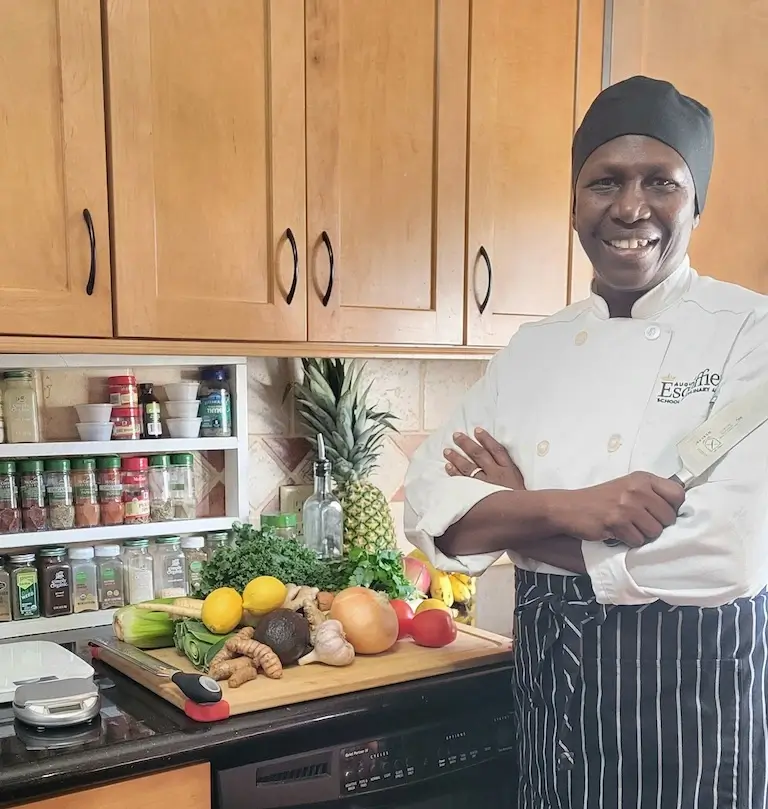
Jeanette Rideau enrolled in Escoffier’s Plant-Based program at age 60 — proof that it’s never too late to start.
Using Military Benefits
Active military members and veterans can receive help paying for culinary school. Escoffier’s Boulder campus (including online programs) is recognized as a 2026-2027 Military Friendly® School, and more than 1,300 GI Bill® students attended Escoffier last year alone.
Qualifying students can receive a tuition benefit through the GI Bill®, up to $21,476 at the Boulder campus or through online programs, and up to $29,921 at the Austin campus. On-campus students may also qualify for a monthly housing benefit of over $2,300. Military spouses pursuing a degree can access up to $4,000 through the MyCAA program, and veterans with financial need may also qualify for the Student Veteran Scholarship, worth up to $15,000.‡
You don’t have to figure out these options on your own. Escoffier’s financial aid team works directly with military and veteran students to help sort out eligibility and next steps.
‡GI Bill® is a registered trademark of the U.S. Department of Veterans Affairs. Benefit amounts depend on individual eligibility and service history; consult the VA or Escoffier’s financial aid office for details specific to your situation.
How to Enroll in Escoffier: Get the Essential Guide
Attending culinary school is a major decision! In this one-stop guide to Escoffier, explore what makes our school different, programs you can study, how to enroll, pay for your education, and more!
Other Ways Career Changers Fund Tuition
Funding a mid-career transition often looks different than financing school right out of high school, tapping into resources accumulated over years of working.
Richard Hodgkiss left a seven-year career in emergency medicine after burnout took its toll. The day he lost his ER job, he applied to culinary school. “I’ve been given the chance,” Hodgkiss says. “I’ve been looking for a reason to walk away from medicine and do culinary.”
He funded his move to Escoffier’s Boulder campus through a mix of sources, including a scholarship from the National Restaurant Association Educational Foundation and student loans.
Every student’s path is different, and there’s no single way to fund culinary school. Depending on your situation, savings, a severance package, scholarships, or financial aid could all help make it possible.
Are You Ready to Take the Next Step
Karen Williams wasn’t in crisis when she found Escoffier. She’d already left her 17-year career as a CNA and moved into a new role directing food service for her school district. Things were stable. But one Saturday, sitting on her couch, an ad for Escoffier came across her Facebook feed, and Williams clicked “learn more” anyway.
She just knew there was more she wanted, and she gave herself permission to find out what that looked like.
“Remove the excuses, get started,” she says. “If you get started and you don’t quit, you will make it to the end.”
You don’t have to map out your entire path before reaching out; support can be available at every step of your decision. Contact us to find out more about how Escoffier can help you build your next chapter in your 40s, 50s, or beyond.
CHECK OUT THESE ARTICLES NEXT!
- Why Older Students Should Consider Culinary School
- Am I Too Old to Become a Chef?
- How Escoffier Can Support Career Changers: Real Student Stories
FAQs
No. Many culinary professionals started later in life, bringing work experience, discipline, and financial planning that younger students may not have yet. Age isn’t a barrier to enrollment, financial aid, or building a new career, and online programs make it possible to train without pausing your current income.
Yes. Online culinary programs are built around flexible schedules, letting you complete coursework and cooking assignments around a full-time job. It may require adjusting your routine, but many students complete their training while continuing to work and support their families.
A culinary education opens paths well beyond line cooking, including private chef work, food entrepreneurship, hospitality management, corporate or institutional dining, and plant-based culinary arts. Your training can lead toward whichever pace, schedule, and physical demand level fits your life best.
Most students don’t pay entirely out of pocket. Options include federal financial aid through the FAFSA®, scholarships and grants, military and spouse benefits for those who qualify, and creative funding sources like severance packages. Speaking with a financial aid representative can help you understand what’s realistic for your situation.