

Listen to This Article:
Do you love to lead as much as you love to cook? Does the idea of being in charge of an entire kitchen excite you? If so, becoming an executive chef or head chef could be the perfect move for your career.
But how do you determine which career path you want to pursue? These two roles have a lot of similarities—in fact, in many restaurants they are a single position, rather than two separate ones. But in restaurants that do employ both an executive and a head chef, there are some big differences in their responsibilities.
Before you start planning your next career goals, let’s take a look at what it means to be an executive chef vs. a head chef, and how you can determine which role is right for you.
What Is an Executive Chef?
First, it’s important to note that many kitchens do not employ an executive chef; instead, they’ll typically only have a head chef, who is responsible for handling most or all of the duties described below. Executive chefs generally only work at larger or higher-end restaurants, commercial kitchens, and restaurants with multiple locations—typically food businesses with larger budgets, and where the responsibilities would be too much for a single person.
That said, at restaurants that do make a distinction between executive chefs and head chefs, executive chefs are at the top of the kitchen hierarchy. They are responsible for making decisions that affect everything that happens in the kitchen, including what’s on the menu, where the ingredients are sourced, and how they should be prepared.

An executive chef’s duties go far beyond the kitchen, like sourcing and ensuring the quality of ingredients.
The nature of these responsibilities means that, even though “chef” is in their job title, they may rarely prepare the food. The traditional role of an executive chef is much more oriented toward management than cooking.
Nevertheless, it is important to have a strong culinary background to be successful in this role. Executive chefs will likely be responsible for creating dishes and managing kitchen operations; in order to thrive in this position, an aspiring chef should have significant experience working in restaurants, and may even want to pursue a culinary degree or other certification.
A Day in the Life of an Executive Chef
Walk into a restaurant before service, and you may find an executive chef reviewing food cost reports from the night before, meeting with a produce vendor about a seasonal menu change, or sitting down with the general manager to go over labor budgets.
Some of the pre-shift duties an executive chef may oversee include checking in with department heads, approving the week’s ordering, or developing a new dish. As service approaches, they may do a walk-through—tasting, checking prep, making sure standards are being met—before stepping back to let the head chef run the floor.
After service work may span everything from recipe documentation and long-range menu planning to supplier negotiations and staff performance.
As chefs move up the kitchen brigade into this leadership role, they often have less hands-on cooking time. As two-Michelin-star chef and Escoffier Advisory Board member Curtis Duffy described it: “If I’m standing in the kitchen every single day peeling vegetables, butchering fish, picking herbs, we don’t grow. We just stand still.”*
What Is a Head Chef?
In restaurants where these two positions are separate, head chefs are second in the kitchen hierarchy, just below executive chefs. While this role also has some administrative responsibilities, it’s a much more hands-on position; a head chef typically works in the kitchen, managing other chefs, handling some of the food preparation, and running the day-to-day operation of the kitchen.

A head chef must have broad culinary skills in order to be an effective leader.
In restaurants that don’t employ an executive chef, however, the head chef may also take on many of the responsibilities associated with that role. Because not all restaurants have an executive chef, when applying for a head chef position, it’s important to understand what the exact scope of the work will be.
Regardless of whether or not a restaurant has an executive chef, head chef is a versatile position that requires broad culinary knowledge and experience along with management skills.
A Day in the Life of a Head Chef
If the executive chef is the architect, the head chef is the one in charge of the daily operations at the build site.
A head chef typically arrives early to review prep lists, check that mise en place is on track, and address any gaps before service begins.
They may taste through dishes, coach line cooks on technique, and handle the steady stream of small decisions that keep a kitchen moving—a substitution when a delivery comes up short, a timing adjustment when a station falls behind, a quick correction when a plate doesn’t meet the standard.
During service, the head chef is usually on the pass, expediting tickets and serving as the final checkpoint for every dish that leaves the kitchen. After service, they’re usually debriefing with the team, logging inventory, communicating issues up to the executive chef, and setting the kitchen up for the next day.
It’s a physically demanding, deeply immersive role, requiring both high-level technique and management instincts.
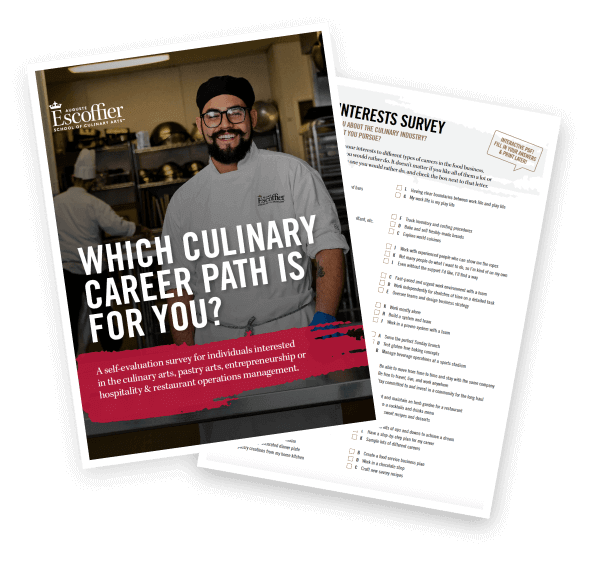
Take the Culinary Career Survey
We’ve compiled a checklist of all of the essential questions into one handy tool: career options, culinary interest surveys, educational opportunities, and more.
Where Head and Executive Chefs Fit in the Kitchen Hierarchy
To understand the interplay between an executive chef and a head chef, it helps to look at the overarching kitchen structure. Most professional kitchens run on a system called the brigade de cuisine, a hierarchy of roles and responsibilities first formalized by Georges Auguste Escoffier in the late 19th century.
Most head chefs have spent years as a chef de partie and sous chef before taking the lead. Most executive chefs have done the same, plus additional experience in kitchen management and business operations.
A Closer Look: Diverging Responsibilities
Within that Escoffier hierarchy, the executive chef and head chef must work in tandem. While both aim for culinary excellence, their methods of achieving it—specifically regarding quality control and team management—differ significantly.
Here’s how those high-level differences translate into the daily reality of the kitchen.
Executive Chef vs Head Chef
| Executive Chef | Head Chef | |
| Primary focus | Big-picture strategy, menu development, business operations | Day-to-day kitchen management and food production |
| Kitchen presence | Occasional, may not be on the line daily | Consistent, present for most or all service |
| Hands-on cooking | Minimal in most settings | Regular, involved in prep and service |
| Budget responsibility | Owns kitchen budget, food cost targets, and financial planning | Monitors daily inventory and waste, reports up |
| Menu authority | Creates and approves menus | Executes menus, may suggest changes |
| Typical setting | Larger restaurants, hotels, multi-unit operations | Restaurants of most sizes |
Quality Control: The Bird’s-Eye View vs. The Final Pass
Both executive chefs and head chefs are responsible for ensuring the quality of the food their establishments serve—though in very different ways.
Executive chefs ensure quality at a high level. They’re responsible for creating their restaurant’s menu, which involves deciding everything from what will be served to how it will be plated. Creating a great menu requires creativity, an up-to-date understanding of food trends, a broad knowledge of culinary techniques, and an investment in sourcing high-quality ingredients.
Beyond menu creation, executive chefs may be in charge of tracking quality through data points like food cost variance reports, customer feedback, and comp rates. This bird’s-eye view of quality is something a head chef on the line simply doesn’t have the bandwidth to monitor.

While executive chefs may design dishes, head chefs are responsible for preparing them.
Head chefs, on the other hand, are responsible for the quality of every dish as it leaves their kitchen. This means ensuring the quality of the food and its aesthetic presentation, and that their kitchen staff follows all food safety and hygiene practices. They must have the attention to detail to make sure each dish gets just the right finish of balsamic glaze or grated truffle, along with the foresight and management skills to train their staff effectively.
Business Performance: Analyzing Data vs. Managing the Floor
Executive chefs and head chefs also have unique responsibilities when it comes to monitoring the business performance of their restaurant.
Executive chefs will likely be responsible for keeping an eye on changing food costs, monitoring the profitability of their menu offerings, and managing inventory. They’re also likely to manage other aspects of the kitchen’s financial planning, like budgeting for staff and equipment. By attending to these big-picture concerns, executive chefs can help maintain the performance of their business and identify opportunities for growth.
Head chefs’ responsibilities in this area are much more hands-on. Because executive chefs are generally not in the kitchen as often, head chefs must be their eyes and ears on the ground. They are responsible for day-to-day inventory management, making sure their staff is storing and rotating stock appropriately to avoid spoilage.
They should also pay attention to their customers’ dining habits; for example, if they notice that one dish frequently comes back half-eaten, they may be able to recommend that the portion size be changed, or the item be removed from the menu. This won’t necessarily be their decision to make, but their input could be invaluable in the process.
The synergy between these roles is what can drive a restaurant’s success. The head chef monitors the “now,” while the executive chef plans for the “next.” This distinction is critical; Culinary Olympics gold medalist Travis Smith’s observation about restaurant ownership can apply to executive chef as well: “You can’t make soup all the time.”

Head chefs and executive chefs work together to monitor the profitability of their menu.
Here’s how these two roles might respond to the same operational challenges:
| Challenge | Executive Chef | Head Chef |
| Rising food costs | Renegotiates supplier contracts, adjusts menu pricing, or removes costly ingredients | Tightens portion control, reduces waste, and finds prep efficiencies |
| Underperforming dish | Removes it from the menu or repositions it based on sales data | Retrains staff on preparation and presentation to improve consistency |
| Staffing shortage | Adjusts labor budget, initiates hiring, or restructures shifts | Redistributes responsibilities across available staff to maintain service |
| Food safety concern | Updates kitchen protocols and retrains at a policy level | Addresses the issue directly on the floor and ensures immediate compliance |
| Slow season | Reduces operating costs, plans promotional menus, evaluates staffing levels | Focuses on prep efficiency and cross-training staff during reduced volume |
Leading the Team: Macro-Management vs. Shoulder-to-Shoulder Coaching
Executive chefs and head chefs are both involved in personnel management—but, again, in ways that are specific to their position.
Executive chefs are more likely to be involved in personnel management at the macro scale. Their duties may include setting staffing levels, creating policies and protocols, conducting performance reviews, and interviewing, hiring, and firing team members.
It’s also worth noting that, as executive chef is the highest ranking position in the kitchen, the head chef is their direct subordinate; executive chefs are responsible for managing their head chefs’ performance, along with the rest of their staff.

Both executive chefs and head chefs have personnel management responsibilities.
Head chefs manage personnel with whom they work shoulder-to-shoulder. Even in restaurants that do employ an executive chef, the head chef is the highest-ranking person actually working in the kitchen. As such, their chief responsibility is managing the brigade de cuisine. In order to be able to manage so many different techniques, a good head chef should possess both extensive culinary knowledge and great management and communication skills.
In short, while an executive chef may not personally be in the kitchen much, they are likely responsible for making all the big decisions that allow it to run. Head chefs, on the other hand, work in the kitchen and are responsible for ensuring that all the pieces come together in support of the executive chef’s vision. Where no executive chef exists, the head chef absorbs many of those responsibilities, often in collaboration with a restaurant manager or owner.
What separates a good executive chef from a great one is often a change in orientation: shifting from personal achievement to deliberate team development. Lee Hillson, James Beard House-featured chef who has run some of Arizona’s most prestigious kitchens, notes that his own approach matured as he realized that his most important job wasn’t standing at the pass, but empowering the people around him.
“We wanted to put our stamp on [our restaurants], our names, even though we had a team around us that we wouldn’t be able to do it without them,” HIllson says. “…Now I sit back and think, ‘It’s about the team, and then I’m in the back.’ Coaching. Being anywhere I can to help them move their career forward.”

How Much Can an Executive Chef or Head Chef Earn?
While executive and head chef salaries may vary depending on employer, geographical location, and experience level, one thing generally holds true: these can be the highest-paid culinary positions.
According to data gathered by the U.S. Bureau of Labor Statistics, the average salary for Chefs and Head Cooks (the category that includes executive and head chefs) is $58,920, with the highest earners reaching $93,900 or more.

Generally speaking, chef positions with more responsibilities can earn higher salaries. Executive chefs and head chefs who handle more of the executive duties may tend to land closer to the higher end of that salary spectrum, while head chefs working under an executive chef would typically earn less. But, again, the earning potential for both of these positions is based on a number of factors—the relative amount of responsibility being just one among them.
Location and type of venue also play a significant role. The BLS data shows that chefs working in traveler accommodation—hotels and resorts—earn a mean annual wage of $73,300, compared to $58,560 for those in restaurants and other eating places. At the geographic level, Hawaii, Rhode Island, and Massachusetts rank among the highest-paying states for this occupation, though cost-of-living can affect the actual spending power.
Chef Compensation by Setting
| Setting | Mean Annual Wage |
| Restaurants and eating places | $58,560 |
| Special food services | $67,190 |
| Traveler accommodation (hotels/resorts) | $73,300 |
| Other amusement and recreation industries | $76,560 |
Source: Occupational Employment and Wages, May 2023: Chefs and Head Cooks, U.S. Bureau of Labor Statistics

Which Role Could Be Right for You?
Both of these positions require an ongoing commitment to learning, years of experience, and possibly a culinary degree. But while executive chefs and head chefs work together closely and have some overlapping duties, the specific differences between the roles mean that, in restaurants where these are distinct positions, you may be better suited for one over the other.
Are You a Big-Picture Person?
Do you enjoy thinking about the big picture and making decisions with far-reaching consequences? If so, being an executive chef might be the right position for you. In this role, you’ll typically be responsible for decisions that affect the long-term success of your restaurant. You’ll need to be comfortable stepping away from the stove and into a more analytical, organizational mindset, trusting your team to execute the vision you’ve built.

Executive chefs make decisions that determine the way their kitchens run.
Do You Live to Cook?
Do you love working with food and being in the kitchen? A position as a head chef might be a better career choice, since an executive chef may spend less time actually cooking.
As head chef, you’ll be right there in the kitchen, working alongside your team, running the pass, and making sure every plate that leaves your kitchen meets the standard. If the energy of service (the heat, the speed, the immediacy of it) is what drives you, the head chef role keeps you close to that every day while still working in a management position.
What’s Your Management Style?
Both positions involve personnel management, but in different ways; think about which style of management you prefer as you consider whether executive or head chef would be a better fit for you. Are you better at crafting policies, conducting performance reviews, and enforcing standards? If so, executive chef might be the right role for you. Do you prefer working directly alongside the people you manage? Then you might be cut out to be a head chef.
Ready to Take the Next Step in Your Career as a Chef?
If you’re unsure which of these positions might be right for you, consider seeking mentorship from others in the culinary industry. Speaking directly with people who have been there already can be a great way to understand what’s involved in these jobs—and which of them you might be a good match for.
No matter where you see yourself in the kitchen, pursuing a culinary degree can be a great way to help you get there. Escoffier’s on-campus or online programs can offer you hands-on experience, business training, and access to knowledgeable Chef Instructors, all of which can be valuable in helping you get closer to achieving your career goals.
Financial aid, grants, and scholarships are also available to those who apply and qualify, which can help bring your aspiration of leading a kitchen that much closer to reality. Contact us to find out more about which program might be your best fit.
IF YOU LIKED THIS ARTICLE, CHECK THESE OUT NEXT:
- 10 Common Interview Questions for a Chef Position
- Is Culinary School Worth It in 2026?
- 7 Books All Chefs Should Read
FAQs
Executive chefs typically focus on big-picture decisions—menu creation, ingredient sourcing, financial planning, and staffing—and may rarely cook themselves. Head chefs are the highest-ranking people actually working in the kitchen, managing the brigade de cuisine and ensuring every dish meets quality standards. In smaller restaurants, these roles may be combined into a single position.
It depends on the business. In restaurants that employ both an executive chef and a head chef, the executive chef holds the highest-ranking position overall, while the head chef is in charge of day-to-day kitchen operations. In smaller establishments without an executive chef, the head chef assumes full authority over the kitchen and may take on many of the executive chef’s responsibilities as well.
Culinary school isn’t required to become an executive chef, but formal education can be an asset. Executive chef roles often demand both culinary knowledge and business acumen—skills that you may be able to develop by pursuing a culinary degree. Having a culinary credential on your resume can potentially be a competitive advantage against other candidates when applying for executive chef positions.
There’s no set timeline, but executive chef is a senior position that can require years of kitchen experience. Executive chefs often work their way through multiple roles—line cook, sous chef, head chef—before reaching the top. Formal culinary education may help you pursue this progression by helping you build foundational skills and business knowledge in a way that differs from on-the-job learning alone.
An executive chef’s day is often more administrative than culinary. Responsibilities may include reviewing food costs and budgets, managing inventory, overseeing hiring and staff performance, and collaborating with the head chef on menu execution.
In larger operations or multi-location concepts, they may also coordinate across kitchens and work with ownership on long-term business strategy. Actual cooking is often a small part of the role.
According to the most recent data from the U.S. Bureau of Labor Statistics, chefs and head cooks earn an average salary of $60,990, with top earners exceeding $96,000. Executive chefs—particularly those overseeing larger or higher-end operations—may be more likely to land toward the higher end of that range. Factors like location, restaurant type, and level of responsibility all influence earning potential.