

Listen to This Article:
Ellen Doerr never imagined she’d be standing in a manufacturing warehouse, watching hundreds of pizzas flow down a production line that stretched the entire length of the facility. But there she was, phone in hand, recording a moment that perfectly captured how far her culinary journey had taken her from the steakhouses of South Dakota.
“It’s so different than in the restaurant where you put up a plate or two plates at once,” Ellen said. “It’s just watching hundreds going down a line and all of these people helping to make it work. And it’s just like, wow, I had a hand in this. This is feeding people on a massive scale.”
Ellen’s journey from Escoffier graduate to food science specialist reflects a spirit of exploration and growth. After earning her culinary degree, she built and sold a successful personal chef business in South Dakota, partnered with a university on nutrition research, and ultimately found her calling in the intersection of culinary arts and food manufacturing—proving that culinary careers can evolve in unexpected and rewarding ways.
A Foundation Built on Food
Food was literally the family business when Ellen was growing up. Her father, grandfather, and great-grandfather all owned restaurants, South Dakota steakhouses that served a simple menu of steak, wedge salads, and baked potatoes. Her dad worked corporate for Burger King, and by 14, Ellen started her first job flipping burgers.
Despite this early exposure to the industry, Ellen didn’t initially see cooking as her future. After graduating high school in 2007, she pursued social work part-time while also working various other jobs. She spent seven years juggling work she didn’t fully enjoy, but food was always at the back of her mind.
“I was working as a loan processor and I was spending more time at work looking up what I was going to cook that night,” she says.
Her roommate made a suggestion that would change everything. She wanted to move to Colorado and didn’t want to go alone. Having watched Ellen’s cooking hobby grow over the years, the roommate dangled an idea: what if Ellen came along and considered culinary school? They had a friend who’d attended Escoffier in Boulder.
“I was like, ‘Okay, well, I guess I’ll look into it,’” Ellen said. “And then it was kind of like, okay, you know what, I don’t see a path forward with social work for me. So maybe this is something I can explore.”
And just like that, Ellen found herself touring the Auguste Escoffier School of Culinary Arts Boulder campus and submitting an application.
Education as Transformation
Ellen enrolled at Escoffier’s Boulder campus in 2014 and found the experience revelatory, particularly her instructor’s emphasis on food history and cultural connections.
“How food is so woven into the history of our lives is something that is just really cool to me,” Ellen said. “Those dishes that you’re like, man, this is very nostalgic. And then, that makes sense, why? Because we’re from this area and this is where this came from.”
She points to dishes like banh mi sandwiches, in which understanding the French colonial influence in Vietnam suddenly makes the French baguette part of the sandwich make perfect sense.
The education gave her something that would define her entire career: instead of memorizing recipes, she gained the ability to understand how food actually works and to translate that knowledge into recipe development.
“Escoffier taught me how to read a recipe and break down a recipe,” she said. “And it doesn’t matter what kind of food you’re cooking or what style or where you’re getting that recipe from, you have the formula and it’s all the same.”
With that foundation, Ellen could walk into any kitchen and improvise—knowing not just what to do, but why it worked.
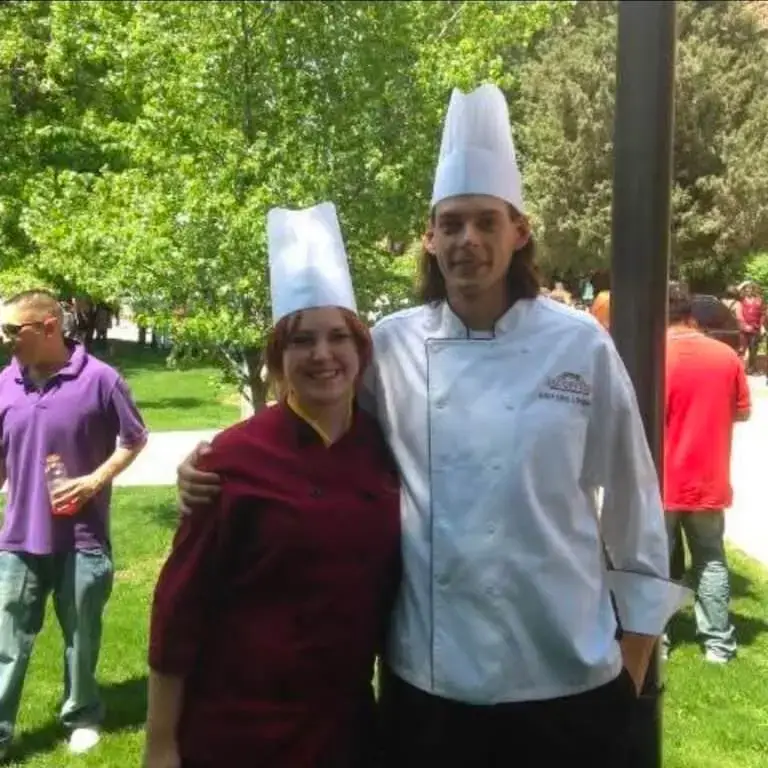
Ellen celebrates her 2015 graduation from Escoffier’s Boulder campus.
The Entrepreneurial Leap
After graduation in 2015, Ellen returned to South Dakota and worked in fine dining restaurants for a few years. But when her youngest son was born, Ellen faced a common industry dilemma: wanting to stay in food but needing more family-friendly hours. Around that time, she reconnected with Escoffier and enrolled in additional online coursework. The timing couldn’t have been better.
“Most of my professors that semester had been personal chefs at some point in their career,” Ellen recalled. Their non-traditional career paths got her thinking. Personal cheffing was something she’d never considered before, but it made sense for her situation; it was a way to stay in food while working from home with a young child. Around the same time, a few people reached out asking if she’d be interested in catering private dinners. Ellen turned to her Escoffier instructors for guidance.
“I was just kind of (asking) instructors the whole time, like how do I navigate this? What do I do? And they helped me get set up with a few things.” The instructors guided her through the practical side of starting a personal chef business, from pricing services to finding insurance for cooking in private homes.
Ellen joined the United States Personal Chef Association, which helped her navigate operating as a service worker rather than a restaurant entity, avoiding the need for her own commercial kitchen initially.
The personal chef business filled a crucial gap in her remote South Dakota community.
“A lot of my clientele were people that had multiple dietary allergies within their family,” she said. “And it was a lot harder to find food for them in town.”
Ellen’s approach was practical: she’d spend one day cooking two weeks’ worth of meals for families, allowing her to stay home more while building a sustainable business.
Scaling and Specializing
By 2019, Ellen’s personal chef business had outgrown her initial setup. She was renting kitchen space from a local caterer, operating under her own health department license while paying for use of his facilities. Business was booming—so much so that they had to plug in his refrigerated catering van to create enough cold storage space for both operations.
The success prompted Ellen to look for her own space. She signed a lease in January 2020 for a location that would need to be completely remodeled into a commercial kitchen, planning to open her brick-and-mortar meal prep shop in March. Then the pandemic hit.
“By the time March of 2020 came along, everything was shut down,” she says. “We had to remodel and put a kitchen into my space. So things were stuck outside of the country and everything was behind. We didn’t end up opening till May. I didn’t get a sign until July.”
Despite the challenges, Ellen’s grab-and-go model proved perfectly suited for lockdown restrictions. She installed a 24-foot-long open cooler and stocked it with pre-made meals that customers could pre-order and pay for online. They could then either grab their order and go or have it brought out to their cars.
“We ended up being really busy just because everybody had shifted to take out at that time.” Ellen says. As business took off, Ellen hired her first employees to help manage the demand.
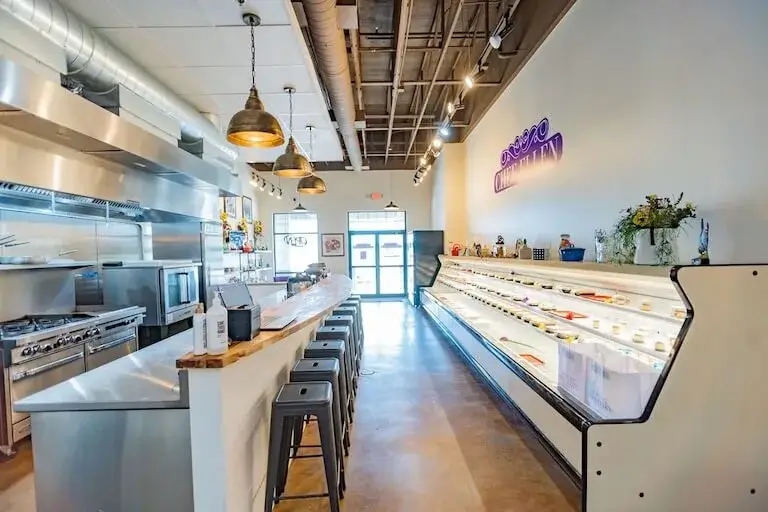
Ellen’s brick-and-mortar meal prep shop opened in May 2020 and featured a grab-and-go model perfect for pandemic restrictions.
The Cost of Success
Ellen’s business was thriving. The brick-and-mortar meal prep shop had weathered the pandemic, her team was growing, and her reputation for handling specialized diets was attracting bigger opportunities. But success came at a price.
The Physical Toll
Ellen had been born with pediatric bunions that worsened after years of standing on concrete floors in her commercial kitchen. The condition eventually required big toe fusion surgery—doctors removed a joint from each big toe. The recovery was brutal: Ellen couldn’t put weight on her foot for a month, followed by walking in a boot, then learning to walk again. She endured this process twice, once for each foot, with surgeries in 2022.
The 2022 holiday season tested her limits. Just months after her second foot surgery, Ellen found herself short-staffed during the busiest week of the year.
“I had staff sick and I had to do the entire Thanksgiving meal by myself, like 36 hours straight of working,” she says, “and I remember getting through that and just being like, you know, this has been great. I can do this, but this isn’t where I want to be and it’s not what I can support long-term.”
But Ellen pushed on. She’d already carved out a successful business in the culinary industry, and the opportunities just kept coming in.
The Research Partnership
Soon, Ellen’s reputation for handling specialized diets caught the attention of South Dakota State University’s Department of Nutrition Science, which needed someone to prepare meals for a year-long research study comparing plant-based and animal-based proteins. The project required feeding 50 participants three meals a day plus snacks—eight weeks on plant-based protein, then eight weeks on animal-based protein. It was a massive and demanding undertaking.
“We ended up making tens of thousands of meals for them,” Ellen says. By 2023, her meal prep business team had ballooned to double-digit staff members to handle the demand of both the research project and her regular clients.
The precision required was extraordinary. Every meal had to be nutritionally identical except for the protein source. “It was like adding fiber to certain meals that were pork-based to make up for what you would get in the plant foods,” she explains.
It was an incredible project to be a part of, but like many business owners, Ellen was wearing multiple hats at once—marketing, managing employees, tracking finances—all while paying exacting attention to the tiniest nutritional details. It was a lot.
The Realization
Between the physical demands on her body and the sheer scope of the university project, something had to give.
“That took about everything I had,” she admits. “That was about the time where I was like, this is great, but also the whole business ownership part of it, I realized my focus and my love was still in the food and not everything else that ownership required.”
The Unexpected Opportunity
The university study ran through the end of 2023, but once that ended Ellen knew it’d be time to call it quits.
“Once January of 2024 came around, I put the business up for sale,” she says, adding that she was unsure what would come next.
“I honestly thought I would still be a chef somewhere because I didn’t really think there was another path for me,” she says. Then she spotted a job posting for a culinary food specialist.
“I was like, well, I definitely don’t have a bachelor’s in food science. Definitely don’t know a lot of this, but… I sent (an application). I didn’t think anybody was going to get back to me,” she says.
Four interviews later, Ellen found herself at OLM (owned by Performance Food Group), one of the largest food distribution companies in North America. PFG distributes food and food-related products to restaurants, healthcare facilities, hotels, and other foodservice operations across the country.
“What this team had here was they already had food scientists, they already had culinary food scientists, but they needed somebody who was more on the restaurant end that could really bridge the gap,” Ellen explains.
While food scientists concentrate on the technical side, like extracting protein from ingredients, Ellen draws on her practical kitchen experience to make sure products perform in real-world foodservice settings. Her work can range from programming ovens and running production trials to developing pizza programs for convenience stores nationwide, ensuring recipes scale efficiently across hundreds of locations.
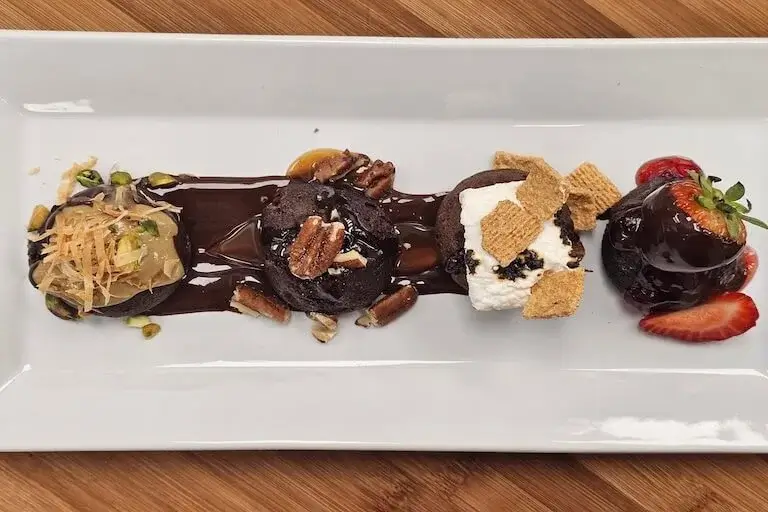
Among her responsibilities at OLM, Ellen creates product flights like this chocolate dessert showcase to help the marketing team sell Performance Foodservice products at trade shows. The chocolate bites featured here are products manufactured by her company.
“The problems in this kitchen are a lot different than the problems in a restaurant kitchen,” she says. “If you’re mixing a pizza dough in a restaurant and it’s too sticky, you’re just like, I’m going to add some more flour. But when you have a manufacturing facility and you don’t have trained cooks doing the mixing, you have to know that this amount of flour and water and ingredients is going to look like this.”
The stakes scale up, too. “I’ve had trials where it’s like, the sauce didn’t turn out and that’s [not just] 10 pounds of sauce. It’s like 1,600 pounds of sauce. And you’re like, okay, well, sorry guys. Oops.”
But Ellen’s team works hard to minimize waste when trials don’t go according to plan, finding creative solutions with whatever ingredients are on hand.
“Sometimes I’ll even step in and people will be like, okay, we ordered too much chicken for this project. We’ve got this much chicken leftover. What can we innovate that only has the ingredients that we have on hand plus this chicken to get it out the door?” Ellen says.
The Bigger Picture
Looking back, Ellen sees a clear thread running through her seemingly disparate experiences: the ability to create solutions where none existed before. Whether it was serving families with complex dietary needs, designing nutritionally identical meals for research, or helping convenience stores execute complicated recipes, she’s consistently found ways to bridge gaps in the food industry.
“I mean, I remember very clearly in culinary school back in 2014 saying I was never gonna own a business,” she says. “I don’t think business ownership was on my radar.”
Her advice to culinary students reflects this journey of discovery: “The thing I tell so many students is, ‘I wish I had known when I was younger, all of the jobs that actually existed versus the ones that we think of existing.’ I wish somebody would have let me know that all of this was possible.”
Words of Encouragement
For anyone considering culinary school, Ellen says: “Do it. I mean, even if you don’t use culinary as your career forever, those are skills you do use forever […] It just made my life better in so many ways outside of just the career that I’ve had.”
She says that the life skills learned in culinary school prove valuable whether you’re accommodating dietary restrictions, running a side business, or simply feeding your family.
When it comes to taking risks, Ellen says: “If you wait until you dot all the I’s and cross all the T’s, you’re never going to start. You just do it… You jump in, have one or two things figured out, (and) you figure the rest out along the way.”
Her last piece of advice reflects her experience creating her own path multiple times: “If you don’t see the path that you think fits you, there is always a way to create it for yourself.”
Ready to start your own culinary journey? Escoffier offers comprehensive programs designed to give you the foundation and flexibility to pursue whatever path calls to you. Whether you’re interested in restaurants, entrepreneurship, food science, or something entirely different, Escoffier may be able to help provide the skills and network to help you succeed. Explore our programs and take the first step toward your culinary future.