

Listen to This Article:
Step into almost any kitchen, and a similar process is already underway. Before the main ingredient ever hits the pan, vegetables are being chopped and fat is heating. Soon, aromatics begin to soften, releasing their flavor into the oil or butter that will carry the rest of the dish.
From a few humble ingredients, the foundation of cooking takes shape. It goes by different names depending on where you are. In France, it’s mirepoix. In Louisiana, the Holy Trinity. Italian cooks build soffritto, while Spanish and Latin American kitchens rely on sofrito or recaíto. Filipino cooks start with ginisa, and in Indian kitchens, spices are bloomed in ghee for tarka.
Learning these bases does more than expand your recipe knowledge. It can give you a way to understand how flavor is built from the very first step, and how to move more confidently across cuisines.
What Is an Aromatic Base?
An aromatic base is a combination of vegetables, herbs, spices, or other aromatics cooked in fat to create the foundation of a dish before anything else is added.
At its simplest, every aromatic base is shaped by two decisions: what you cut and what you cook it in.
Onion, carrot, and celery will give you something balanced and subtly sweet. Swap in bell peppers or chilies, and the profile shifts, losing that sweetness and taking on a more vegetal, slightly sharper edge. Add ginger, garlic, or whole spices, and the profile becomes more robust and assertive, with sharper, more defined flavors.
Fat matters just as much, and it varies by region. Butter builds richness, while olive oil is lighter, more savory. Lard adds depth, and ghee brings a distinct nuttiness and helps spices bloom in a way other fats don’t. Even neutral oil has a role, by staying out of the way and letting the aromatics speak for themselves.
One other thing worth knowing early: some bases stay in the finished dish, becoming part of its texture and flavor. Others are strained out, doing their work invisibly in the background. That distinction will come up as you move through the traditions below.
Aromatic Bases Around the World: At a Glance
| Base | Cuisine | Key Ingredients | Fat | Technique | Stays in Dish? | Common Uses |
| Mirepoix | French | Onion, carrot, celery | Butter | Low, slow, no browning | Usually strained | Stocks, sauces, braises |
| Suppengrün | German | Leek, celeriac, carrot | Butter or neutral | Simmered, often whole | Strained | Broths, soups |
| Soffritto | Italian | Onion, carrot, celery | Olive oil | Slow, softening/caramelizing | Yes | Ragù, sauces |
| Sofrito | Spanish | Tomato, onion, garlic | Olive oil | Cooked down, jammy | Yes | Paella, stews |
| Recaíto | Puerto Rican | Culantro, cilantro, ají dulce | Oil/lard | Blended paste | Yes | Rice, beans |
| Holy Trinity | Cajun/Creole | Onion, celery, bell pepper | Butter/lard | Sautéed, often with roux | Yes | Gumbo, étouffée |
| Chinese Aromatics | Chinese | Ginger, garlic, scallion | Neutral oil | High heat, fast sequence | Yes | Stir-fries |
| Ginisa | Filipino | Garlic, onion, tomato | Neutral oil | Sequential sauté | Yes | Everyday dishes |
| Adu Lasan | Indian | Ginger, garlic | Ghee/oil | Fried paste | Yes | Curries |
| Ata Lilo | West African | Peppers, tomato, onion | Palm oil | Blended then reduced | Yes | Stews, rice |
The French Mirepoix
For many culinary students, mirepoix is one of the first introductions to building flavor through classical French technique. This base is made from onion, carrot, and celery, typically in a 2:1:1 ratio. Mirepoix is cooked slowly in butter over low heat, without browning. The goal here is to soften the vegetables and draw out their natural sweetness, not to develop color.
With mirepoix, its primary role is as a background flavor. You might use it to build stocks, braises, or classic sauces like espagnole, where it supports the dish rather than standing out. In many cases, it’s strained out before serving, leaving behind the flavor but not the vegetables themselves. In other preparations, mirepoix is left in the dish, particularly in rustic soups or stews where the vegetables are cut larger and meant to be eaten, rather than strained out as in a clear stock or refined sauce.
German Suppengrün
Within European cooking, Suppengrün offers a useful contrast to mirepoix. It serves the same function, building flavor for stocks, broths, and braises, but the ingredients and preparation lead to a different result.
Suppengrün, which translates to “soup greens,” typically includes leek, celeriac, and carrot. It’s often supplemented with parsley root, parsley stems, and thyme, sometimes tied together as a bundle. Regional variations may even include kohlrabi, savoy cabbage, or celery stalk.
Unlike mirepoix, which is usually finely diced, suppengrün is often left whole or roughly cut. The intention is different. Since it’s primarily used to flavor a liquid and then removed, precise knife work matters less than the overall balance of ingredients.
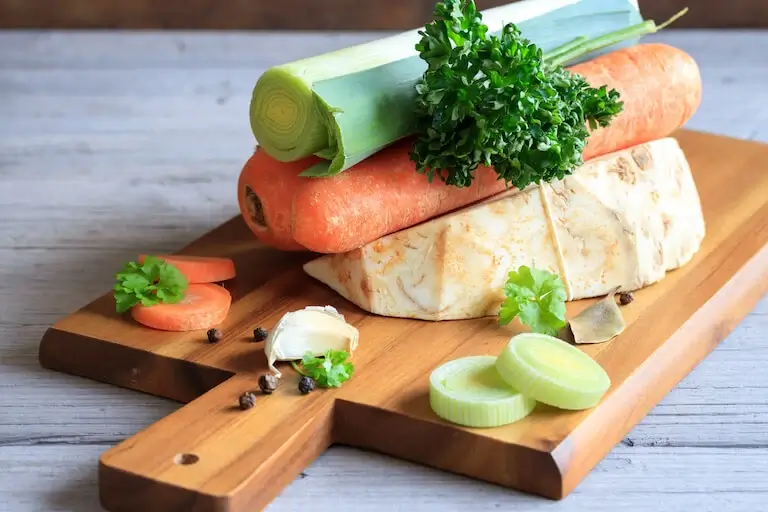
Suppengrün ingredients like leek, celeriac, and carrot create a deep, earthy stock base.
Like mirepoix, it’s most often strained out before serving. But the flavor it leaves behind is distinct. The combination of leek and celeriac creates a deeper, more earthy and slightly mineral profile compared to the softer sweetness of a French stock.
You’ll see suppengrün used in German stocks, broths, soups, and braised dishes, where it builds a clear, structured base without becoming part of the final plate.
The Italian Soffritto
Cross the Alps into Italy, and the pantry changes with the landscape. Soffritto uses a similar combination to mirepoix, built from onion, carrot, and celery, but the technique and fat shift the final result.
Instead of butter, soffritto is cooked in olive oil over moderate to low heat. The vegetables are typically minced instead of diced, left to slowly brown and caramelize, developing a gentle sweetness. The olive oil carries the flavor differently, giving the base a lighter, more savory profile compared to the richness of butter.
Unlike mirepoix or suppengrün, soffritto is typically left in the dish. The vegetables break down as they cook and become part of the final texture, especially in longer-cooked preparations. Depending on the intended dish (or the Italian nonna), tomato paste, bay leaves, garlic, fennel, or other aromatics may find their way into the pan.
You’ll find soffritto at the start of dishes like ragù bolognese, ribollita, braised meats, and many tomato-based sauces.
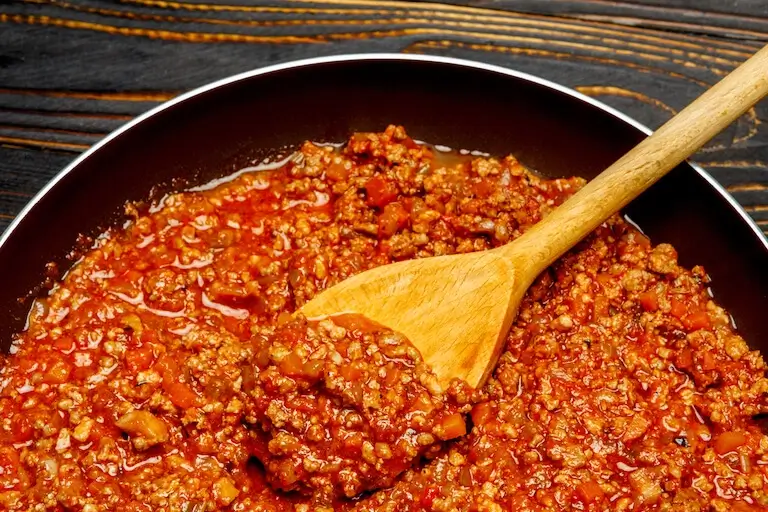
Soffritto breaks down into the base of sauces like bolognese, becoming part of the final texture.
It’s also worth noting the distinction in name. Soffritto is Italian, while sofrito refers to Spanish and Latin American bases, which we’ll dive into next.
The Spanish Sofrito
Sofrito shares a similar starting point with soffritto, but the addition of tomato changes both the technique and the final result.
While versions vary by region, a typical Spanish sofrito includes tomato, onion, garlic, and olive oil, sometimes with peppers such as pimiento or ñora. The presence of tomato makes this a wetter base from the start, introducing both acidity and natural sugars that develop as it cooks.
Sofrito is cooked longer than mirepoix or soffritto, often until it thickens and concentrates. As the moisture reduces, the mixture becomes deeper in flavor and slightly jammy, with a balance of sweetness and acidity that carries through the dish.
Olive oil is essential here, in part as a cooking medium but also as a way to distribute and extend the flavor of the aromatics. It allows the base to coat grains, proteins, and vegetables evenly, which is especially important in dishes like paella and rice-based preparations.
In addition to paella, you’ll see sofrito used in braised meats, stews, and a wide range of rice dishes across Spain and Latin America. As it moves across regions, the ingredients and proportions shift, adapting to local flavors and leading into variations like recaíto.
Puerto Rican Recaíto
As sofrito moves across Latin America, it shifts in both ingredients and technique. In Puerto Rican cooking, one of the clearest variations is recaíto, which takes the base in a completely different direction.
Recaíto is made from culantro (a long, flat-leaf herb with a stronger, more pungent flavor than cilantro), ají dulce (a small sweet pepper), cilantro, garlic, and onion, notably without tomato. That absence changes both the flavor and the appearance. Instead of the red, cooked-down base of sofrito, recaíto is bright green and herb-forward, offering a fresher, more aromatic profile from the start.
It’s also prepared differently. Rather than being built directly in the pan, recaíto is typically blended into a paste ahead of time. This shifts the role of the base. It’s not just something you cook at the beginning of a dish, but something you can add in measured amounts, depending on how much flavor you want to build.
In many Puerto Rican dishes, recaíto and sofrito are used together, layering flavor in stages. In dishes like arroz con gandules, recaíto is often cooked first as the green, herbal base, while sofrito is added afterward to deepen the flavor with tomato and sweetness. In others, recaíto stands on its own as the primary base. The fat varies as well, with lard or neutral oil commonly used, and annatto oil adding both flavor and the characteristic warm color to finished dishes.
You’ll find recaíto in dishes like arroz con pollo, pernil, beans, soups, and stews, where it provides a distinct, herb-driven foundation that differs from the slower, more concentrated bases seen in European traditions.
The Cajun Holy Trinity
The Cajun Holy Trinity builds on the same foundation as mirepoix, but with a key shift in ingredients and outcome. Instead of onion, carrot, and celery, the Trinity is made from onion, celery, and green bell pepper. The structure is familiar, but replacing carrots with peppers changes the flavor immediately, moving away from sweetness and toward a more savory, slightly sharper profile.
This base is used across both Cajun and Creole cooking, though the traditions themselves are distinct. As Chef Instructor Albert Schmid puts it, “The best description that I’ve ever heard of the difference between Cajun and Creole was by Chef Paul Prudhomme, who said Cajun was country food and Creole was city food.”
Cajun cooking developed from rural, resource-driven conditions, while Creole cuisine reflects a more urban blend of French, Spanish, African, and other influences. The Trinity appears in both, but the surrounding ingredients, techniques, and dishes can differ.
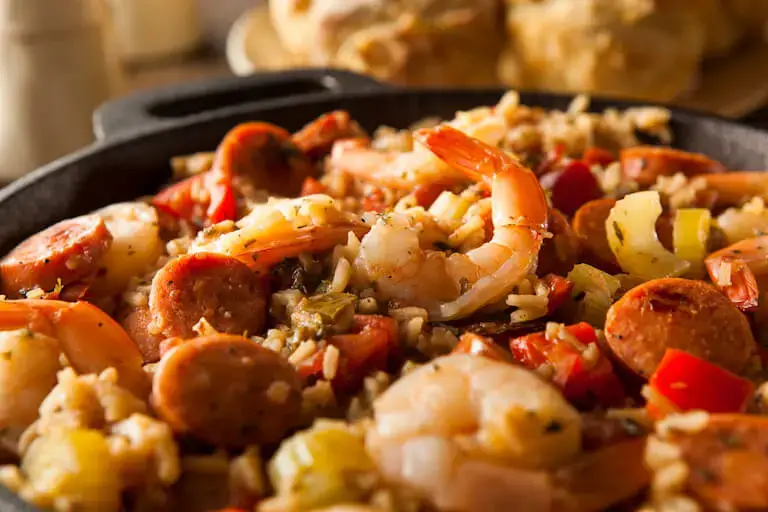
The Cajun Holy Trinity in action, forming the base of a flavorful rice dish like jambalaya.
One of the clearest distinctions from mirepoix is how the Trinity is used in the final dish. Rather than being strained out, it often remains visible and is meant to be eaten. In dishes like shrimp étouffée, the Trinity is cooked first, then combined with a stock made from shrimp shells to form the base of the dish. The vegetables are not merely background flavor here, rather, they become part of the finished texture and structure of the sauce.
Fat also plays a central role. Butter or lard is commonly used, and in many dishes, a roux is built from the same fat before the Trinity is added. This layering of fat and aromatics creates a deeper, more developed base that carries through the entire dish.
In addition to étouffée, you’ll see the Holy Trinity at work in dishes like gumbo, jambalaya, and red beans and rice.
Chinese Aromatics
In Chinese cooking, the aromatic base is built from three ingredients: ginger, garlic, and scallion, sometimes called the holy trinity of Chinese cooking. Unlike the European bases in this article, which tend to cook slowly over low heat, this combination works fast and at high temperature.
The technique is called bao xiang, which translates roughly to “exploding fragrance.” When the aromatics hit a hot, oiled wok, they release their essential oils almost immediately, scenting the fat and creating the flavor foundation for everything that follows. Because the heat is high and the oil is already hot, this step happens quickly. Garlic in particular can burn and turn bitter if left too long, so the aromatics are stirred and moved constantly, then followed almost immediately by the next ingredients.
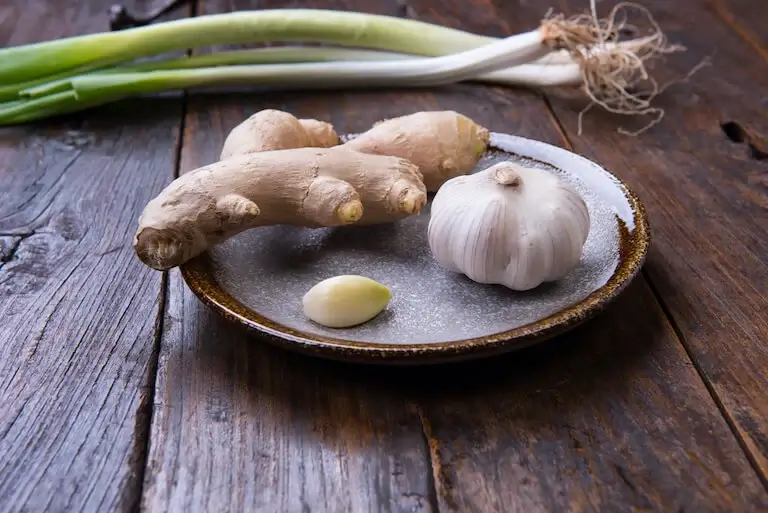
Ginger, garlic, and scallions form the backbone of many Chinese dishes through high-heat aromatic cooking.
The fat is typically a neutral, high-heat oil, which stays out of the way and lets the aromatics come forward cleanly.
It’s worth noting that Chinese cuisine spans enormous regional variation. In Sichuan cooking, for example, doubanjiang (spicy, salty, and savory fermented chili bean paste) and dried chilies take on much of the aromatic work. The ginger-garlic-scallion combination is a widely shared foundation, not a single universal rule.
You’ll find bao xiang at the start of stir-fries, braises, soups, and dumpling fillings, where the flavor needs to be immediate and defined rather than slow-built in the background.
Filipino Ginisa
Ginisa is built from garlic, onion, and tomato, often in a ratio of 1 part minced garlic, 1 part chopped tomatoes, and 1 to 2 parts sliced onions. The base gets its name from the Spanish word guisár, meaning to cook, and it describes both a technique and a flavor base that sits at the center of Filipino home cooking. Three centuries of Spanish colonial rule left a mark on the Filipino kitchen that’s still visible today.
Ginisa is the starting point for so many Filipino dishes that learning it is considered essential to Filipino cooking. The ingredients go in sequence, with garlic first cooked in oil until lightly golden. Onion follows, softened until sweet. Tomato goes in last, cooked down until it breaks apart and the whole base comes together. Each ingredient has its own time in the pan before the next one arrives.
The base isn’t fixed, though. Tomato comes in when the dish calls for it, as in ginisang ampalaya, a popular stir-fry, or ginisang monggo, a stew made from sautéed mung beans, garlic, tomatoes, and onions.
For dishes like adobo or tinola, the base stays leaner, built on garlic and onion alone, sometimes with ginger added.
Indian Adu Lasan
The name of this base says exactly what it is. In Gujarati, adu means ginger and lasan means garlic, and adu lasan is simply those two ingredients ground or pounded into a paste. The Hindi equivalent, you’ll see it as adrak lasun. This base spans regions and cuisines across the Indian subcontinent, showing up under different names but built on a similar foundation.
The paste is typically made without water, since water would cause splattering when the paste hits hot oil or ghee. The goal when adu lasan goes into the pan is to cook it until fragrant, releasing its sharp, layered aroma before anything else is added.
Ratios vary by cook and region. A common starting point is 1 part ginger to 2 parts garlic, which keeps the garlic flavor forward without letting the ginger overpower. Some cooks use equal parts, particularly when the ginger is milder. The paste can also be used as a rub on meat or poultry before cooking, where it works differently, flavoring from the outside in rather than building a base in the pan.
Adu lasan is often used alongside other aromatics such as onion, tomato, or whole spices, depending on the dish. You’ll find it at the start of curries, lentils, vegetable preparations, and braised meats, where it provides the sharp, aromatic foundation that everything else builds on.
West African Ata Lilo
In Yoruba, ata lilo means “blended peppers,” and the name describes exactly how the base begins. Fresh red bell peppers, Scotch bonnet, tomatoes, and red onions are blended into a smooth mixture before they ever hit the pan. The blending of ingredients first sets ata lilo apart from most of the other bases in this article, where ingredients go into the pan whole or chopped.
The mixture is cooked in oil until the water cooks off and the flavors concentrate. As the moisture reduces, the color deepens and the texture thickens into something closer to a sauce than a raw blend. Palm oil is traditional and adds a distinct richness and color that other oils won’t replicate.
Traditionally, the peppers and tomatoes were ground by hand on a stone slab rather than blended. Cooking was done over firewood, which gave the base a smoky depth. Some cooks add ginger or garlic to the blend depending on the preparation.
Ata lilo is rooted in Yoruba cooking from southwestern Nigeria, though pepper-based bases appear across West Africa in different forms. You’ll find it as the foundation for stews, rice dishes, braised meats, and soups, where its heat, acidity, and depth carry through the entire dish.
A Foundation Worth Learning
Every base in this article developed for a reason. The ingredients reflect what grows in a region, the fat reflects what’s available, and the technique reflects how generations of cooks learned to build flavor from the ground up.
Mirepoix is more than just a French technique, it’s a product of French soil, French kitchens, and French culinary values. The same is true of ginisa, ata lilo, and the Holy Trinity, and the rest of the bases.
Learning these gives you a way into each cuisine, shaped by its own logic and history. When you understand why a base works the way it does, you can cook with more accuracy and more respect for where it comes from.
Chef Thomas Keller put it well: “Once you understand the foundations of cooking, whatever kind you like, whether it’s French or Italian or Japanese, you really don’t need a cookbook anymore.”
That foundation starts with understanding the basics. If you’re interested in building those skills in a more structured way, exploring a program at the Auguste Escoffier School of Culinary Arts can help you develop the techniques and confidence to cook across cuisines with intention.
IF YOU ENJOYED THIS ARTICLE, TRY THESE NEXT:
- Why Study at a French Culinary Institute?
- What to Know Before Enrolling in Culinary School
- 6 Benefits of Studying at a Top Culinary Institute
FAQs
An aromatic base is a combination of vegetables, herbs, spices, or other aromatics cooked in fat at the beginning of a dish to build its foundational flavor. Almost every cuisine in the world has one, though the specific ingredients, fat, and technique vary by region and tradition.
Both are built from onion, carrot, and celery, but the fat and technique differ. Mirepoix is cooked slowly in butter over low heat and is often strained out before serving. Soffritto is cooked in olive oil, the vegetables break down more completely, and it typically stays in the finished dish.
The names share a common origin but refer to different bases. Soffritto is Italian, built from onion, carrot, and celery cooked in olive oil. Sofrito is Spanish and Latin American, and typically includes tomato, which makes it wetter, more acidic, and cooked longer until it concentrates.
The Holy Trinity is the aromatic base of Cajun and Creole cooking, made from onion, celery, and green bell pepper. It developed from the French mirepoix, with bell pepper replacing carrot, a practical adaptation to what grew more readily in Louisiana. Unlike mirepoix, it stays in the finished dish.
Onions and garlic are alliums, and some form of allium appears in the aromatic base of virtually every culinary tradition in the world. Cooking them in fat at the start of a dish releases their essential oils and builds a flavor foundation that carries through everything added afterward.