

Listen to This Article:
Culinary school can be challenging. There’s no getting around that. You may learn terminology that can sound foreign at first. You can practice techniques until they become second nature. And some days, you may wonder whether you’re keeping up.
That’s true whether you’re 18 or 48, whether you’ve worked in restaurants for years or never held a chef’s knife. The curriculum moves quickly and the standards are high. And unlike a lot of other educational programs, you’re being evaluated on skills that require physical precision and repetition, not just understanding concepts on a test.
Because the standards are high, the support infrastructure should be equally robust. At Auguste Escoffier School of Culinary Arts, the curriculum is paired with active mentorship from Chef Instructors and logistical help from Success Coaches. As the technical demands increase, students have the tools and, for those enrolled in online programs, the scheduling flexibility they may need to stay focused on their growth.
Here’s what the challenge of culinary school at Escoffier can look like, what support is available, and what you can do to set yourself up for success.
What to Expect in Culinary School
Culinary school takes commitment and perseverance. But is culinary school hard? The truth is that many find the challenge to be exciting and fun.
Students arrive at culinary school with varying levels of experience. Some might start with very little knowledge of kitchen terminology or basic techniques, and that’s perfectly fine—the program is designed to teach you, not to test what you already know.
Culinary school can push everyone to refine their skills and understand the science behind the craft. It can be technical and complex, requiring students to focus on both minute detail and the larger picture all at once. Even the students with culinary experience can find themselves challenged. They may have bad habits to unlearn, or they may discover gaps in their knowledge.
At Escoffier, programs follow a deliberate progression. Students start with foundational skills—knife techniques, basic preparations, kitchen safety—and can build from there into more advanced techniques, world cuisines, and foodservice industry training. It’s fast-paced, but each course is structured to prepare you for what comes next.
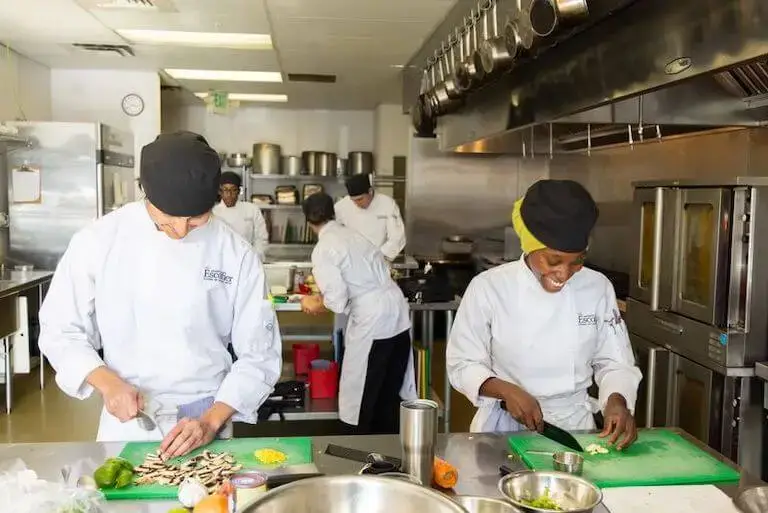
Students can build foundational techniques and confidence through hands-on training in Escoffier’s professional kitchen environments.
How Escoffier Helps Students Navigate Culinary School
Culinary school can be challenging, but you don’t have to figure it out alone. Escoffier provides support throughout the program, from Success Coaches who can help with personal obstacles to Chef Instructors with real industry experience to flexible online options if you need to keep working while you study.
The support is designed to help you navigate the difficult parts, not just provide a list of resources.
Escoffier graduate Marion Lancial explains why Escoffier was her only choice when coming from France.
Online Culinary Programs That Fit Your Schedule
Students can only succeed in culinary school if attending is realistic. For many, quitting a job or committing to an on-campus schedule Monday through Friday simply isn’t possible.
Escoffier is an accredited institution offering 100% online diplomas and degrees with culinary programs and hands-on industry externships.** These programs are designed to work with your schedule. As long as you meet program deadlines, you can complete your assignments at any time, day or night.
Live lectures provide opportunities to interact with classmates, while hands-on work remains central to the experience. Students submit photos to their Chef Instructors, documenting their process. Instructors then provide personalized feedback based on each student’s submission.
See how Escoffier helps online culinary students build confidence in tasting and evaluating their own work.
How Success Coaches Can Help Culinary Students
The culinary world benefits from a wide range of perspectives, and Escoffier students come from different countries, experience levels, economic backgrounds, and stages of life.
Some students may need additional support. Students returning to school after a long break, military veterans, and single parents may all face unique challenges as they work toward graduation.
At Escoffier, all online students have access to a Success Coach who can offer suggestions or guidance to help students meet the challenges they face during school. For example, the Success Coach could help you connect with resources in your area. Coaches have helped students find financial help and even guided them through keeping up with their academics during unexpected health or personal issues.
Success Coaches reach out early to establish a connection and remain available throughout the program. If a student appears to be struggling, the coach can step in to offer help. Students can also reach out at any time with questions or concerns. On-campus students have access to student success support as well.
Where to Turn When You Need Support
Success in the kitchen is often a collaborative effort. At Escoffier, students have access to various support resources designed to help them navigate the different types of challenges they may encounter.
| If you are struggling with… | Turn to your… | For help with… |
| Technical Skills | Chef Instructor | Refining knife cuts, understanding flavor profiles, or troubleshooting a recipe that isn’t working. |
| Life & Scheduling | Success Coach | Balancing school with a job, managing time, or finding resources for personal obstacles. |
| Costs & Funding | Financial Aid Office | Navigating FAFSA, identifying scholarship opportunities, and understanding loan options. |
| Future Employment | Career Services | Building a professional resume, preparing for interviews, and finding an industry externship. |
Chef Instructors with Real Industry Experience
Our Chef Instructors are the greatest asset to our culinary school. Their industry experience and technical expertise allow them to teach not just how to cook, but how professional kitchens actually work. They’ve been in your shoes, whether you’re learning foundational knife skills or refining advanced techniques, and can provide guidance based on actual experience.
While most instruction happens in the classroom, many Chef Instructors also make themselves available for additional questions and career-related advice. That level of access can make a meaningful difference as students build confidence and navigate challenges both in and out of school.
Boulder Culinary Arts graduate Parker Wilks-Bryant experienced this firsthand, receiving reassurance and encouragement from Chef Instructors while working through a difficult professional environment.*
The Financial Aid Office Can Help Demystify Student Loans and Tuition
Securing funding for culinary school can feel overwhelming, especially when navigating unfamiliar terms like FAFSA and the differences between subsidized and unsubsidized loans. Understanding these details is important for making informed decisions about your education.
At Escoffier, you don’t have to navigate this system alone.
Beyond explaining loan types and paperwork, staff within the Financial Aid office can also help students identify scholarships they may qualify for. Boulder Culinary Arts student Kadie Sardo connected with resources for military families this way.
“I worked with Jordan in the Financial Aid Department, who helped me get some of the scholarships I qualify for because my dad is a disabled veteran… Every time I reached out to Financial Aid, they were always super attentive to [my] questions and always responded in a timely manner,”* Sardo said.
What You Can Do to Make Culinary School Easier
Following these tips can help you get more out of your culinary education and stay confident as the pace picks up.
Always Do the Reading
Simply following the assigned recipe without reading the background material often leads to confusion. The reading explains how each step connects, so reviewing it ahead of time can help the process go more smoothly.
Come to Class Focused and Prepared
Being prepared matters in culinary school the same way it will in a professional kitchen. Being “on time” means more than walking in at the start of class. It means arriving ready to work, wearing a clean uniform, with your station set up and distractions put away.
Building these habits in culinary school can prepare you for the expectations of a professional kitchen.
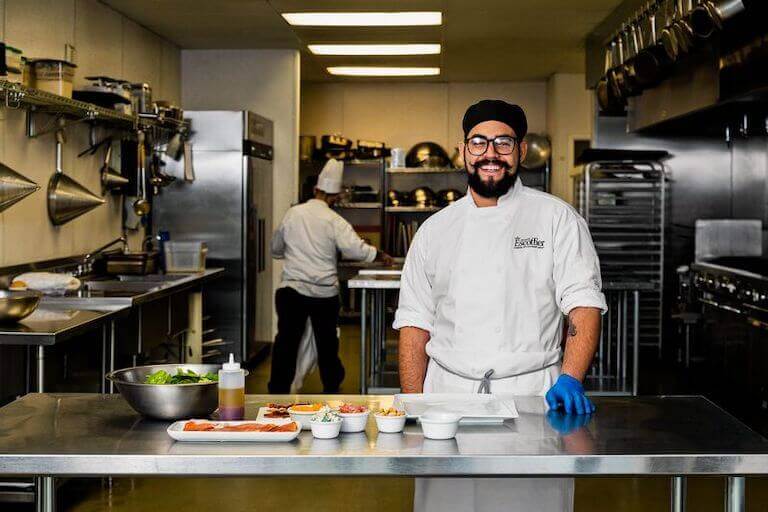
The preparation habits students can build in school—clean uniform, organized station, ready to work—are the same ones employers may look for in professional kitchens.
Take Notes
Culinary school revolves around hands-on tools like knives, pots, pans, and scales. But one of your most valuable tools is a notebook. Write down your Chef Instructor’s guidance rather than relying on memory alone.
Notes give you a personal reference you can return to long after class, especially as techniques begin to build on one another.
Ask for Help
You will rarely have as much access to experienced chefs as you do during culinary school.
If something is not working, ask questions. If your dough is not coming together, ask why. Mistakes are part of the learning process, and correction is often where the most growth happens.
You’re Ready to Meet the Challenge
Is culinary school hard? Yes. But the support systems at Escoffier are designed to help students manage the workload and get through the tough spots.
And even after graduation, students can look forward to help through Career Services, which may provide resume writing assistance, interview preparation, and industry referrals.
Explore all of the programs available at Escoffier to find the one that’s best suited for your goals. And contact our Admissions Department to get answers to your questions about what you can expect in the classroom.
WANT TO LEARN MORE ABOUT CULINARY EDUCATION? TRY THESE ARTICLES NEXT:
- How Long Does it Take to Finish Culinary School?
- Can You Become a Chef Without Going to Culinary School?
- What Are the Different Chef Certifications?
**Our Boulder, CO campus is the only accredited institution in the United States to offer both fully online diploma and degree programs nationwide with culinary classes and hands-on industry externships. We are accredited by ACCET – A Partnership for Quality. ACCET is listed by the U.S. Department of Education as a nationally recognized accrediting agency.
This article was originally published on May 4, 2022, and has since been updated.
FAQs
Culinary school may be right for anyone who wants a deeper understanding of cooking and dreams of a culinary career—whether in professional kitchens, in restaurant ownership, or in alternative careers like food photography or recipe development. It’s particularly beneficial for those who see education as an investment in their future and want to build a professional network and comprehensive skillset.
Culinary school isn’t required to become a chef, but formal training can potentially give you an edge. A culinary diploma or degree can signal to employers that you’ve invested in your craft, and can help you build foundational skills—such as knife techniques, food safety, and cost control—more efficiently than learning on the job alone. Escoffier’s culinary programs also include hands-on industry externships offering real-world experience before you graduate.
For aspiring culinary professionals, culinary school can be worth it for a variety of reasons. It offers an environment dedicated to developing culinary skills and knowledge, unlike the workplace where the pressure of service competes with learning.
A culinary education can also potentially open new career paths by demonstrating your commitment to the craft. Culinary school can provide access to industry externships and professional networks that can be difficult to build on your own.
Program length varies depending on the credential you pursue. At Escoffier, diploma programs can be completed in 30-60 weeks, while associate degree programs can be completed in 60-84 weeks. Online options may offer added flexibility for students balancing work or family commitments while completing their culinary education.
Culinary school curricula may cover foundational cooking techniques, world cuisines, food safety and sanitation, kitchen management, and business skills like cost control and food math. At Escoffier, students also complete hands-on industry externships that provide real-world experience before graduation. This combination of classroom and practical training can be difficult to replicate through on-the-job experience alone.
Most culinary schools, including Escoffier, have non-competitive admissions—meaning that, if you meet the basic requirements and demonstrate readiness to commit to your education, you can typically be admitted. This can make culinary school accessible to a range of students.
A culinary degree can lead to diverse careers including food writing, photography, styling, consulting, recipe development, nutrition, event planning, and food and beverage management. You can also pursue roles in culinary tourism, artisan food production, and food science.
Many of these positions can give you the opportunity to combine culinary knowledge with interests in business, media, health, travel, or entrepreneurship.