Listen to This Article:
The question comes up constantly in online forums, Reddit threads, and culinary school information sessions: Do I really need formal training, or can I just learn to cook from YouTube?
It’s a fair question, especially given that we live in an era of unprecedented access to culinary knowledge. You can watch dozens of videos that show Jacques Pépin break down a chicken in stunning detail. Entire channels are dedicated to French mother sauces, knife skills, and plating techniques. You can watch Michelin-starred chefs walk through their signature dishes from your couch at 2 a.m. The learning resources are there, they’re free, and they can be surprisingly comprehensive.
But if you’re considering cooking as more than a hobby, it’s worth understanding what each path actually offers.
What Self-Teaching Actually Teaches (And What It Doesn’t)
Self-directed learning can have real advantages. It’s accessible, affordable, and allows you to learn at your own pace. If you want to level up your pasta-making before moving on to proteins, you can spend three months working on fresh pasta alone, from anywhere in the world. Or if you’re curious about Thai cuisine, you can deep dive into curry pastes and fish sauce for as long as you want, without needing to move on to another technique.
For home cooks and those exploring culinary interest, YouTube and online resources can be genuinely valuable. You can develop your skills, expand your repertoire, and cook impressive meals for family and friends. Many people use self-teaching for personal enrichment with great success, and there’s nothing wrong with that approach if cooking remains a hobby rather than a profession.
But if you’re considering turning your passion into a career, some limitations of self-teaching can become more apparent.
Missing the Language of Professional Kitchens
“There are certain French terms that we use regularly, certain Italian terms that you use regularly, that somebody off the streets wouldn’t necessarily know,” says Chef Albert Schmid, Lead Chef Instructor at Auguste Escoffier School of Culinary Arts. Professional kitchens operate in this specialized language—precise measurements, standardized techniques, and terminology that signals you understand professional expectations.
Take knife cuts, for example.
“When somebody asks for a julienne, they’re looking for a very specific knife cut,” Chef Albert explains. “A quarter by a quarter by two inches, and that’s difficult to produce if you’ve never done it before. Somebody coming off the street wouldn’t necessarily be able to produce that cut.”
You can certainly look up what “julienne” means on YouTube or Google. But just as the fastest way to become fluent in a spoken language is to immerse yourself in the culture, developing true fluency in restaurant language happens most effectively through immersion in a professional kitchen environment. That means being able to execute techniques quickly, consistently, and under pressure. Knowing the definition and being able to produce it on command during a busy service are two different skills.
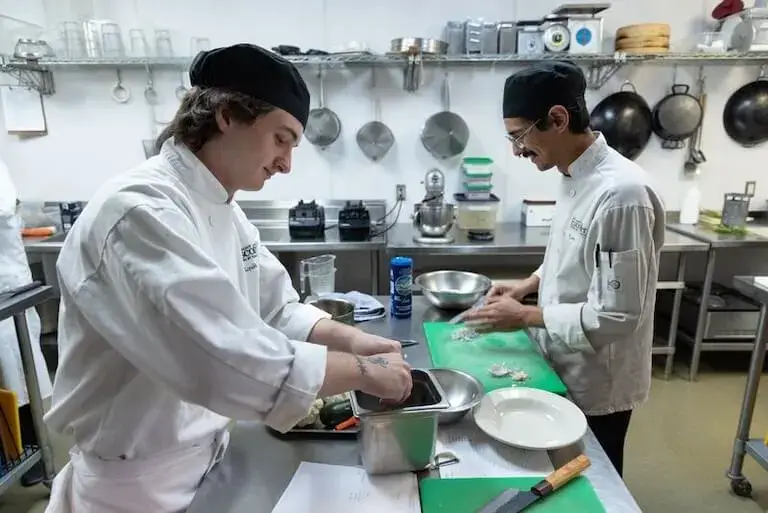
Immersing in professional kitchen environments can help students develop fluency in the language, pace, and precision required of working chefs.
Less Structured Progression
Chef Miguel Olmedo, who worked everywhere from the Queen Mary to the New York Hilton before becoming a Chef Instructor at Escoffier, emphasizes foundations.
“Students that have zero experience, I tell them to go ahead and focus on one type of cuisine for now, learn from it. And the one I tell them to focus on is French classical cuisine. That’s the basic foundation,” Chef Miguel says. “Once they learn that, it is better to understand and adapt and cook different cuisines.”
YouTube learning follows your interests, cravings, and what your algorithm serves up. One day it might be Korean fried chicken, the next might be croissants, then cacio e pepe. This freedom is wonderful for exploration, but it also means there’s no framework ensuring you’ve built competency in stocks before attempting sauces, or developed basic knife skills before complex butchery. You might become proficient at specific dishes while remaining weaker in foundational technique.
Limited Feedback
Perhaps the biggest challenge of self-teaching is learning without real-time guidance.
“We want you to make mistakes,” Chef Miguel tells his culinary arts students. “If you break a hollandaise sauce, I’m going to teach you how to fix it. Make those mistakes now so when you’re in the street, you don’t make those mistakes later.”
When relying on open-access videos alone, there’s no instructor actively helping you correct mistakes before they set in. YouTube can demonstrate outcomes, but it can’t adapt to what you’re doing, identify errors, or provide the kind of guided feedback that supports skill development.
In culinary school, instructors provide real-time correction, like spotting when you’re holding your knife at the wrong angle, when your pan isn’t hot enough, or when you’re over-mixing dough. That feedback loop is how skills can become second nature, though it’s worth noting that motivated self-learners can develop these skills over time through persistent practice and experimentation.
What Culinary School Can Offer
When people compare culinary school to YouTube, they’re often surprised to learn that cooking is only one part of what it takes to succeed as a chef.
“History, terminology, calculating COGS, profit margins, profit/loss, product waste—there’s so much more to learn than just cooking,” says Lance McWhorter, an Escoffier online culinary arts graduate.
Susan Kaiser Yurish, General Education Department Chair at Escoffier, adds: “The thing that makes me most proud of our students is their willingness to understand that the business management side of their degree is just as important as the kitchen side of their degree.”
This knowledge gap affects passionate cooks who try to turn their skills into businesses. Although you can learn how to bake some incredible pastries on YouTube, it can be harder to learn how to cost those treats, accounting for food cost, labor, overhead, and waste. Culinary school often integrates business courses within the curriculum that explain how to price menu items profitably, manage inventory, calculate par levels, and understand the margins that make or break restaurants.
“Anybody can say they are a chef,” says Tiffany Moore, an Escoffier online culinary arts graduate and military veteran. “As far as the management portion, that is where Escoffier is really helping me actually run a restaurant, run a café, or run a business. And that’s what I want. I want my own restaurant.”
Many restaurants fail within the first few years not because the food isn’t good, but because the owners struggle with food cost percentages, labor management, cash flow, or basic accounting. Formal culinary education addresses both sides: how to cook well and how to run a sustainable culinary business.
Comprehensive Skills & Palate Development
In Chef Miguel’s regional cuisine class, students can travel the globe one dish at a time.
“We start in the Midwest with meatloaf, mashed potatoes, butter green beans, and then we move to East Coast, clam chowder, low country, shrimp and grits,” he says. “We spend two days in barbecue. We spend two days in Mexico, Colombia, Ecuador, Peru, Brazil, Chile, Argentina, and then move to Germany. From Germany, we go to Spain, Italy, France, and then Northern African cuisine, Morocco, Algeria, Tunisia, Egypt. And then from there we go to the Middle East, India, China, Philippines, and then Vietnam, Korea, Thailand, and then we end in Japan.”
Many students arrive “knowing mac and cheese and chicken fingers,” as Chef Miguel puts it. “[The students] haven’t even heard of mussels or shiitake mushrooms. So they get exposed to that cuisine and they learn not just how to cook it, but what it looks like and what (those dishes) actually taste like.”
Building your palate takes more than watching videos. It comes from tasting again and again, with guidance from someone who can explain what you should notice and why. You discover not just how to make risotto, but how it should feel on the tongue and flow on the plate—where the line is between al dente and undercooked. The same goes for recognizing balanced Thai curry paste or properly spiced North African tagine. These instincts come from tasting, comparing, and learning firsthand what “right” truly tastes like.
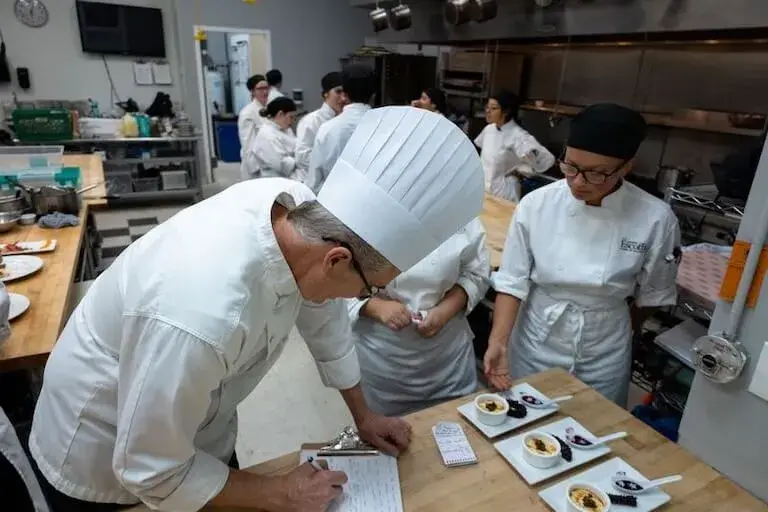
Immersing in professional kitchen environments can help students develop fluency in the language, pace, and precision required of working chefs.
Credentials and Connections
In a competitive industry, credentials and relationships made through culinary school, networking, and food events can open doors.
Before culinary school, Michael Fields worked in finance while caring for his mother, who encouraged him to pursue the cooking he’d always loved. Taking her advice, he enrolled at Escoffier’s Austin campus, determined to build a more fulfilling career. During his program, one of his Chef Instructors introduced him to world-renowned pitmaster Aaron Franklin. This connection ultimately led to a job at Franklin Barbecue.
“I’ve had people ask, did you even need to go to culinary school, because you’re doing barbecue?” Michael says. “First of all, I would never have gotten the opportunity. They would never have hired me straight off the street, ever.”*
That introduction came from the professional network he built at school, and from the dedication his instructors noticed along the way. “At Escoffier the Chef Instructors notice when you care, and you show up, and you follow the instructions,” he explains. “If you put in that effort, they go out of their way for you.”
Similarly, Katie Sualog, a Baking & Pastry graduate and mother of two, found that campus life in Austin opened doors she couldn’t have imagined. Between balancing motherhood, school, and her home bakery business, Katie still found time to volunteer at events like the Austin Food & Wine Festival, where she met chefs including James Beard Award winner Rodney Scott.
“The doors that are opened by being at the Austin campus are mind-blowing,” she says. “You get to meet with a lot of chefs that you probably wouldn’t be able to meet in your normal life. You can’t match that.”
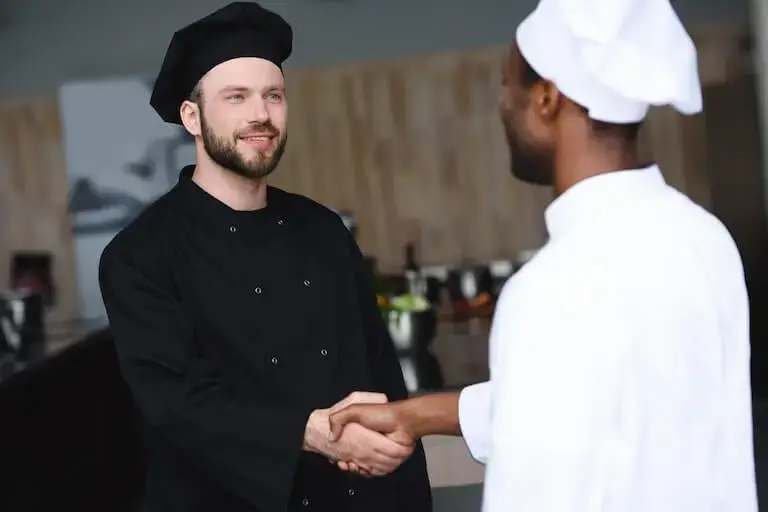
Networking and mentorship can open doors in the culinary world, connecting students with chefs and new career opportunities.
*Information may not reflect every student’s experience. Results and outcomes may be based on several factors, such as geographical region or previous experience.
When Does Each Path Make Sense?
The choice between self-teaching and culinary school isn’t really about which approach is “better,” it’s about what you’re trying to build.
Self-teaching works well if cooking is a personal passion. If you want to cook better meals for your family, explore cuisines that fascinate you, or simply enjoy the creative outlet, then YouTube and cookbooks can be excellent for this, and there’s genuine value in that journey.
But if you’re building a career, especially if you want to open your own restaurant or work in professional kitchens, the calculation changes. The business fundamentals alone make formal education worth considering. As Tiffany Moore pointed out, anyone can cook well, but understanding how to cost a menu, manage labor, and run a profitable operation requires a different kind of training.
There’s also a hybrid approach: combine self-teaching with restaurant work and eventually pursue formal education when you’re ready to level up. Chef Schmid recommends that anyone considering culinary as a profession get three to six months of restaurant experience first, as it helps you understand the industry’s demands and confirms whether that’s the right path.
For those who need flexibility, online culinary programs can bridge the gap. Kevin Fuller balanced a full-time career in fire and EMS with his schooling, often working 24- or 48-hour shifts before diving into his assignments.
“If it wasn’t for the online classes, I probably wouldn’t have ever got my certificate,” he said. “With the schedules that we have, family, balancing work and school and everything else—it made it obtainable. It really made it obtainable.”
If video-based learning appeals to you, an online culinary program can provide that format with depth and direction. The online culinary curriculum at Escoffier includes live and archived video class sessions, cooking demonstrations, reading assignments, cooking theory lessons, and hands-on cooking assignments, creating a structured learning experience that goes well beyond watching tutorials. Along the way, students receive expert feedback and graduate with credentials that carry weight in the industry.
If video-based learning appeals to you, an online culinary program can provide that format with depth and direction. The online culinary curriculum at Escoffier includes live and archived video class sessions, cooking demonstrations, reading assignments, cooking theory lessons, and hands-on cooking assignments.
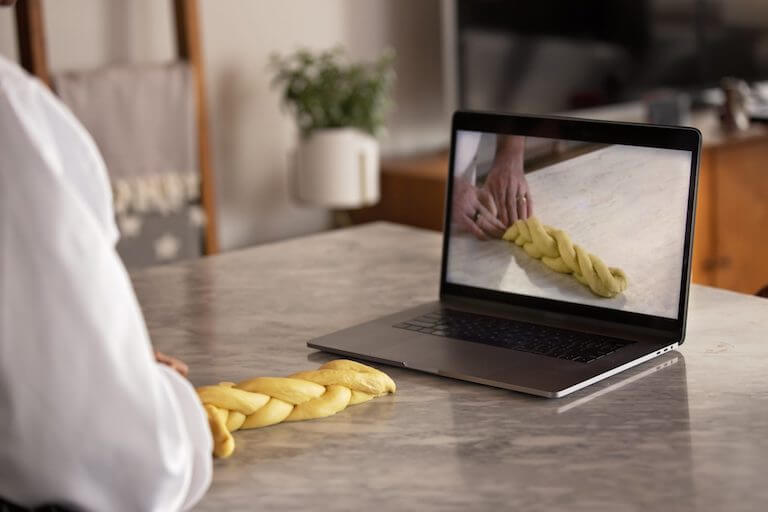
Online culinary programs offer video-based learning with structure, instructor feedback, and credentials that help turn passion into a profession.
Beyond the Recipe
Can you learn to cook from YouTube? Absolutely. Can you build a culinary career from it? That depends on your goals and circumstances. The choice isn’t simply between YouTube and culinary school. It’s about recognizing what you want to create for yourself and choosing the combination of resources that can get you there.
As Chef Miguel says, “If you’re dedicated and you’re hard at it, you get the passion, you have no idea how far you can go.”
If YouTube has sparked your passion and shown you what’s possible in the kitchen, formal culinary education can be the next step that transforms that passion into a profession. Contact us to explore culinary arts programs that build on what you’ve already learned and give you the credentials, business training, and industry connections to turn cooking into a career.