

Listen to This Article:
Every two years, the food world gathers in France for the Bocuse d’Or (pronounced “boh-KOOZ d’or”), the world’s most prestigious culinary competition. Cameras sweep across the kitchens as teams work with steady hands and practiced calm, where chefs from over 20 countries compete for a gold medal and the title of World’s Best Chef.
Behind the calm is a level of preparation that starts long before chefs ever step into the stadium. Teams train for months under pressure, testing techniques and timing until their dishes are as polished as their performance. Understanding the Bocuse d’Or—what it demands, who competes, and why it matters—offers culinary students a window into what’s possible when skill meets perseverance.
Paul Bocuse’s Legacy as a Call to Excellence
Long before the rise of celebrity chefs, there was a time when cooking wasn’t seen as a prestigious profession.
“Parents aspired for their child to be a lawyer or a doctor, but not a cook,” the legendary Jacques Pepin once said. “So we were very low on the social scale.”
Paul Bocuse, a chef whose influence still echoes through French cuisine, wanted to change that. He believed that chefs deserved the same respect given to painters, musicians, and architects, and others at the top of their creative fields.
In the 1960s and 70s, Bocuse helped usher in nouvelle cuisine, moving away from the heavy, elaborate dishes of earlier eras. His cooking celebrated clarity and lightness, letting the quality of ingredients speak for themselves. Just outside Lyon, France, his restaurant, L’Auberge du Pont de Collonges, became a symbol of that philosophy. It earned three Michelin stars in 1965 and retained them for more than half a century, continuing to operate under Bocuse’s name even after his death in 2018. The restaurant’s longevity stands as a testament to the consistency, vision, and standards that defined his work.
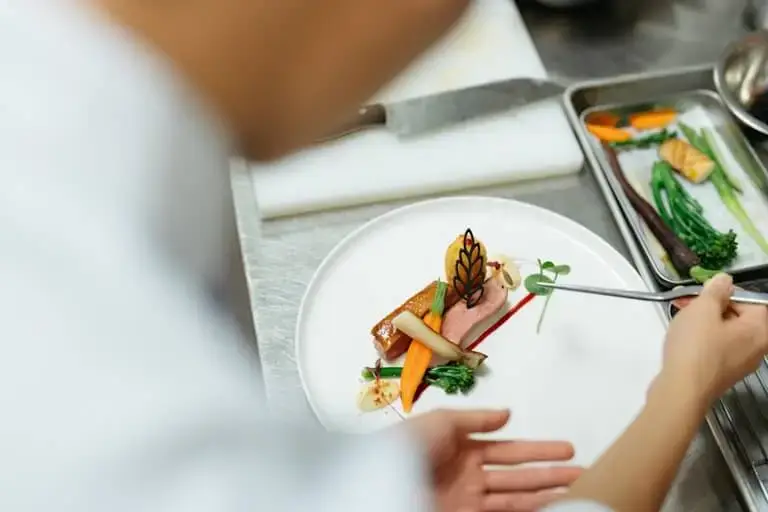
Precision has long been central to the craft Bocuse championed, where every detail on the plate reflects skill and intention.
By 1987, he wanted to create something that honored chefs at the top of their game, and on a world stage. The result was the Bocuse d’Or—”Bocuse’s Gold”—a competition built to showcase technical skill alongside the dedication, imagination, and discipline that shape a chef’s work. Rather than existing solely to crown winners, the competition was designed to inspire chefs everywhere to pursue excellence with pride.
Since then, every other year, chefs from around the world have traveled to Lyon to compete under his name. In a stadium filled with lights, cameras, and national flags, they present dishes that reflect the very principles Bocuse championed: precision, creativity, teamwork, and an unshakable commitment to excellence.
Why the Bocuse d’Or Is Considered the Peak of Culinary Skill
The Bocuse d’Or showcases what happens when foundational skills meet world-class execution. For culinary students, watching this competition reveals what excellence truly looks like.
- Technique at the Highest Level: Precision knife work, exact cooking times, advanced classical foundations, and flavor development under intense pressure define Bocuse competition.
- The Power of Teamwork in Elite Kitchens: The chef and commis relationship is critical. Communication must be flawless in high-speed environments where creativity and structure must balance perfectly.
- Creativity Under Constraints: Teams work within strict rules and required ingredients, transforming limitations into opportunities for original, thoughtful cooking.
How the Bocuse d’Or Works
Before any team steps foot in the stadium in Lyon, they first must excel at qualifying competitions. Each country first holds a national selection to choose its representative chef and commis. From there, teams compete in their continental qualifiers.
In the Americas, recent qualifiers have included teams from Guatemala, Canada, Colombia, Bolivia, Mexico, the United States, Chile, and Ecuador. In 2026, the Bocuse d’Or Americas takes place in the Ernest N. Morial New Orleans Convention Center.
Other teams advance through the European, Asia-Pacific, and African selections. Only the highest-ranking teams earn a place at the Grand Final in Lyon.

Lyon, France—the home of the Bocuse d’Or—hosts chefs from around the world every two years.
Each team is made up of just two people: the chef and the commis assistant, who must be 22 years old or younger. Finding the right commis is its own challenge.
“A commis is probably the hardest position to fill because of the age,” said Chef Stefani De Palma, who led the U.S. team to gold at the Bocuse d’Or Americas in 2024.
Because so much of a commis chef’s learning happens during the competition cycle itself, they must be able to multitask, stay organized, and handle a high-pressure environment. It is an extraordinary opportunity for young cooks to learn professional-level technique under close mentorship, but one that comes with a great deal of pressure.
As the competition cycle progresses, the chef and commis work to build a deep sense of trust. For Chef De Palma and her commis, Bradley Waddle, the preparation period between selection and competition day was about six months. During that time, the pair worked relentlessly, testing proteins, vegetables, and sauces until every element was perfect. They refined their timing down to the second. All the while, they consulted with other chefs for ideas and advice and worked with designers to transform the creative idea into a finished platter.
Their work reflects a common cadence and goal among Bocuse teams—to practice until coordination becomes second nature and both chefs can move through the kitchen as one.
Chef Stefani de Palma describes the selection process and what it means to represent the USA in the Olympics of cooking.
The Format: 5.5 Hours, Two Dishes, Infinite Pressure
Teams that excel in their continental qualifiers earn a place in Lyon, where they compete in the Bocuse d’Or Grand Final. In total, 24 teams cook in a stadium packed with lights, cameras, and supporters, where they have exactly 5 hours and 30 minutes to produce two deliverables: an individually plated dish and an elaborate grand platter showpiece.
The core dishes, themes, and required ingredients are announced well in advance, giving teams months to train, refine techniques, and rehearse timing in replica kitchens. On competition day, they execute those plans under strict conditions, often incorporating required garnishes or presentation elements that must meet detailed specifications.
Throughout the competition, two juries evaluate the teams. The Kitchen Jury assesses organization, hygiene, ingredient handling, technical execution, and waste reduction. The Tasting Jury focuses on presentation, flavor, and how each component works together on the plate. It is a comprehensive assessment of skill, creativity, and composure under pressure.
When the cooking ends, a gold medal and a 20,000-euro prize await the winning team. The financial prize is modest given the time and dedication, but earning a place at the Bocuse d’Or is widely regarded as a significant mark of achievement in the industry.
The next day, a breakfast is held at Chef Paul Bocuse’s restaurant, where a ceremony honors the top three teams by adding a plaque with their names and countries to the walkway leading into the restaurant.
How Teams Qualify for the Bocuse d’Or Grand Final
Although allocations may vary year to year, the pathway to Lyon typically follows this structure:
| Region / Category | Number of Teams Qualifying for Lyon |
| Europe | 10 teams |
| Americas | 5 teams |
| Asia-Pacific | 5 teams |
| Africa | 2 teams |
| Middle East | 1 team |
| Host Country (France) | 1 automatic spot |
| Wild Card(s) | Awarded as needed to complete the 24-team field |
| Total | 24 teams |
The U.S. Journey at Bocuse d’Or: From Underdogs to Champions
For years, the United States struggled to make its mark at the Bocuse d’Or. The competition was dominated by European teams with deep culinary traditions and government-backed training programs.
France has won the most Bocuse d’Or medals overall, with Norway close behind as a powerhouse in recent decades. Denmark, Sweden, and Switzerland have also claimed multiple podium finishes. American chefs competed, but podium finishes were rare. That began to change in 2015.
2015: Taking Home the Silver
Before competition cheffing, Chef Phillip Tessier had built his career in some of the world’s most respected kitchens, from Roger Vergé’s Le Moulin de Mougins and Eric Ripert’s Le Bernardin to Thomas Keller’s Per Se, Bouchon, and The French Laundry. Still, when he and his commis, Skylar Stover, arrived in Lyon for the 2015 Bocuse d’Or, expectations for Team USA were low.
“In 2015, we went there as total underdogs,” Tessier recalled on The Ultimate Dish podcast.
“Nobody paid attention to us. Having been involved in competition now for the better part of a decade, you realize very quickly that there are three, four, maybe five teams that everybody’s really paying attention to. At the beginning of that day, we were not one of them.”
The spotlight was on the French team. Cameras followed their every move, leaving most of the other teams to work under the radar. But as the day progressed, that changed.
“People started to realize that we had come with something quite different,” Tessier says.
The team presented a plated dish of brioche-crusted brown trout pavé and a meat platter of barrel-oak roasted guinea hen. Their technical execution was flawless, and the flavors were bold.
This boldness earned Chef Tessier and Stover the d’Argent (silver statue), marking the first time the United States placed at the competition and exceeding its previous best finish of 6th place.
When Chef Grant Achatz announced the silver medal winner, the release of emotion was overwhelming.
“For so many months, and really the whole year, just trying to push aside the pressure and focus on the task at hand, (and) when you’re finally able to let your guard down and accept what we had achieved, it was pretty extraordinary,” Chef Tessier said. “Just a flood of emotion.”
2017: Leading the Team to Gold
Two years later, Tessier was back, but this time as a coach. Head Chef Matthew Peters and commis chef Harrison Turone were competing for Team USA, and Tessier brought his 2015 experience to help guide the new team to victory.
The 2017 competition asked for a meat platter based on chicken and crayfish. Team USA presented chicken stuffed with morel sausage, foie gras, and crawfish for their platter, and California green asparagus with toasted almond custard and lemon confit for their plated dish.
After the dishes were tasted and the envelope was read, Team USA took home the gold. The win was even more special because it was the competition’s 30th anniversary. Tessier describes the achievement as reaching an extraordinarily different level of reward.
2023-2025: De Palma’s Journey to Lyon
After more than a decade at San Diego’s three Michelin star Addison, Chef Stefani De Palma stepped away in 2022 to explore new opportunities. She had joined the restaurant at 19 and moved through a wide range of positions, including pastry chef, chef de partie, chef tournant, pastry sous chef, sous chef, and eventually chef de cuisine.
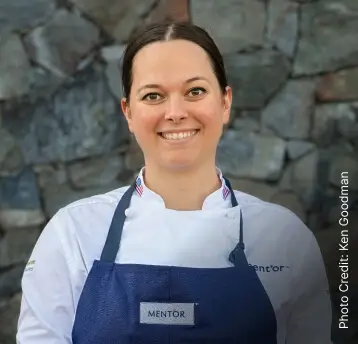
In September 2023, Chef De Palma and her commis Waddle won the first stage in the competition, the Bocuse d’Or Team USA National Selection at the Culinary Institute of America’s campus in Napa, California. This earned her the role of Head Chef for Team USA. From there, the pair began training for the Bocuse d’Or Americas regional qualifying round.
The regional competition took place in June 2024 in New Orleans, where Team USA built a menu that highlighted California ingredients while honoring Louisiana’s culinary heritage.
“American cuisine is a melting pot, so for us it was really trying to hone in on what we wanted to focus on. California ingredients—let’s speak to our regionality, give it a sense of place—and then let’s bring in some of these Southern flavors,” Chef De Palma explained.
“We incorporated smoked flavors into the wild boar to highlight some Southern barbecue. We transformed the alligator sausage into the ultimate American snack food, a little corn dog of sorts. We really just want to showcase American cuisine as best we could.”
Waiting for the results became the most nerve-racking moment of the entire experience. Team USA took gold, securing their place in the Grand Final in Lyon, held in early 2025.
“I just remember when USA was called. I heard my dad yelling on the megaphone. I saw them in the crowd. My mom’s bawling. So many tears of joy and excitement from friends and family and mentors that were all there. I think we were all just overwhelmed with emotion,” Chef De Palma recalled.
Chef Stefani de Palma shares the emotional moment her team won gold at Bocuse d’Or and her family’s proud reaction.
The 2025 Grand Final
In January 2025, Chef De Palma and Waddle joined the world’s competitors at the Bocuse d’Or Grand Final in Lyon. It was France’s Paul Marcon, though, accompanied by his commis Camille Pigot, who were crowned the winners. Denmark’s Sebastian Holberg earned silver and Sweden’s Gustav Leonhardt took bronze, continuing the Nordic countries’ tradition of excellence at the competition. Norway won the award for Best Plate, while Hungary was recognized for the Best Platter.
Team USA finished seventh, a respectable showing on the world stage and a testament to the growth of American culinary talent in international competition.
“It was an honor in itself to represent the U.S.,” Chef De Palma said. “Not many chefs get to do something like that—represent their country on a world stage.”
Why Bocuse Stories Matter for Culinary Students Today
The Bocuse d’Or represents the summit of culinary achievement, but the path to that summit is paved with the same daily habits and principles that culinary students can practice from day one.
Foundations Are Built in Culinary School
Chef De Palma describes the rhythm her team developed through months of preparation: “We got to get into a rhythm of timing and repetition and skills.”
That rhythm doesn’t start at the elite level. It starts the first time a student breaks down a chicken, makes a stock, or plates a dish for evaluation. Every repetition builds muscle memory, while every mistake can teach a lesson and every successful execution can reinforce confidence.
The habits Bocuse chefs rely on are the same ones culinary students practice daily: working clean, staying organized, tasting as you go, communicating clearly with your team, and respecting every ingredient that crosses your cutting board. Whether you’re plating for a Chef Instructor or a panel of Michelin-starred judges, the principles don’t change. The precision, consistency and care you put into a plate matters.
Opportunity Grows from Preparation
Chef Tessier’s journey to Bocuse came from years of preparation. He worked in some of the world’s best restaurants, though he never set out to compete.
“I’ve never considered myself a competition chef,” he said, “but I think when you’re put into this environment, it really pushes you to your limits.”
When he eventually stepped into the role, one thing grounded him: the caliber of the team behind him.
“I looked at the team of coaches with Grant Achatz and Dave Beran and Thomas Keller, Daniel Boulud and Gabriel Kreuther and others, and Richard Rosendale who had just competed multiple times,” he said. “I thought, ‘If I can’t do it with these guys, how are we going to do it?’”
Chef Tessier explained that the opportunity was a result of sustained commitment to his craft. “It’s one of those things that’s really hard to translate to a young chef,” he said. “That level of commitment just reaches such an extraordinarily different level of reward.”
When the opportunity to compete for Team USA came, Chef De Palma was ready not because she had trained for that specific moment, but because she had trained for excellence every single day during her time in Michelin-starred kitchens.
For students, it’s a reminder that preparation can often shape the path forward. You can’t always predict which externship will lead to a new role or which skill will become unexpectedly valuable later on. But you can stay open to learning, take feedback in stride, approach each plate with care, and meaningfully connect with mentors along the way. Small habits built now tend to matter more than they seem in the moment.
The Courage to Step Into Big Moments
Chefs Tessier and De Palma both describe the Bocuse d’Or as an experience defined by pressure. Even at the top of their craft, they felt the weight of expectation and the intensity of performing on a world stage.
“You don’t realize the weight that is on your shoulders until you allow yourself to think about it,” Chef Tessier said. His honesty shows that nerves aren’t a sign of inexperience; they’re part of being a chef who cares deeply about the work. Learning to stay focused in those moments comes from steady practice, repetition, and showing up day after day.
Chef De Palma adds a perspective that’s just as important for students stepping into their own challenges. “The most important thing for anyone is a positive attitude because you can’t teach that,” she said. “If you go in there with a positive attitude, you can learn everything else.”
For future culinarians, their stories serve as a reminder that confidence isn’t built overnight. It comes from saying yes to new tasks, working through busy services, and handling feedback with an open mind. The nerves may always be there, but so is the opportunity to trust what you’ve learned and grow through each experience.
How Culinary Students Can Watch the Bocuse d’Or
If you’re excited about watching chefs compete at the top of their game, there are several reliable ways to follow the competition online. For students, watching these events is a chance to study technique, timing, teamwork, and the standards that define professional cooking on a global stage.
- Official Livestreams: The Bocuse d’Or often broadcasts the Grand Final and continental selections on its YouTube channel, with replays available after the event.
- Bocuse d’Or Website & Social Media: Real-time updates, highlights, and behind-the-scenes clips appear on the organization’s website, Instagram, and Facebook pages.
- Team USA Coverage (Ment’or BKB): Ment’or shares training videos, streaming links, and insights from the U.S. team throughout the competition cycle.
- Industry Media: Outlets like Eater, Fine Dining Lovers, and Michelin Guide publish summaries, chef interviews, and plate breakdowns.
- Past Finals on YouTube: Archived competitions show full runs of timing, teamwork, and plating for students who want to study technique.
A Window Into What’s Possible
The Bocuse d’Or offers a clear view of what is possible when skill, preparation, and teamwork come together. Watching these chefs move through long rehearsals, tight timelines, and high expectations shows how far foundational techniques can take someone over time. For future culinarians, the value is not just in the spectacle of the competition. It is in seeing how the habits built in school kitchens and early jobs can grow into something larger. The path to Lyon begins with small, steady steps, and each plate you create becomes part of that ongoing journey toward greater skill and confidence.
If stories like these make you eager to learn, practice, and grow in the kitchen, culinary school may be a meaningful next step. Escoffier can provide hands-on training that helps future culinarians begin shaping their own careers. Contact us to find out more.