Listen to This Article:
Scroll through TikTok for five minutes and you’ll probably see at least one chef teaching you how to make pasta from scratch, another showing you their “secret” burger technique, and maybe someone turning a simple cake into an over-the-top creation layered with intricate piping, edible glitter, and dramatic final reveals.
Some of these creators have millions of followers. Some are making six figures. And some of them have never worked a single shift in a traditional restaurant kitchen.
If you’ve ever paused mid-scroll wondering whether you could build something like that yourself, you’re not alone.
In this guide, we walk you through what it can take to build a career as a food content creator, including how you can grow an audience, build a content strategy, develop the necessary skills, and turn your culinary knowledge into sustainable income.
What Is a Food Content Creator?
A “food content creator” is a culinary professional or skilled cook who shares their knowledge online. This could include teaching recipes, demonstrating skills, or reviewing food. Instead of working in a restaurant kitchen, they choose where they work and share their content on YouTube, Instagram, TikTok, blogs, and podcasts.
Some creators partner with major brands in the culinary industry. Others create their own product lines, publish cookbooks, or combine their content creation with hands-on services such as working as a personal chef.
The global culinary content creation market is estimated to reach $46.23 billion by 2032, growing at 12.5% annually. This isn’t just a side hustle anymore.
Some graduates from August Escoffier School of Culinary Arts have built careers that blend their culinary education with digital content.
Carolina Smith combined her journalism background with her nutrition certification and culinary education to partner with brands as a content creator while working as a personal chef. Amy Kimoto-Kahn also balances blogging with cookbooks and hands-on services. Chef Marion Lancial is a head chef at a restaurant while also teaching online cooking classes and creating content for her culinary podcast.
These creators found what worked for their skills, interests, and audiences. Content creation offers room for your unique approach.
How This Path Differs From Traditional Restaurant Work
Working as a content creator can come with some unique advantages that restaurant work alone isn’t able to provide. It can allow you the freedom to be your own boss, have a flexible schedule, and build multiple income streams.
But that doesn’t mean the path is easy. It requires just as much discipline, creativity, and attention to detail as any commercial kitchen. There’s no one standing over your shoulder making sure you do what you need to in order to accomplish your tasks and hit your goals.
Here’s a side-by-side look at how the two paths compare:
How Content Creation Compares to Traditional Restaurant Work
| Traditional Restaurant Role | Food Content Creator |
| Structured hierarchy (brigade system) | Independent and self-directed |
| Fixed schedule, shifts, holidays | Flexible schedule, self-managed deadlines |
| Predictable salary or hourly wage | Variable income, especially early on |
| Income tied to employer | Income tied to audience growth and diversification |
| Physical workplace environment | Home studio, on-location shoots, or hybrid work |
| Clear promotion ladder | Growth depends on brand building and entrepreneurship |
| Immediate team collaboration | More solo work, digital community engagement |
One of the biggest differences is income stability. In a commercial kitchen, you typically earn a set salary or hourly wage. According to the U.S. Bureau of Labor Statistics, the median salary for chefs and head cooks was $60,990 per year in 2024 (figures updated through Aug. 2025).
Although a content creator technically has nearly unlimited potential for earnings, you will also most likely start at $0. Even when you start earning income, it can grow slowly and fluctuate, especially in the early stages when trying to build followers.
While Ziprecruiter reports that social media influencers earn an average of $57,928 annually (as of March 2026), the numbers vary widely. Some top content creators earn millions, but many more are still building their platforms and investing time and resources before seeing any kind of consistent returns.
Earning an income as a creator is possible, but it’s not the same as finding a job that comes with a regular paycheck.
The Wide Range of Skills Needed for Culinary Content Creation
Being a chef and content creator requires multiple skill sets: culinary skills, content creation skills, and business skills.
Culinary Skills
You don’t need Michelin-star experience to start, but you should have solid cooking fundamentals, knowledge of techniques, and the ability to engage people when talking about food.
Your ability to understand and explain flavor profiles, different cooking methods, and the best way to use each ingredient matters. People may follow your content because you’re able to teach them something they didn’t know, even if you’re approaching it through the lens of sharing what you’re currently learning.
Food styling and plating can also be important skills when creating digital content. Whatever you’re making needs to look appetizing on screen, which can require different skills than used when plating at a restaurant.
A formal culinary education can help you build that foundation and credibility. At Escoffier, students can gain a versatile skill set that could translate well into non-traditional culinary roles, including content creation. Some programs are even fully online with hands-on industry externships.
Why Content Creation Can Work for Career Changers
- Flexible hours that accommodate family or other commitments
- Lower startup costs compared to opening a restaurant
- Ability to test ideas before making major investments
- Work-from-home option that eliminates commute time
- Scalable income that can grow with your audience
Content Creation Skills
If you have no interest in learning videography, photography, or digital marketing skills, this probably isn’t the avenue for you. While your culinary skills matter, it’s your ability to show them to the world that helps you build an audience.
Photography and videography basics don’t require expensive equipment initially. Many successful creators began with smartphones. But you need to understand lighting, composition, and how to frame shots that tell stories or showcase food effectively.
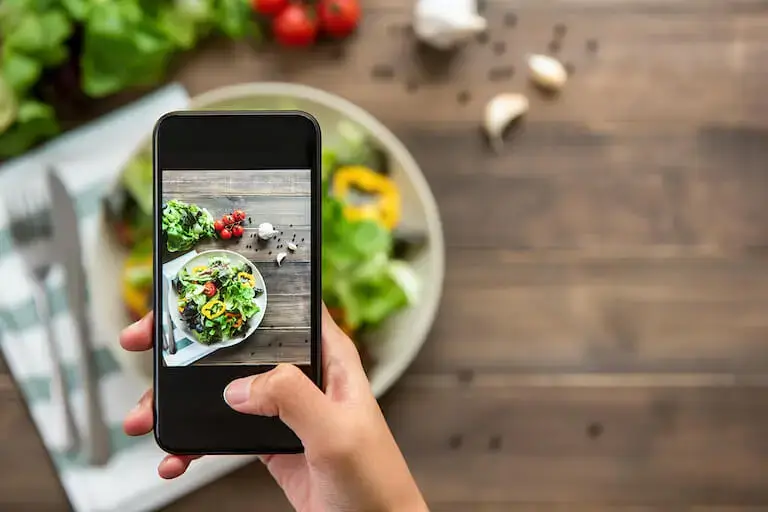
Many successful content creators start with just a smartphone, proving you don’t need expensive equipment to create engaging food content.
You don’t need to be a professional, but getting comfortable with the basics—cutting clips, adding text overlays, and balancing audio—can help you produce a much more polished final product. Fortunately, there are plenty of free and low-cost apps that make these tools accessible to everyone.
Ultimately, these technical skills serve a single purpose: helping you tell a compelling story. Even in a 30-second clip, your content needs a beginning, middle, and end. Ask yourself: Why should the viewer care? What are you showing them? What is the payoff?
While storytelling skills help you connect with your audience, business skills could turn those connections into a career.
Business and Digital Marketing Skills
Content creators are running their own businesses, so it can help to understand basic business principles like:
- Budgeting
- Pricing your services or products
- Tracking expenses
- Managing cash flow
- Negotiating contracts
- Marketing
- Analyzing reports and performance metrics
Part of the business side also involves understanding how platforms work. When you know how algorithms prioritize different types of content and engagement, you can work with them instead of against them.
Data can also guide your creative choices. Brands tracking influencer partnerships look for specific Key Performance Indicators (KPIs) including engagement rates, reach, view rates, affiliate clicks, conversion rates, and sales generated. Even if you aren’t working with brands yet, these numbers can show you which messages truly land with your audience.
Ultimately, building an online brand is about more than just posting. You’re creating an identity that builds trust. By responding to comments, engaging with other creators, and staying active in the conversation, you could turn passive viewers into a real community.

How You Can Become a Food Influencer: The Essential Guide
Passionate about both content creation and food? Uncover the secrets to carving your culinary niche, reaching your target audience, and monetizing your content in this essential guide!
A Step-by-Step Approach to Building Your Career as a Content Creator
Step 1 – Define Your Niche and Creator Identity
Before you begin sharing content with the world, it can help to get clear on two things: What do you want to talk about? Who do you want to talk to? The intersection of those two answers is your “niche”—the specific audience you’re creating for.
Marketing expert, author, and entrepreneur Seth Godin is credited with saying “When you speak to everyone, you speak to no one.” This is why defining your niche is an important step for businesses, including content creators.
Your audience and message need to align; trying to appeal to everyone usually results in connecting with no one. You need to be specific about what makes you different.
In the culinary world, that focus can take many directions. Are you helping busy parents get dinner on the table in 30 minutes? Teaching people to cook on a tight budget? Exploring your cultural cuisine? Demystifying fine dining techniques for home cooks?
Culinary Content Creator Niche Ideas
- Quick weeknight meals
- Budget cooking
- Specific dietary needs (gluten-free, vegan, keto)
- Cultural or regional cuisine
- Technique-focused instruction
- Comfort food with a twist
- Fine dining techniques for home cooks
- Sustainable cooking
- Beginner-friendly basics
Once you know what you want to say and who you want to reach, the next question is: where will you share your content?
Step 2 – Choose Your Platform and Content Format
Content creators used to go all in on one platform and build their audience there. Now, relying on a single platform can be risky. AI-powered search tools and recommendation systems are reshaping how people find content. Instead of searching for answers in a single app, online users may find recipes and how-to videos through AI platforms like ChatGPT, which draws its information from multiple platforms.
At the same time, platform algorithms change frequently, affecting reach and visibility overnight. A feature that drives growth one year may be deprioritized the next. By building a presence across more than one platform, you reduce your dependence on any single algorithm and increase the chances that your content can be discovered in multiple ways.
That said, start somewhere. Consider where your niche audience spends time and what type of content you enjoy creating.
Platform Comparison: Where Should You Start?
Food content creators primarily build their careers across three distinct platforms.
| TikTok | YouTube | ||
| Best For | Quick recipes, trends, and viral moments. | Visual storytelling and community building. | Detailed tutorials and in-depth food education. |
| Typical Audience | Primarily 18–34 (expanding across all age groups). | Broad demographic; 25–45 is the “sweet spot” | All ages; specifically education-focused viewers |
| Content Style | Short-form vertical video (15–60 seconds) | Photos, Reels, Stories, and longer video | Long-form video (5–30+ minutes) |
| Growth Potential | Fastest for new creators; algorithm-driven | Steady with consistent follower engagement | Slower start, but much stronger long-term |
| Why It Works | Pushes content to new audiences instantly | Strong for brand identity and sponsorships | Builds deep trust and higher ad revenue |
Short-Form vs. Long-Form: Matching Format to Your Teaching Style
When choosing a platform, it can also be helpful to consider how you naturally like to communicate and create.
Short-form video content (15 seconds to 3 minutes)—TikToks, Reels, YouTube Shorts—requires intentional messaging. You break ideas into key concepts and communicate them quickly with no room for rambling. This format demands fast editing, tight scripting, and strong visual hooks.
It works well if you like quick demonstrations and getting straight to the point.
Long-form video content (8 to 30+ minutes) gives you time to explain in depth. You can walk viewers through full processes, share mistakes and troubleshooting, offer substitutions, and explain the science behind a dish. This format may feel more natural if you enjoy teaching step by step or breaking down complex techniques.
Claire Saffitz built a large YouTube following with videos that often run 20 to 40 minutes and feature detailed recipe testing and technique instruction. Her approach demonstrates how long-form content can build trust and support opportunities like cookbook sales and brand partnerships.
Written blog content follows a similar distinction. Short-form posts (300 to 800 words) work for quick recipes, single technique explanations, or brief tips. Long-form posts (1,500 to 3,000+ words) allow comprehensive guides, detailed recipe development stories, or in-depth culinary education. Many successful food bloggers combine both approaches.
Choosing the right format comes down to what kind of creative process you want to maintain long-term. The format that aligns with your strengths can help keep you motivated and consistent over time.
Step 3 – Build Your Content System
Many content creators make their work look effortless. It can be easy to assume they just snapped a few photos or grabbed a quick video while cooking, but the reality is very different.
Great creators don’t just post whatever they feel like in the moment. They strategize, follow trends, and create plans. The ones who make it look effortless are often the ones who put in the most intentional work behind the scenes.
Develop Content Strategy
A content strategy is a clear plan for what you create, who it’s for, and how it supports your long-term goals. Instead of posting randomly, you decide in advance the types of content you’ll produce, how often you’ll publish, and how each piece fits into building your brand and serving your audience.
Batch creation is your friend. By setting aside specific blocks of time to create multiple pieces at once, like filming three recipe videos in one day or photographing several dishes in one shoot, you can maintain a consistent schedule even when life gets busy.
Follow trends while staying authentic. Pay attention to what’s getting traction, but don’t jump on every trend if it doesn’t fit your brand. Think of trends as a vehicle for your unique perspective, not to copy everyone else.
All of this planning and strategizing happens before you ever hit publish.
The Work Behind the Scenes
In the world of content creation, there’s a massive range in production scales; a simple one-minute clip might take ten minutes to capture, while a highly produced, edited piece can easily require a ten-hour investment.
Between planning, scripting, and setting up equipment, not to mention the hours spent editing and engaging with a community, content creation can easily be a full-time commitment. While it can be a rewarding career, it may require far more work than a quick scroll through your favorite platform might suggest. The time investment varies depending on the complexity of the project.
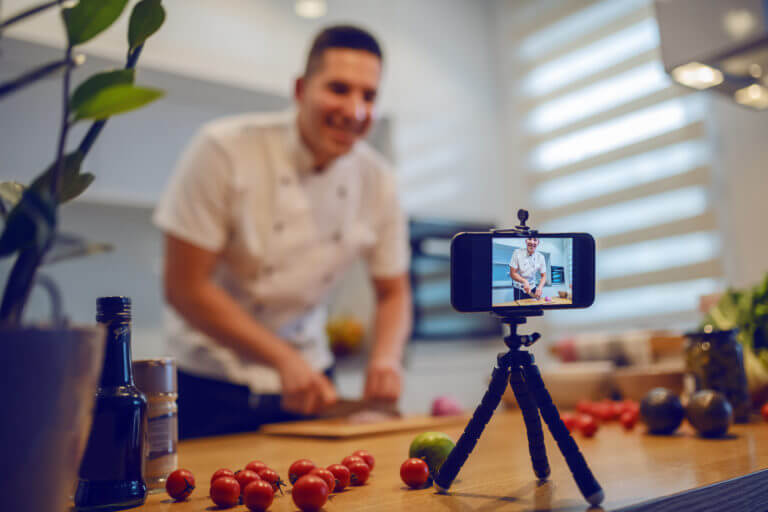
Content creators carefully plan their shots and set up equipment—work that happens behind every video you scroll past.
Consistency Matters More Than Virality
People are constantly scrolling, and if you’re not providing them with the content they want, someone else will. Building a reliable posting rhythm can help your audience know when to expect new content from you.
If people know you’re bringing them a YouTube video once a week, they’ll anticipate your content. However, posting three times a week for a short burst and then disappearing for months makes it difficult for viewers to stay engaged or invested when you eventually return. Over time, consistent showing up tends to build a stronger foundation of trust.
That doesn’t mean you need to commit to daily posts. Be realistic and start small if necessary. Choose something you can maintain as you learn, then increase when you know you can sustain it.
Establishing a content system helps get your work in front of an audience, but the production itself is often just one part of the process. The other involves cultivating genuine connections with the people who engage with what you’ve created.
Step 4 – Turn Viewers Into Community
You don’t need to go viral to grow your audience. Instead, it’s often more helpful to be clear about who you’re serving and be consistent in how you show up.
Growing an audience isn’t just about numbers; it’s about building a community that trusts you. And that trust directly impacts what becomes possible for your business.
What does that look like in practice? For some creators, audience growth means reaching enough engaged followers to attract brand partnerships. For others, it means building a loyal subscriber base for a paid newsletter, online course, or membership. If even a small percentage of your audience purchases a product, books a class, or uses your affiliate links, that can create meaningful income over time.
Knowing your goals can help you focus on the type of audience growth that matters most.
Engagement Is the Real Growth Engine
Brands and sponsors care more about engagement than follower count. Engagement includes comments, shares, saves, clicks, and meaningful interactions. A creator with 10,000 engaged followers can often be more valuable to a brand than someone with 100,000 passive ones.
That’s because engagement signals trust. It shows that your audience isn’t just watching—they’re listening, responding, and acting on what you share.
Analytics help you see what’s resonating. Every platform provides data about which content performs best. So, pay attention to view counts, engagement rates, and audience retention. These numbers show you what your audience wants more of.
Strategic creators track what resonates and adjust accordingly. For example, if a creator notices that their quick “knife skills” clips consistently get higher engagement than full recipe walkthroughs, they might build a weekly “Technique Tuesday” series around that format. If audience retention drops halfway through longer videos, they may tighten their introductions or move the most visually compelling moments to the beginning.
Strategy is about observing patterns and making intentional adjustments over time. But all the data and optimization in the world won’t matter if people don’t actually connect with you.
Building Trust Through Authenticity
Many of us have been trained to present ourselves professionally at all times. But on social media, overly polished content can sometimes feel distant.
People connect with people. They want to see your personality, hear your perspective, and understand why you care about what you’re teaching. That doesn’t mean oversharing—it means being real.
“You just have to very much be yourself—whoever that self is,” says food blogger and author Joy Wilson. “It sounds easy, it sounds simple, but I feel like it is sometimes not easy. We find ourselves on these social media platforms intaking so much of what other people have for us. That intake can affect your output. It can affect your authenticity, making you feel you have to do a certain thing, be a certain way, present yourself in a certain way. That’s just not the case. That’s not true. You can show up as you are.”*
Joy practices what she preaches. In a recent post about preparing food before her baby arrives, she writes about “cooking like someone who knows she’ll need tenderness later”—batch-making breakfast sandwiches, portioning cookie dough, and stashing soup.
Her writing has personality and vulnerability. She’s not just listing meal prep tips, she’s sharing the reality of preparing for a major life transition through the lens of food. This combination of practical advice and a genuine personal voice can help build a deeper connection, layering a relatable human element onto traditional instructional content.
Building trust often leads to deeper engagement, which in turn can open up new opportunities. Over time, these moments are what can help shift content creation from a hobby into something that can support you financially. As those possibilities grow, it also becomes more important to protect the foundation you’ve worked so hard to build.
Why You Should Own Your Audience (Email Lists + Website)
Growing a following on social media is valuable, but it’s important to remember that you don’t own those platforms. If Instagram closes, YouTube changes its algorithm dramatically, or TikTok access is restricted, your entire audience could disappear overnight if they exist only on one app.
That’s why many successful content creators focus on building assets they control. An email list gives you a direct line of communication with the people who care about your work. A website gives you a home base where your recipes, products, services, and brand live beyond any single platform.
Social media helps you get discovered and engage with your audience, but owned platforms can provide stability. Over time, having an email list and website can make it easier to launch products, promote classes, sell cookbooks, or share new opportunities without depending entirely on an algorithm.
Building a community and having a direct way to reach them creates your foundation. Once you have that in place, it can be much easier to see how all that hard work can eventually turn into a sustainable income.
Step 5 – Monetize and Diversify Revenue Streams
You may be able to make money from platforms like YouTube and TikTok once you have a large following. But multiple income streams can be smarter, more stable, and are often more lucrative.
Different income streams grow at different speeds. Ad revenue may require a large audience. Sponsorships may depend on engagement metrics. Product sales may take time to develop.
By diversifying, you can bring together different revenue streams to create more consistency. Rather than depending on just one source, you’re building layers of income that work together to support your overall goals.
Thinking about monetization early can help you approach content creation like a business rather than a hobby. It can shape how you create, who you serve, and what you eventually offer.
For example, Escoffier graduates Carolina Smith and Amy Kimoto-Kahn have collaborated as personal chefs, creating private dining experiences while also documenting elements of their work on social media. Their digital presence helps showcase their culinary style and attract clients, while their hands-on service work strengthens the credibility of their content.
Revenue Streams for Food Content Creators
To help visualize how these layers can work together, here is a look at the different stages of revenue a creator chef might explore:
| The Visibility Stage | The Collaboration Stage | The Expertise Stage | The Ownership Stage |
| Building an audience | Working with brands | Leveraging your skills | Building your assets |
| YouTube ad revenue | One-off Sponsorships | Culinary Consulting | E-books & Meal Plans |
| TikTok creator programs | Brand Ambassadorships | Speaking engagements | Self-published Cookbooks |
| Instagram bonuses | Affiliate marketing | Virtual Cooking Classes | Paid Memberships |
| Fan Tips / Subscriptions | Licensing Deals | Pop-ups or Events | Physical Product Lines |
Sponsorships and Brand Partnerships
Sponsorships involve being paid to feature a brand’s product in your content. These can be one-time collaborations or ongoing relationships.
Brands evaluate creators based on engagement, audience alignment, and demonstrated influence—not just follower count. A smaller but highly engaged audience can often be more valuable than a larger, passive one.
Don’t take sponsorships just for income if you don’t believe in the product. Your audience can tell when you’re promoting something you don’t actually use, and that breaks down trust.
Create Products to Sell
When you develop your own products, you’re building an asset that belongs to you, not an algorithm.
Digital products like e-books, meal plans, or cooking guides can be created once and sold repeatedly. Online courses teaching your expertise provide value while generating income. Merchandise—from branded aprons to kitchen tools—can work if you have a strong brand identity and an engaged community.
The key is to create products that genuinely serve your audience’s needs and align with your expertise. What problem can you solve? What do your followers keep asking about? That’s where product opportunities exist.
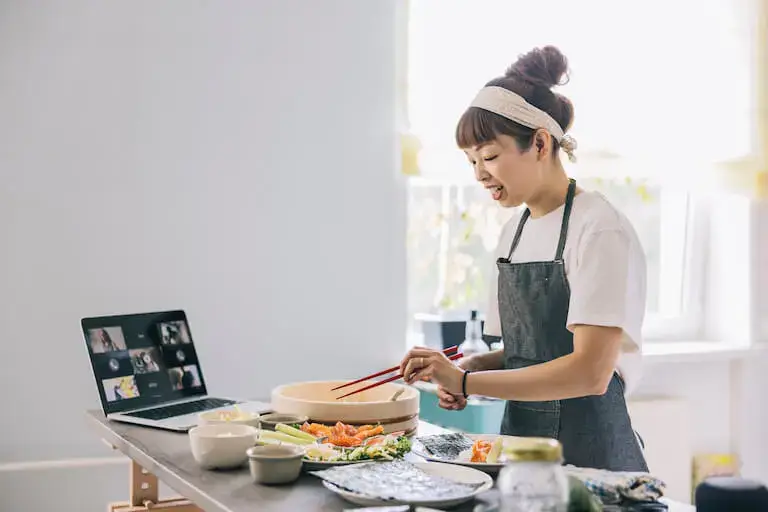
Online cooking classes are one way content creators can monetize their expertise while connecting directly with their audience.
Additional Revenue Streams
Affiliate marketing involves promoting products with tracking links. When someone purchases through your link, you earn commission. This works when you’re already recommending products you use—kitchen tools, ingredients, equipment.
Consulting opportunities can emerge as you build expertise and reputation. Other food businesses, restaurants, or aspiring creators may pay for your knowledge about content strategy, branding, or culinary expertise.
Speaking opportunities at food conferences, culinary events, or business gatherings provide both income and visibility.
Over time, some creators leverage their platforms into larger ventures such as restaurant concepts, retail product lines, or traditional media opportunities.
Step 6 – Build Systems for Long-Term Sustainability
Building an audience and earning your first sponsorship can feel exciting. But turning content creation into a long-term career requires a shift in mindset.
At some point, you have to stop thinking like someone who “posts online” and start thinking like someone who runs a business.
Thinking Like an Entrepreneur, Not a Hobbyist
Food content creators are entrepreneurs. That means your creativity is only part of the equation. The other part is decision-making.
- What are your long-term goals?
- Are you building toward brand partnerships? A cookbook? A course? A product line?
- How does the content you create today support that direction?
When you think like an owner, you plan intentionally, protect your time, and build systems instead of relying on momentum.
This doesn’t mean everything has to be perfectly mapped out from day one. But it does mean recognizing that sustainability comes from structure, not luck.
Viral moments can spark growth but systems are what sustain it.
Tracking Metrics and KPIs
Earlier, we talked about analytics in terms of content performance—views, engagement, retention. But long-term sustainability means zooming out.
What is actually generating revenue? Which platform drives the most conversions? Are certain types of posts leading to affiliate clicks, product sales, or class signups?
Business-minded creators track more than likes. They monitor:
- Conversion rates
- Revenue by income stream
- Email list growth
- Audience retention
- Cost versus return on time invested
If a product takes weeks to create but generates little interest, that’s useful information. If a simple weekly series consistently brings in affiliate income, that’s a signal worth paying attention to.
Tracking metrics isn’t about obsessing over numbers. It’s about making informed adjustments so your effort aligns with your goals.
Over time, sustainability comes from clarity about what you offer, who you serve, and what’s actually working.
Content creation can absolutely be a viable culinary career path. But like any career in food, it rewards those who combine creativity with discipline.
How Culinary Education Can Support a Digital Career
If you’re interested in the business side of content creation, Escoffier’s Food Entrepreneurship Degree and Diploma programs could help you bridge the gap between cooking and media. The coursework dives into the creative and strategic skills you may need, like social media content creation, food styling, food photography, food writing, business planning, food marketing, and branding.
How to Enroll in Escoffier: Get the Essential Guide
Attending culinary school is a major decision! In this one-stop guide to Escoffier, explore what makes our school different, programs you can study, how to enroll, pay for your education, and more!
Culinary Arts and Plant-Based programs emphasize business and entrepreneurship with courses in marketing concepts, personal branding, storytelling, technical writing, and portfolio development. Online programs can allow students to create content from their own kitchens, practicing production, editing, and real-world menu development—ideal for food bloggers, YouTubers, and content creators.
Beyond the classroom, Escoffier’s Career Services can help you navigate the business side of being a creator. From building a professional portfolio to finding roles in food media and consulting, they can help connect you with the right opportunities at the right time.
Choosing A New Kind of Culinary Career Path
Building a career as a creator chef requires a mix of culinary skill, business savvy, and a genuine connection with an audience. The discipline that once came from the brigade system now has to come from you. But for those looking for creative control and the ability to build something truly their own, this path offers a meaningful opportunity.
As you plan your next steps, it can be helpful to consider how formal training in both culinary technique and business planning might support your goals. Having a solid foundation often makes it easier to turn your unique perspective into a professional career.
Your voice, your perspective, and your approach to food could be exactly what someone out there is looking for. Contact us to find out more about how Escoffier’s programs can help you with cooking technique, content creation, business planning, and brand building.
TO LEARN MORE ABOUT BUILDING A CULINARY CAREER OUTSIDE A PROFESSIONAL KITCHEN, TRY THESE ARTICLES NEXT:
- How You Can Become a Personal or Private Chef
- How to Start a Food Business from Home
- How to Start a Food Truck
FAQs
Yes. Some students document their culinary school journey—sharing what they’re learning, practicing techniques from class, or creating content around their externship experiences. This approach lets you build your audience and portfolio while gaining formal culinary education. Just make sure to balance schoolwork with content creation so neither suffers. Remember to also follow the shareable content guidelines outlined in the student handbook.
Formal programs like Escoffier’s Food Entrepreneurship degree include structured coursework in food photography, food styling, social media strategy, and branding, skills that can take years to develop through trial and error. You also get feedback from experienced instructors and the chance to practice in a structured environment. Self-teaching is possible, but a program can accelerate your learning curve and help you avoid common beginner mistakes.
For brand partnerships and sponsored content, what matters most is your audience engagement and content quality. However, formal culinary education can strengthen your credibility, especially when teaching techniques or explaining culinary science. Some brands may prefer working with creators who have professional training because it signals reliability and expertise. A culinary degree also gives you credibility if you pivot into other food industry roles—catering, personal chef work, recipe development, or food writing.
Absolutely. Many students come to Escoffier with existing social media followings or blogs and use their education to deepen their content. Formal training fills knowledge gaps, teaches you the “why” behind techniques (not just the “how”), and can give you more credibility when explaining culinary concepts.