

Listen to This Article:
Richard Hodgkiss knows what high-pressure situations feel like. He’s navigated them in a military uniform and in the controlled chaos of an emergency room. But these days, that intensity shows up differently—in the hiss of a searing pan, the rhythmic chop of a knife, the focus required when everything has to come together at once.
For Richard, a student at Auguste Escoffier School of Culinary Arts in Boulder, Colorado, food became the thing that made sense when nothing else did. After years of service that took a heavy toll, cooking offered something his previous careers couldn’t: peace.
“At the end of the day, the one true peace language we have in this world is food,” Richard says. “You never see people — even if they don’t like each other — just fully going at each other, argumentative, over a good dinner. It’s near impossible.”
His path to culinary school wasn’t straight, and food was always somewhere in it. But it took hitting a breaking point before Richard realized that the kitchen wasn’t just another job. It was where he needed to be all along.
A Charleston Table
Growing up in the Lowcountry of Charleston, South Carolina, Richard learned early on that meals were rarely just about eating. They were events that brought people together: Frogmore stews, oyster roasts, and homemade gumbo. It wasn’t uncommon for the whole-hog smokers to be fired up by 8 a.m. in preparation for a house full of friends arriving by mid-afternoon.
He started cooking around age eight, when his parents let him help make pancakes. He experimented by adding vanilla and cinnamon, and everyone loved them.
“By about the age of 11, they let me actually start cooking on my own,” Richard says, “The first full meal I ever made was a Wiener Schnitzel with spaetzle and just a little side salad. And from then on, I was just kind of addicted to cooking.”
His early experiences cooking as a child taught him that cooking is a way to make people happy. You put food in front of someone and watch their face to see the results.
“In the South, food is our soul. It’s who we are,” Richard says. “That’s how we communicate as Southerners.”
Food shaped a big part of Richard’s childhood, but it wasn’t the only tradition that defined his family.
A Family Tradition of Service
Military service ran deep in Richard’s family. Generations of Navy sailors stretched back to the Revolutionary War, with some Army service mixed in.
“I always knew I wanted to serve in the military,” he says. “My dad served, and he still serves. And it’s been a family tradition.”
Richard joined the South Carolina Army National Guard, starting as an Apache mechanic before eventually becoming a Psychological Operations Specialist. PSYOPs, as it’s commonly called, focuses on communication and influence.

Richard Hodgkiss during his service with the Army Reserve PsyOp.
Richard enjoyed that side of the work.
The role required understanding how people think and finding ways to connect across cultures and languages to help keep villages safe. It also encouraged individual thinking, something he didn’t always see in other parts of the military.
Alongside his Guard service, Richard began working in emergency services. He performed well with the fast pace, pressure, and instant decision-making.
“I was good at it. I had a mind for medicine,” he says. “But it destroyed me.”
Burnout, PTSD, and the Only Thing That Helped
For years, Richard’s career in emergency medicine was a steady climb. He spent seven years in the field as an EMT before moving into the ER, adding phlebotomy and other credentials to his resume along the way.
By every external measure, he was progressing. But internally, he was falling apart.
“They don’t really tell you how hard it is to watch a civilian die. Someone who was just going about their day. And after seven years, the last two working in the ER, I couldn’t take it anymore,” he says.
Friends and family told Richard he should go to school to become a chef. He knew they were right, but resisted because he had invested years and money into his healthcare career. It didn’t feel logical to walk away from it all.
But the toll of the ER was becoming impossible to ignore. Richard speaks openly about his mental health: diagnoses of PTSD, bipolar disorder, and ADHD that the intensity of emergency medicine only aggravated.
The PTSD didn’t come from one catastrophic moment. It built up over years—shift after shift of watching people suffer and die, of carrying trauma he never had time to process before the next emergency came through the door. It’s the kind of toll that emergency workers carry quietly, often without the support or recognition that other forms of trauma receive.
“I’d been praying about it, and for the past two years, I’d been almost looking for an excuse to get out of healthcare,” he says. “I was miserable, everyone around me knew I was miserable, and the only time that people saw me happy was when I was cooking.”
He adds, “I was cold, I was angry, and I lost my job at the ER. And that was the best thing that ever happened to me.”
That same day, he applied to three culinary schools.
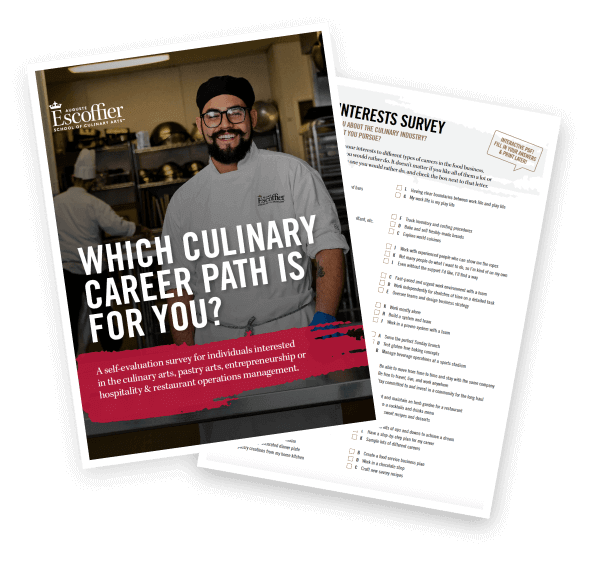
Take the Culinary Career Survey
We’ve compiled a checklist of all of the essential questions into one handy tool: career options, culinary interest surveys, educational opportunities, and more.
The Culinary Path He Was Already Walking
The decision might have seemed sudden to outsiders, but food had been part of Richard’s life for years.
His work life had been running on parallel tracks. On one side: the military and medicine. On the other: restaurants and the food industry. He had cut his teeth waiting tables at a 300-seat blue plate special.
“You’re running around with those table-size trays,” he says, “And I enjoyed it. It was fun.”
From there, Krispy Kreme, and then a farm-to-table pizzeria where he made the dough, played heavy metal in the back, and fell in love with bread. He bartended. He worked front of house and back of house.
Food was always there, woven into the margins of whatever else was happening.
Travel became another way he learned about food. Richard had been through a good stretch of Europe — England, Scotland, France, Germany, Italy — and every trip deepened his understanding of how food tastes when it’s made authentically.
In Rome, he had traditional carbonara with guanciale. The experience showed him the dish is supposed to be simple, authentic, and nothing like the versions back home. In Scotland, he tried haggis and discovered it’s actually good when made properly — a spreadable sausage, nothing like the oddly sweet version sold at Scottish games in the U.S.
In Naples, he ate at the place voted second-best pizza in the world, and while the pizza earned it, the rude staff made him question the ranking entirely. His favorite slice ended up being from a street stall down the road.
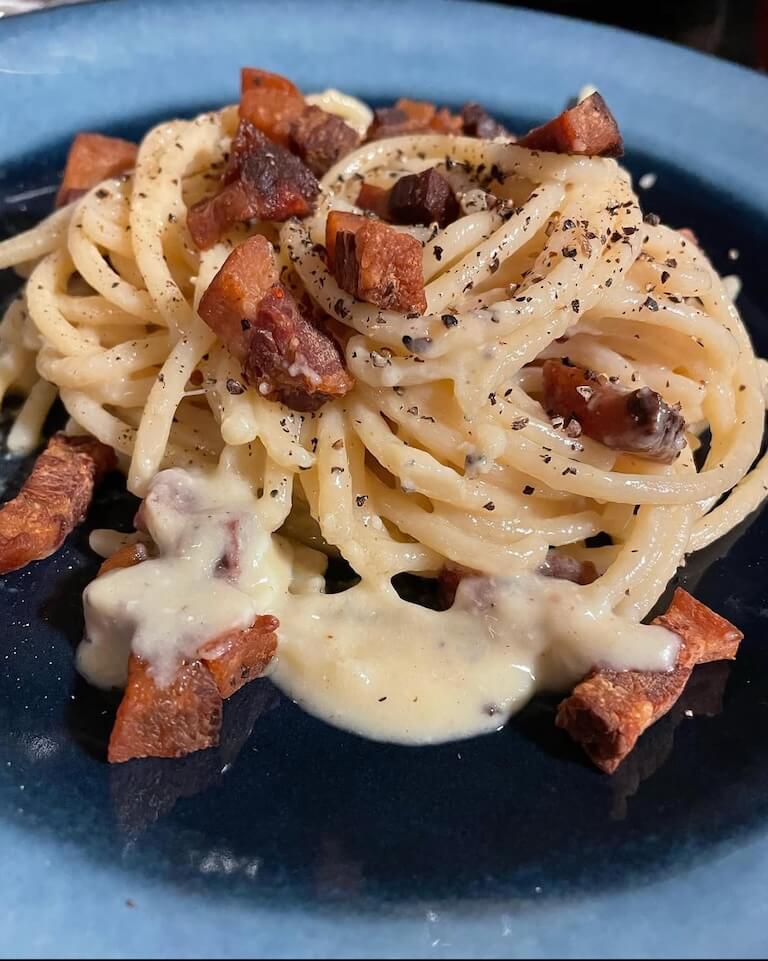
One of Richard Hodgkiss’s dishes: carbonara topped with pancetta and black pepper.
All of it—the restaurant jobs, the European travels, the growing understanding of authentic food—had been pointing him somewhere. It just took a breaking point to finally see where.
Choosing a Different Path Through Culinary School
Not long after he submitted the applications, the answers started coming in. Richard had been accepted into all three schools: Escoffier, the Culinary Institute of America, and Le Cordon Bleu in Paris.
He ended up at Escoffier’s Boulder campus for two reasons. First, while researching culinary schools, Richard heard nothing but good things about the campus. But more importantly, he received a phone call that sealed the deal.
“What really won me over was when one of our admissions reps — just an excellent guy — when I put in my application, instead of just getting an email back like every other university, he called,” Richard says. “He was like, ‘I want to interview you for this.’ It kind of made an impression on me that they wanted to actually know the potential students. And then when he explained the way the program was built and how it all works, I was like, ‘That’s the one.’ The way that they actually teach you the business side, plus the culinary.”
Richard wanted the full picture of how to run a business, not just how to cook.
A DiRoNA scholarship helped make the move financially possible. Richard sold his house, loaded his Mustang, and drove from South Carolina to Colorado to start over.
Looking back, Richard doesn’t sugarcoat the state of mind he was trying to escape.
“I was angry. I hated people. I hated everyone. I hated myself. And so I came out here and I just kind of made a promise: I’m going to be as Zen as I can be. And I do try to stick with it,” Richard says.
To anyone else considering the same leap, he’s direct: “If (cooking) is where you actually enjoy life, just do it. I’ve wasted four years of my life and mental health, killing myself in the ER, knowing that (the kitchen) is where I should have been. Don’t waste the time or the money on the therapy you’ll need later.”
Life at Escoffier — and What the Kitchen Actually Does for Him
Moving to Boulder to attend Escoffier was a fresh start. These days, that new chapter looks like early mornings, long days, and a schedule built around the kitchen.
Class starts at 6 am. After class, Richard goes straight into his federal work study shift from 11:30 a.m. to 3:30 p.m. From there, he’s either working an ambassador dinner event, picking up a shift waiting tables at a nearby senior living facility, or finally going home to rest. It’s a full schedule, built exactly the way he functions best.
For Richard, a professional kitchen provides the same mental clarity he once found in an ambulance or on a lacrosse field. He describes his ADHD as a brain that naturally runs too fast, but in high-pressure, frenetic situations—like an active shooter response or a chaotic ER shift—the noise suddenly falls away. It works the same in a busy, fast-paced kitchen environment.
“My brain goes a little too fast for its own good. And I’ve found in moments of adrenaline or even in the kitchen, everything’s clear,” he says. “I’ve got five minutes to get this dish out. Your buddy down the way accidentally burned the carrots for the dish. Now we’ve got to get that on the fly, pivot real quick. There’s no real time on the line to fully go, ‘Hmm, let me think about that.’ We’ve got to get the food out.”
Those years in the military taught him how to adjust quickly when plans change. Kitchens operate the same way — fast decisions, constant movement, and the ability to pivot when something doesn’t go as expected.
And beyond the pace of it, cooking does something else for him that nothing else has.
“Diagnosed PTSD and Bipolar Disorder, lovely things. But for me, I could be having the worst day ever, the manic energy is going through the roof, and someone just goes, ‘Hey, can you make me something?’ And it just kind of grounds me,” Richard says. “Working on the knife cuts, cooking — all the things that were bothering me are just gone. And they might come back later if it’s one of those bad days, but at least for that moment, I’m at peace.”
What Comes Next
Richard’s externship is coming up, and he’s secured a placement in Florence, Italy. After that, he plans to stay for five to ten years, cooking real Italian food, the way it’s meant to be made. After that, the plan is to bring it back home with him.
“You can’t get real Italian in the U.S., and it drives me insane,” Richard says.
His long-term vision is a farm-to-table trattoria in upstate South Carolina — a region with strong farm-to-table roots and a culture of sourcing locally.
“I just want to serve people good food,” he says.
If Everyone Were at the Table
Ask Richard what meal he’d make if he could sit down every divided group in the world and get them talking, and he doesn’t hesitate.
“It would definitely be a lot of Mediterranean and North African,” he says. “I find (with) that cuisine, generally most people are willing to eat it. Start with maybe a North African spiced salad to just get things going. Move into lamb, because that’s something that everybody can eat — it can be halal and kosher. Finding these dishes that have flavors that everybody recognizes, so they can all sit there and go, ‘Hmm, yeah, that tastes familiar.’…’ And when you start discussing something you’re agreeing on, you’re more likely to have a civil conversation.”
For Richard, that’s the whole point. Food does what emergency medicine couldn’t: it creates connection instead of crisis, offers peace instead of trauma.
He learned what food could do at a Charleston dinner table as a kid, watching people gather and settle in. He lost sight of it during years in the ER, where the work slowly destroyed him. And he found it again in the kitchen, where he finally had a way to serve people that didn’t cost him his mental health.
“The most addictive drug I’ve found in life is just sitting back and watching that soft little smile that you get from somebody when they take that first bite of a good dish,” he says.
Finding Your Own Path in the Culinary World
Richard’s journey from the ER to Escoffier shows that culinary school isn’t just for recent high school graduates or people who’ve always known they wanted to be chefs. It can be for anyone who’s realized that food is where they need to be, whether that realization comes right out of high school or after a completely different career.
His story also highlights what can make culinary education valuable beyond just learning techniques. The business knowledge, the structured externship experience, the chef instructors who’ve worked in the industry—these elements can help bridge the gap between loving to cook and building a sustainable career around it.
Ready to start your own culinary journey? Escoffier offers culinary programs designed to help students build a strong foundation in both cooking skills and kitchen operations. Whether you’re interested in restaurants, entrepreneurship, food media, or another path in the food world, Escoffier may be able to help you develop the skills and experience to move forward. Explore our programs or contact us to find out more about how to get started.