


Leaving military service can sometimes feel like stepping into uncertain territory. The structure, camaraderie, and clear mission that defined your days suddenly give way to civilian life—a transition that can feel disorienting, even when it’s welcome.
But what if your next mission could build on the discipline, teamwork, and resilience you’ve already developed?
The culinary industry can offer that opportunity. Professional kitchens can operate with military-like precision, value the same leadership qualities you’ve honed, and reward the ability to perform under pressure.
Whether you’re an experienced cook looking to formalize your skills or someone exploring culinary work for the first time, understanding the range of career paths available can help you chart a course toward a fulfilling next career.
Why Culinary Careers Can Work for Veterans
The parallels between military service and professional kitchens run deeper than you might expect. Both environments demand excellence under pressure, rely on clear hierarchies, and succeed or fail based on how well teams execute complex operations in real time.
Discipline and attention to detail are non-negotiable in both worlds; precision, consistency, and reliability come with the terrain. Mise en place—the culinary practice of having everything in its place before service—mirrors the preparedness drilled into every service member. Veterans understand that shortcuts can lead to failures.
Team coordination and leadership translate directly from military units to kitchen brigades. Auguste Escoffier, the legendary chef who revolutionized professional cooking, actually served as a military officer before establishing the brigade system that most kitchens still use today. The chain of command, the reliance on clear communication, and the understanding that everyone’s role matters—these aren’t new concepts for veterans.

Performance under pressure becomes second nature in military service, and kitchens test this ability constantly. The intensity of a Saturday night dinner rush with 200 covers requires split-second decisions that may feel familiar to those who have served. Veterans often thrive in this environment because they’ve trained to maintain composure when stakes are high.
Adaptability and problem-solving round out the skill set. Ingredients run short, equipment fails, staff call out—the ability to adjust on the fly while maintaining standards is essential. Military experience can teach you to improvise, adapt, and overcome, skills that prove invaluable when a vendor delivers the wrong cut of meat an hour before service.
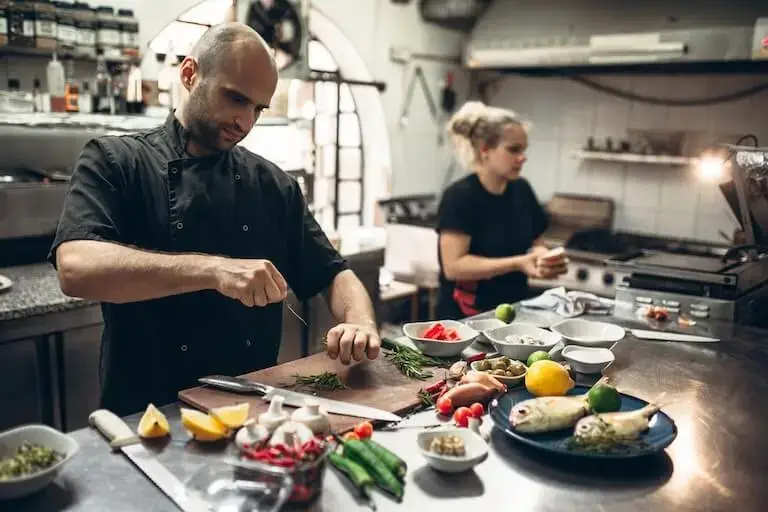
Kitchens can be fast-paced and demanding; veterans may find they have the skills to thrive in this environment.
The organizational and logistics skills developed in military service also apply directly to kitchen operations. Managing inventory, coordinating schedules, ensuring supplies arrive when needed—these are the same competencies that keep both mess halls and fine dining restaurants running smoothly.
Front-of-House Career Paths
Restaurant Management
Restaurant managers orchestrate every aspect of front-of-house operations while maintaining close coordination with kitchen teams. They handle staffing, scheduling, customer service, inventory control, and financial oversight, essentially serving as the operational commander of the dining experience.
This role leverages military leadership experience exceptionally well. Managing diverse teams, maintaining morale, handling customer conflicts with diplomacy, and ensuring every shift runs according to standard operating procedures are all likely to be familiar tasks for veterans. The ability to see the big picture while attending to operational details can make former service members natural fits for this position.
Did You Know?
A recent industry paper revealed that hospitality professionals believe veterans have the skills and traits necessary to hold a variety of hospitality positions—particularly leadership roles.
Career progression typically starts with assistant or floor manager roles, advancing to general manager positions overseeing single locations, and potentially reaching multi-unit management or regional director roles. Restaurant managers can earn median annual salaries of more than $65,000 (per the latest federal Bureau of Labor Statistics figures as of August 2025), with experienced managers at high-volume or upscale establishments potentially earning more.
The work often requires flexibility—nights, weekends, and holidays are peak times—but can offer the satisfaction of building and leading teams while directly impacting customer experiences.
For veterans who enjoyed the leadership aspects of military service more than the technical specialties, restaurant management provides a civilian equivalent where command skills may translate directly to career success.
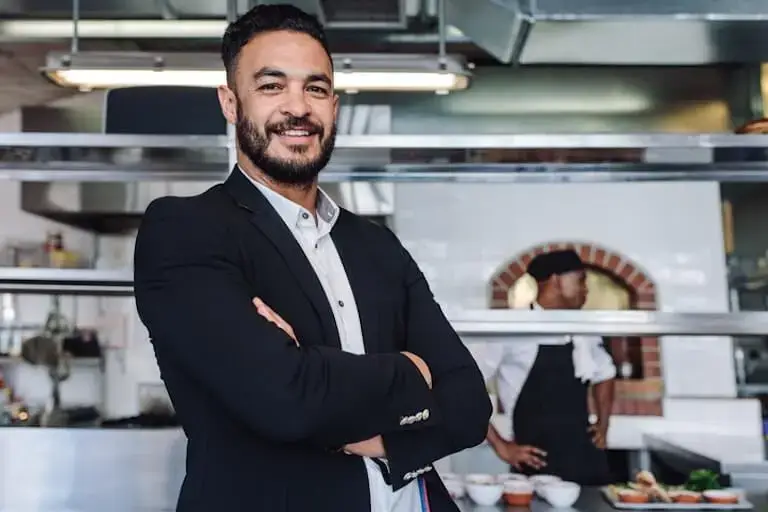
Restaurant managers are typically responsible for coordinating service between the front- and back-of-house teams.
Hospitality Operations & Hotel Food Service
Hotels, resorts, country clubs, and conference centers offer another avenue for applying military logistics and operational management skills. These establishments often operate multiple food service venues simultaneously—restaurants, banquet facilities, room service, bars—creating complex operational challenges that require systematic coordination.
Veterans can excel in these environments because the work mirrors the kind of large-scale, multi-faceted operations common in military service. You might coordinate a 500-person conference breakfast, manage room service for a 300-room hotel, and oversee a fine dining restaurant, all within the same shift.
The ability to prioritize, delegate, and maintain quality across multiple concurrent operations is exactly what military training develops.

Career paths in hospitality operations can lead to positions like Food & Beverage Director, overseeing all dining operations for a property, or Director of Catering and Events, managing the business side of large-scale functions. Salaries vary depending on property size and location, and may include additional benefits such as health insurance and retirement plans more structured than typical restaurant positions.

Hospitality operations can be a good fit for detail-oriented veterans with good customer care skills.
Hospitality sector jobs can value the professional demeanor, attention to protocol, and ability to maintain standards that veterans bring. You’re not just managing food service—you’re upholding a brand’s reputation with every interaction.
Back-of-House Career Paths
Executive Chef/Chef de Cuisine
The executive chef holds ultimate responsibility for everything that happens in a professional kitchen. This role extends far beyond cooking—it encompasses menu development, cost control, inventory management, staff hiring and training, maintaining food safety standards, and ensuring consistent quality across every plate that leaves the kitchen.
The parallels to military command are notable. An executive chef must inspire their team, maintain discipline, make critical decisions under pressure, and take responsibility for outcomes. The ability to balance creativity with operational efficiency, to lead diverse personalities toward common goals, and to maintain composure during service crashes—these are leadership competencies veterans may have already developed.
Student Stories: Lance McWhorter
Army and Navy veteran and Escoffier graduate Lance McWhorter used culinary school as a stepping stone to a rewarding career as an executive chef and restaurant owner.
Read his story
Career progression typically requires years of experience working through various kitchen positions, building both technical skills and leadership credibility. Some executive chefs spend a decade or more developing their craft before reaching this level. Executive chefs can earn median annual salaries around $60,000, with the highest earners—such as those leading kitchens at prestigious establishments or multiple locations—potentially earning nearly six figures.
For veterans, the transition to this career path might mean starting in lower positions to build culinary fundamentals, but the leadership trajectory may accelerate once your technical skills catch up with your management capabilities.
Sous Chef
The sous chef serves as second-in-command, the executive chef’s right hand in managing daily kitchen operations. This position bridges the gap between line cooks and executive leadership, requiring both strong cooking skills and supervisory capabilities.
Sous chefs manage scheduling, oversee prep work, step into any station during service, train new cooks, and often run the kitchen when the executive chef focuses on administrative duties or isn’t present. The role demands versatility; you may need to demonstrate proficiency across multiple cooking stations while managing the team executing them.
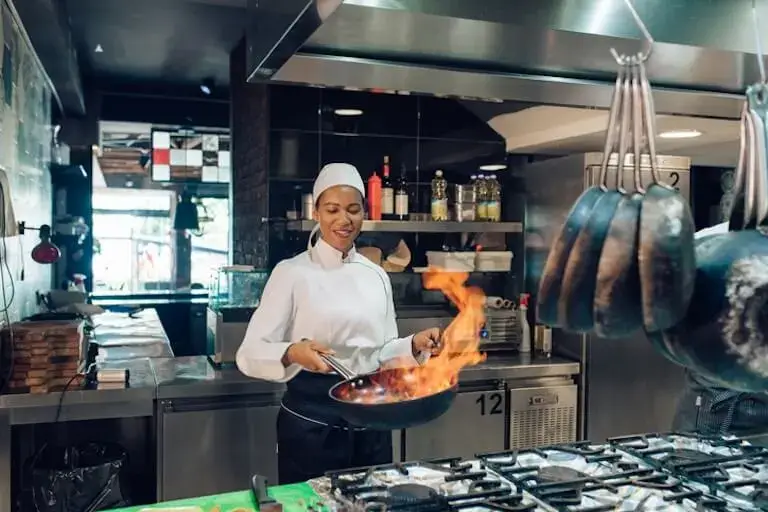
Sous chefs typically require broad culinary skills, so that they can effectively run their kitchens.
For veterans, the sous chef position can be an excellent proving ground. It provides leadership responsibility without the full burden of menu development and financial oversight that executive chefs carry. You’re essentially the kitchen’s operations officer, ensuring that the executive chef’s vision translates into consistent execution.
This role typically represents a crucial step toward executive positions; sous chefs who demonstrate both culinary competence and leadership ability often advance to chef de cuisine or executive chef roles.
Specialty Chef Positions
Specialization offers additional paths for veterans interested in developing deep expertise in particular culinary areas. For example:
- Pastry chefs create desserts, breads, and baked goods, requiring precision and consistency that appeals to detail-oriented personalities.
- Butchers break down whole animals and prepare specialty cuts, combining physical skill with deep product knowledge.
- Private and personal chefs work directly for individual clients or families, offering more control over schedules and menus.
Specialty roles can help you develop a focused skill set that commands higher compensation. A skilled butcher at a high-end steakhouse or specialty meat purveyor, for example, often becomes an invaluable asset, while private chefs can earn $80,000 or more depending on their clientele and responsibilities.
Specialization can also accelerate career growth. Rather than competing with everyone else advancing through traditional kitchen ranks, you become one of the few with expertise in a specific area. For veterans who prefer becoming technical experts over managing large teams, specialty positions can offer rewarding alternatives.
Catering & Event Management
Catering operations present unique challenges that often align well with military experience.
Large-scale events require meticulous planning, precise timing, equipment logistics, personnel coordination, and the ability to execute flawlessly in temporary or challenging environments—skills that military service often thoroughly develops.
Catering encompasses diverse opportunities: corporate events, weddings and social gatherings, institutional contracts (think feeding college campuses or business cafeterias), and even disaster relief or emergency food service. Some caterers operate from commercial kitchens—or even from their homes—and transport food to venues. Others manage on-site preparation at hotels or event spaces.

Some caterers run their operations out of their own homes — a potentially low-overhead, flexible business model.
The focus on logistics can mirror military operations. You may be responsible for calculating exact quantities for hundreds of guests, coordinating transportation and setup of equipment, managing staff working in unfamiliar environments, maintaining food safety across extended timelines, and troubleshooting inevitable last-minute changes.
Veterans often excel here because they understand operational planning—breaking complex events into manageable phases, building contingency plans, and leading teams through execution.
Alternative & Emerging Culinary Careers
Culinary Entrepreneurship
Veterans often possess many qualities that can support successful business ownership: discipline to maintain systems, ability to work independently, resilience through setbacks, and strategic thinking about operations and growth. Several culinary business models can suit these strengths particularly well.
- Food trucks may require lower startup capital than traditional restaurants while demanding the same operational discipline. You’re essentially running a compact, mobile restaurant where space efficiency, inventory management, and time management directly impact profitability. Veterans may find success in this model because it combines cooking with business management, offering independence without the up-front complexity of starting a brick-and-mortar restaurant.
- Meal prep businesses capitalize on growing demand for healthy, convenient meals. You prepare bulk meals according to customers’ dietary needs and deliver them weekly. The operation rewards systematic processes—the same meal prep, portioning, and packaging repeated efficiently. Military experience with planning, logistics, and executing repetitive tasks with precision can translate directly.
- Personal chef services offer another entrepreneurial path, providing customized meal preparation in clients’ homes. This model offers schedule control, relationship-based work, and the opportunity to build a business gradually while potentially maintaining other employment.
The military mindset—planning thoroughly, executing consistently, maintaining standards even when difficult—provides a competitive advantage in food entrepreneurship. The key is matching your business model to your strengths and realistic market opportunities.
Food Service Management in Institutions
Institutional food service—corporate dining programs, healthcare facilities, educational institutions, government facilities—can offer stability and benefits that many restaurant positions may lack. These operations often involve contracts with large organizations, creating more predictable schedules and compensation structures.
- Corporate dining programs serve employee cafeterias, executive dining rooms, and catering for company events.
- Healthcare food service provides patient meals and cafeteria operations for hospitals and nursing facilities.
- Educational dining manages everything from elementary school cafeterias to university dining halls.
- Government contracts include military bases, federal buildings, and correctional facilities.
For veterans, institutional food service represents familiar territory in many ways. You’re often working within established protocols, managing large-scale operations, maintaining strict standards (especially for healthcare food safety), and serving diverse populations—all situations that mirror military food service environments. Government contracts in particular may offer the advantage of working with familiar bureaucratic structures and procurement processes.
Culinary Education & Training
Teaching can be a natural next step for many veterans who’ve developed expertise and enjoy mentoring others. If you love to cook, culinary education may be a path worth exploring.
Culinary instructors work at various institutions—dedicated culinary schools, community colleges, high schools with culinary programs, corporate training facilities, and even as private consultants.
The role combines subject matter expertise with teaching ability. Instructors demonstrate techniques, guide students through practical exercises, evaluate their progress, and help them develop both skills and professional judgment. The structured environment, clear objectives, and opportunity to shape the next generation of culinary professionals appeals to many former service members.
Escoffier Chef Instructor Eric Jenkins understands that appeal firsthand. He served more than 24 years in the U.S. Army as a Food Service Specialist, including stints as a White House Kitchen chef, before transitioning into a civilian culinary career.
After leaving the military, Chef Jenkins used the Montgomery GI Bill to fund his education, earning both an Associate in Applied Sciences in Restaurant and Culinary Management and a Bachelor of Professional Studies in Culinary Arts Management from the Culinary Institute of America.
Today, he points to the culture of support at Escoffier as something he hasn’t experienced elsewhere.
“In every job I’ve had there’s a level of support, but it’s thin,” he said. “The corporate chef doesn’t want to teach you too much, because they don’t want you to take their job. Same in the military. Everybody’s protecting their job. There’s a brotherhood, but nobody’s trying to teach you too much. But at Escoffier, there’s always information available. I’ve just never had that kind of support.”*
*Information may not reflect every student’s experience. Results and outcomes may be based on several factors, such as geographical region or previous experience.
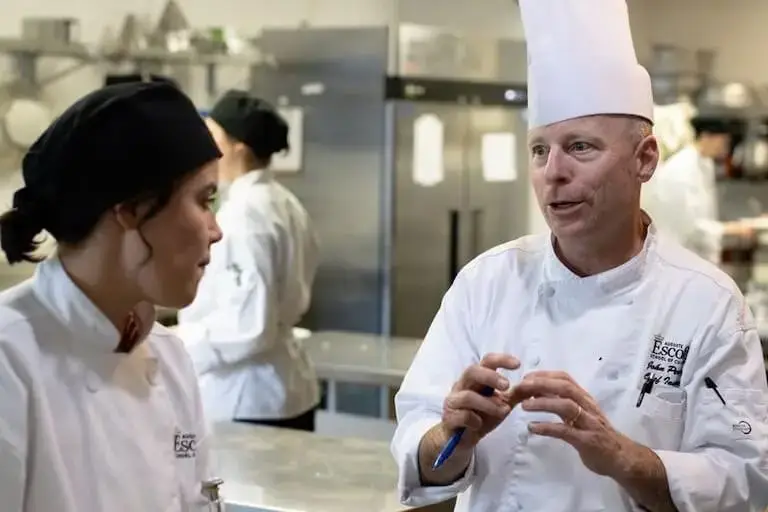
Culinary instructors are responsible for passing on knowledge to the next generation of culinary professionals.
Beyond traditional classroom teaching, consulting opportunities may exist for experienced culinary professionals. Restaurants, food manufacturers, and hospitality companies often hire consultants to develop training programs, improve operations, or solve specific challenges. This work leverages both culinary expertise and the analytical, problem-solving approach that military service develops.
Building Your Culinary Career
Gaining Skills & Credentials
As a veteran, there’s a good chance you already have many of the fundamental competencies that culinary and hospitality employers look for. But what about domain experience? Do you have the job-specific skill set that may be required for your next career?
Generally speaking, there are two paths you might follow in order to develop your industry skills: getting a culinary education, and learning on the job.
Formal culinary education can provide a structured curriculum that may cover techniques, food safety, nutrition, menu planning, cost control, and business fundamentals—a broad-based education designed to prepare students for culinary careers.
Auguste Escoffier School of Culinary Arts offers programs across a range of disciplines, including fully online options with hands-on industry externships. These flexible formats can work particularly well for veterans transitioning careers, allowing you to build skills while managing other responsibilities.

Culinary externships can give students the opportunity to gain real-world experience – and potentially make connections that could advance their careers.
On-the-job training is another common path—learning through working your way up from entry-level positions. This route can require more time to reach advanced positions, though it can also provide immediate income and practical experience from day one. Many successful chefs have taken this path, though it typically means starting at lower wages while building competency.

The decision between formal education and learn-as-you-go approaches often comes down to how quickly you want to progress and what kind of positions you’re targeting. Management and specialty positions may favor candidates with formal credentials, while line cook positions may prioritize demonstrated ability regardless of educational background.
Leveraging Military Benefits and Other Resources
Financial support for culinary education exists specifically for veterans and active-duty service members. For example:
- The GI Bill can cover tuition, housing, and other expenses for approved culinary programs.
- The Yellow Ribbon Program can help cover costs that exceed GI Bill caps at participating schools.
- Military Tuition Assistance may be available for active-duty personnel.
- The MyCAA program provides support for military spouses pursuing education and career development.
Escoffier’s Financial Aid office has experience helping veterans take advantage of the unique financial resources that may be available.
Beyond the financial aspect, Escoffier can assist students and alumni with various other career development resources, such as resume preparation, interview practice, and connecting with potential employers. Your military service may serve as a credential in itself, demonstrating the reliability and work ethic that employers value—but dedicated career support staff can potentially help you leverage that experience as you seek out the next step in your journey.
Ready to Make the Transition?
The transition from military to civilian life rarely follows a straight line, but in the culinary industry, your service experience can provide some genuine advantages. The discipline, teamwork, leadership, and ability to perform under pressure that defined your military career are often exactly what professional kitchens and hospitality operations need.
Some veterans may choose to break into the industry through employment first, developing their skills on the job. Others may pursue a culinary education, taking advantage of the opportunity for formal training and career resources to prepare for their next chapter.
Could culinary school help you get to where you want to be? Explore Escoffier’s program offerings to see whether there’s a track that could support your goals—and reach out to Admissions with any questions about how culinary education could fit into your transition plan.
You’ve already proven you can excel in a demanding role. Now it’s about finding the right place where those abilities can drive your second career forward.