
Listen to This Article:
You’ve completed your military service and are thinking about what comes next. For many veterans, that question comes with both practical considerations and a desire for work that feels structured, challenging, and meaningful.
If you’re considering culinary school, you’re not alone. Many veterans find that professional kitchens value the same skills they developed in service: discipline, teamwork, the ability to stay calm under pressure. Culinary work can be demanding, but it can also be deeply rewarding.
Whether you’re just starting to explore the idea or you’re ready to submit an application, this guide walks through the steps of enrolling at Auguste Escoffier School of Culinary Arts. From choosing a program and navigating GI Bill® benefits to gathering your application materials and completing the enrollment process, we’ll break down the process with specific considerations for veterans and active duty personnel at each stage.
Before You Apply: Choosing Your Path
Before submitting an application, take time to consider what kind of program might support your career goals. Your decision may shape not just your education, but the career path that follows.
Selecting Your Discipline
Military service develops a range of transferable skills—leadership, attention to detail, adaptability, and the ability to work under pressure. The question now is where to apply those strengths.
Think about what you want to create and where you want to lead. Do you see yourself running a restaurant kitchen? Launching a catering business? Coaching clients on nutrition? Managing hotel operations?
Escoffier offers programs across six disciplines:
- Culinary Arts – Comprehensive training in cooking techniques, sanitation, kitchen operations, and practical business skills. May prepare graduates to work as line cooks, sous chefs, or restaurant owners.
- Baking & Pastry Arts – Focused on breads, cakes, confections, and plated desserts. Emphasizes precision and technique. Graduates may pursue careers as pastry chefs, bakery owners, or cake designers.
- Plant-Based Culinary Arts – Explores ingredient substitutions, seasonal cooking, and plant-forward techniques. Can prepare students for positions in vegetarian restaurants, wellness-focused establishments, or private chef roles.
- Hospitality & Restaurant Operations Management – Develops skills in leadership, cost control, human resources, and facilities operations. May help prepare graduates for management roles in restaurants, hotels, cruise ships, and catering companies.
- Holistic Nutrition & Wellness – Combines nutrition science with coaching and culinary application. Online-only program designed for those interested in health coaching, wellness consulting, or holistic nutrition practice.
- Food Entrepreneurship – Blends culinary fundamentals with business skills like marketing, operations, and financial management. Designed for aspiring restaurant owners, food truck operators, and culinary entrepreneurs.
These six disciplines can support a wide range of career goals—from opening a wellness coaching practice to managing hotel operations to joining the kitchen brigade at a popular restaurant. The choice depends on what kind of work engages you and where you see yourself making an impact.
The Brigade System Connection
Georges Auguste Escoffier, the founder of classical French cuisine, served in the French military during the Franco-Prussian War. His experience in military structure directly influenced his development of the brigade de cuisine—the kitchen hierarchy still used in professional kitchens today.
In the kitchen brigade, orders are clear, roles are defined, and communication follows the chain of command. For many veterans, this structure feels intuitive.
Degree vs. Diploma – Which Could Work for You?
Within each discipline, you’ll typically choose between a diploma or an associate degree program. This is about aligning credentials with your timeline, budget, and how you plan to use your benefits.
Diploma programs include fewer courses, require less time to complete, and cost less than degree programs. They focus on core culinary or hospitality skills and may be ideal if you want to enter the workforce quickly.
Associate degree programs include additional general education courses—subjects like technical writing, nutrition science, or business principles—that can make you a more well-rounded professional. These programs take longer and cost more, so you’ll want to consider your schedule and confirm your GI Bill® coverage as part of your personal and financial planning.
Both credentials can be valuable. Your choice may depend on your timeline, career goals, and how you plan to use your veteran education benefits.

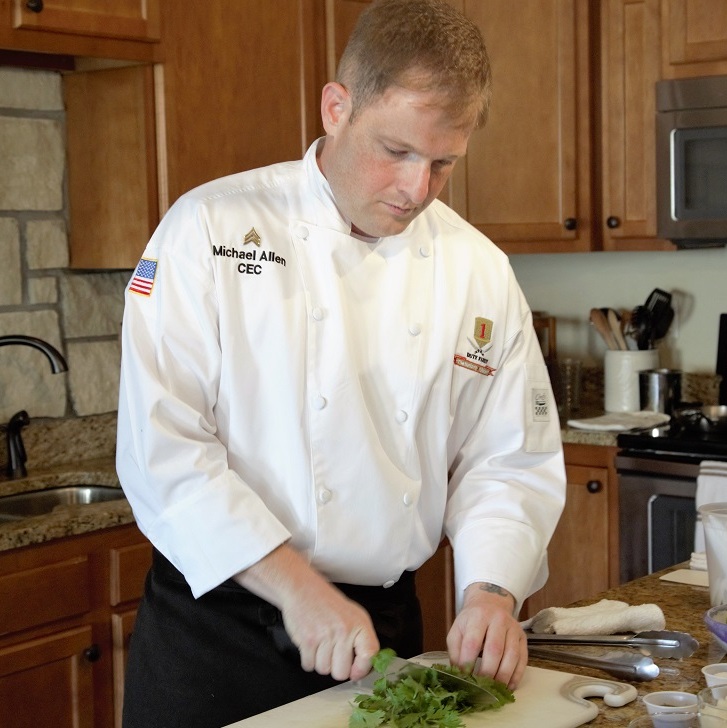
Whether you pursue a diploma or associate degree may depend on your interests and career goals.
Will You Study on Campus or Online?
Where you study can be just as important as what you study, especially when you’re balancing education with other commitments or considering relocation.
Escoffier offers programs at two campus locations and online:
Austin, Texas – Campus programs with access to experienced Chef Instructors and hands-on learning in professional kitchens. Proximity to Austin’s dynamic and growing food scene.
Boulder, Colorado – Campus programs with access to experienced Chef Instructors and hands-on learning in professional kitchens. Proximity to Colorado’s thriving restaurant, farm-to-table, and hospitality industry.
Online programs – Fully online with hands-on industry externship. Online students complete coursework remotely, then gain real-world experience through required externships that can help build professional connections and may lead to post-graduation employment opportunities. Programs typically require 15-23 hours per week depending on program, credential, and personal pace.
For active duty personnel who may be deployed or stationed away from campus locations, online programs can offer flexibility while maintaining rigorous standards. However, not all programs are available at all locations, so check with Admissions to confirm which options align with your goals.
*Information may not reflect every student’s experience. Results and outcomes may be based on several factors, such as geographical region or previous experience.
Understanding Veteran Benefits & Financial Aid
Paying for school is a legitimate concern, but as a veteran, you may have options that other students don’t. Understanding what’s available, and how to coordinate these benefits with your enrollment, can make culinary education more accessible than you might expect.
GI Bill® Overview
You earned your GI Bill® benefits; now, the question is how to use them strategically to support your educational and career goals.
Escoffier accepts multiple types of military education benefits. The most common include:
- Post-9/11 GI Bill® – Covers tuition and fees, provides a monthly housing allowance, and includes a stipend for books and supplies. Eligibility is based on length of active duty service after September 10, 2001.
- Montgomery GI Bill® – Active Duty (MGIB-AD) – Provides monthly education benefits based on length of service and contribution during active duty. Can be used for degree and diploma programs. This is a supplemental education benefit and may not cover all tuition and fee costs but can help offset education-related costs.
- Yellow Ribbon Program – A provision of the Post-9/11 GI Bill® that can help cover costs that exceed the standard benefit amount. Escoffier participates in this program for eligible students.

GI Bill benefits may be available to you depending on the nature of your service.
You can typically use only one GI Bill® benefit per service period, so choose carefully based on your eligibility and program costs. And apply early—benefit approval can take 30 days or more. You don’t want to be waiting on VA paperwork when you’re ready to start class.
For comprehensive details on eligibility, benefit amounts, and application procedures, explore Escoffier’s comprehensive GI Bill® guide.

*Information may not reflect every student’s experience. Results and outcomes may be based on several factors, such as geographical region or previous experience.
Escoffier-Specific Grants for Veterans
Beyond federal benefits, Escoffier offers institutional grants specifically for military-connected students. These can help cover costs that your GI Bill® may not fully address:
- Military Grant – Up to $1,000 for active duty service members
- Veterans Grant – Up to $1,000 for honorably discharged veterans
- Veterans Spouse/Dependent Grant – Up to $500 for spouses and dependents of veterans
- MyCAA Program – Support for military spouses pursuing career training, to be used toward Associate of Occupational Studies programs
These grants cannot be combined with other institutional scholarships, but can be applied toward any institutional expense; contact Escoffier’s Financial Aid office to explore eligibility and discuss how these grants could work alongside your potential GI Bill® benefits.
Military Friendly® School Status
For 2025-2026, Escoffier’s Boulder campus—including its online programs—has been designated a Military Friendly® School. This reflects the institution’s commitment to supporting veterans and military-connected students through dedicated resources, veteran-friendly policies, and best practices in education.
Gathering Your Application Materials
Getting your paperwork in order before you apply can save time and keep the process moving. Here’s what you may need, and how you can get it.
Proof of High School Graduation or Equivalent
Every applicant needs to prove they’ve completed high school or an equivalent program. For veterans, there’s a streamlined option that might save you some time.
DD Form 214 as Proof of Graduation
If you can’t track down your high school diploma or your school has closed, your DD-214 may work as proof of graduation, as long as it includes your high school graduation date.
To request your DD-214:
- Visit the National Archives eVetRecs system
- Submit a request for your DD Form 214 (Certificate of Release or Discharge from Active Duty)
- Allow 2-4 weeks for processing
Other Ways to Show You’ve Graduated
If your DD-214 doesn’t include graduation information, or if you’d prefer to use something else, Escoffier accepts:
- High school diploma or official transcript
- High school equivalency exam results (GED, HiSET, TASC, or HSED (for Boulder campus))
- Official college transcript showing completion of an associate or higher degree
- State-approved homeschool certificate of completion
Requirements differ slightly between Boulder and Austin campuses, so check Escoffier’s catalog or contact Escoffier Admissions about which specific documents your campus needs. For comprehensive instructions on obtaining any of these documents, reference Escoffier’s complete guide to proof of graduation.
Additional Required Documents
Beyond proof of graduation, your Admissions Advisor can provide a complete checklist tailored to your program and any campus-specific documentation. Having these ready before your interview can keep things moving smoothly.

Collecting required admissions documents ahead of time can streamline the application process.
Preparing for Your Admissions Interview
The admissions process also includes an Admissions interview, which gives you the opportunity to talk with an Escoffier representative about what you’re looking for and whether the school can help you get there. During this conversation, you’ll likely have the chance to:
- Discuss your career goals and interests
- Ask questions about programs, veteran support, and campus life
- Share your military background and how it relates to your culinary aspirations
- Receive program recommendations
You might prepare for this conversation by taking some time to reflect. What type of culinary work interests you most? What skills from your military service do you want to build on? What questions do you have about balancing school with other commitments?
Veteran Success Story
Tiffany Moore, a U.S. Army veteran, sustained a serious spinal injury during deployment and was told she’d never work in a kitchen. When the VA declined her request to attend culinary school in person, she discovered Escoffier’s online program—and graduated with honors in 2019. Read her story to see how determination and flexible education options can help veterans overcome obstacles.
Applying to Culinary School as a Veteran
Escoffier’s application process is generally the same for everyone, veteran or not. It’s straightforward, and you can access support along the way. Here’s what it looks like.
Initial Contact & Information Request
Everything starts with a simple online form. You’ll provide basic information about yourself and what you’re interested in, and a member of our Admissions team will reach out to schedule a conversation.
What to have ready: Your contact information, a general sense of which program catches your interest, and any questions you’ve been thinking about. That’s it. There’s no cost to inquire, and filling out the form doesn’t obligate you to anything.
The Initial Interview
This first conversation happens over the phone, and it may be less formal than you might expect. You’ll likely talk about where you’ve been—including your military service—and where you’re trying to go. The conversation may include your career goals, what draws you to culinary work, and what kind of program might fit your life right now.
They may also share information about the programs that might align with what you’ve described, answer your questions about veteran resources and support, and walk you through what the timeline might look like, including how long VA benefit approval typically takes and when you could realistically start classes.

The initial admissions interview is an opportunity to share your experience, goals, and concerns with an Escoffier Admissions representative.
This is also a good time to be direct about any concerns you have. Concerned about balancing school with other responsibilities? Not sure whether online or campus makes more sense? Wondering how other veterans have navigated this transition? Ask. Our Admissions team has worked with plenty of military-connected students and may be able to give you a realistic picture of what to expect.
Take notes if it helps. Ask for time to think things over if you need it. The program recommendations you hear are suggestions, not assignments. The decision is yours.

*Information may not reflect every student’s experience. Results and outcomes may be based on several factors, such as geographical region or previous experience.
Completing Your Application
Once you’re ready to move forward, you may complete the online application form. This is where things become official.
The application includes signing the Enrollment Agreement, indicating your veteran status so the school can provide appropriate support, and submitting the documents you’ve already gathered—proof of graduation and a photo ID. If your campus needs anything else, your Admissions Advisor can let you know.
There’s no application fee. After you submit everything, Escoffier reviews your materials and most applicants hear back within a few business days. Your Admissions Advisor can keep you in the loop about where things stand and what comes next.
Working with Financial Aid
While you’re completing your school application, you should also be working on your VA benefits application. These two processes run on parallel tracks, and getting them both moving early can prevent delays down the line.
Apply for VA benefits as soon as possible. Approval typically takes 30 days or more, and you’ll generally want confirmation before your start date. Once your application is approved by the VA, they will send you a Certificate of Eligibility (COE). Once this is received, please provide this to the financial aid department for your records.
Lean on Escoffier’s Financial Aid team. They know the VA paperwork, they’ve helped veterans navigate the process before, and they are available to help you understand what your aid package might look like.
Keep them informed if things slow down. If your VA benefit approval is taking longer than expected, let the Financial Aid office know. They may be able to suggest solutions or adjust timelines where possible.

Financial aid may be available that could help finance your education and open new career opportunities.
After Acceptance: Completing Enrollment
You’re accepted. Now what? Only a few more steps stand between you and your first day of class.
What Happens During Orientation
Before classes begin, new students participate in orientation. Think of this as your onboarding; it’s where you see how everything can work so you’re not figuring it out on the fly once coursework starts.
Orientation can cover how to navigate the learning platform if you’re studying online or how to find your way around campus facilities if you’re on-site. You can find out more about academic expectations, program structure, and what’s expected of you as a student. You can also get introduced to the resources available to support your success—everything from Career Services to technical support—and meet faculty and support staff who may be part of your experience.
The timing is usually close to your start date, and your Admissions Advisor can give you specific details about when and how to complete this requirement. It’s worth showing up prepared to take notes.

*Information may not reflect every student’s experience. Results and outcomes may be based on several factors, such as geographical region or previous experience.
Tools, Uniforms, and Other Necessities
Escoffier provides much of the essential culinary equipment you may need to get started, which means you’re not scrambling to figure out what to buy or where to find it.
If you’re studying on campus, you may receive a uniform. You also may get a professional toolkit with knives and other essential tools. The one thing you’ll need to purchase on your own is a pair of non-slip kitchen shoes.
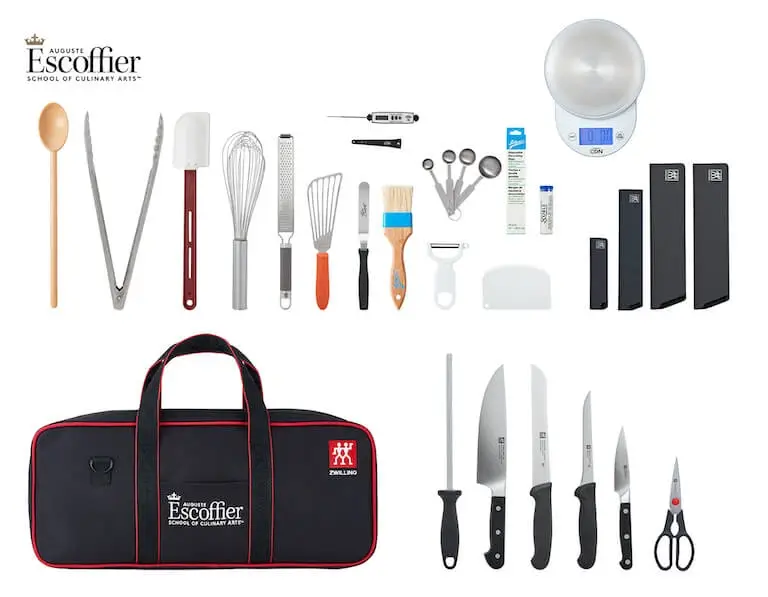
Escoffier students can receive a toolkit containing essential kitchen equipment to use during their programs.
If you’re in an online program, you may also receive a toolkit that includes utensils and tools specific to your program, as well as a chef’s uniform. Programs also require a computer with a reliable internet connection; if you don’t have a computer that meets the requirements, you can purchase a Chromebook through Escoffier. You’ll likely also want a phone or camera for documenting your food preparation—part of how online coursework gets evaluated.
Your Next Mission: From Service to Kitchen
Your military service has already developed many of the qualities that culinary professionals often value: discipline, teamwork, adaptability, and the ability to perform under pressure. The brigade system’s clear structure and the kitchen’s mission-focused environment may feel more familiar than foreign.
The application process at Escoffier can be straightforward, and support is available for veterans at every step—from navigating GI Bill® benefits to coordinating enrollment timelines. Whether you choose campus or online study, diploma or degree, you have the opportunity to find a path that can help prepare you for your next chapter.
Ready to move forward? Contact us to see what it could take to start your application.