
Listen to This Article:
Whether you’re serving on active duty, wrapping up your service, or navigating life after the military, figuring out “what comes next” can feel overwhelming. For some service members and veterans, culinary school becomes part of that answer. But showing up to campus five days a week doesn’t work for everyone—especially when you’re juggling deployments, shift work, relocations, or managing service-related injuries.
Auguste Escoffier School of Culinary Arts’ online programs can offer an alternative, with live and archive video class sessions, recorded demonstrations, reading assignments, cooking theory lessons, and hands-on cooking assignments. As long as students meet their course/program deadlines, they can complete this coursework whenever it’s convenient for them.
In this article, we walk through how Escoffier’s online format works, what veterans and active duty service members need to know before enrolling, and how VA benefits and military-specific grants may help fund your education.
Why Online Culinary Programs Can Work for Military-Connected Students
If you’re navigating deployments, shift work, or frequent moves, an online culinary education can help you work around obstacles that might derail traditional on-campus programs.
Flexible Scheduling Around Military Obligations
Escoffier’s online programs run in six-week sessions, with each week including a mix of scheduled live sessions with chef instructors and on-demand videos students can complete when their schedule allows. You’ve got course/program deadlines to hit, but you choose when to do the work.
If you get deployed or need to pause for a PCS move, you may be able to take up to 180 days of leave (split across multiple breaks if needed) and pick up where you left off.
Study from Anywhere: Base, Home, or Abroad
With online programs at Escoffier, coursework can travel with you whether you’re finishing a contract overseas, moving between duty stations, or settling into post-military life. The format is designed to work around transitions that might otherwise force you to drop out of a traditional program.
How Escoffier’s Online Format Works
Here’s what an online program at Escoffier might look like.
Weekly Course Structure
Live sessions with chef instructors typically include assignment overview, real-time Q&A, and feedback. Other coursework (like lectures, readings, assignments, and discussion boards) can be completed on your own schedule throughout the course/program.
Chef Luke explains how Escoffier’s online format works, from live sessions to hands-on kitchen assignments.
A typical week might include:
- One or two live sessions with your chef instructor
- Video demonstrations or recorded lectures covering specific techniques
- Hands-on cooking or baking assignments completed in your own kitchen
- Discussion boards where students share results, troubleshoot challenges, and engage with classmates
- Quizzes or written assignments covering theory, food safety, or business concepts
You can still get face time with instructors and classmates, but you’re not locked into someone else’s schedule for every assignment.
Understanding the Trial Period
The first three weeks of any online program at Escoffier serve as a trial period—a chance to test whether the format works with your schedule and commitments. To continue past week three, you’ll need to earn a grade of 60% or better in all registered courses, ensuring you’re set up for success.
If you’re on active duty and wondering whether culinary school fits your current schedule, this trial period can provide an opportunity to experience the workload and format before making a full commitment.
Programs Available Online
Escoffier’s online programs are available through the Boulder, Colorado, campus and offer degrees and diplomas.
Associate of Occupational Studies Degree (90 quarter credits):
- Culinary Arts
- Baking and Pastry
- Food Entrepreneurship
- Hospitality and Restaurant Operations Management
- Holistic Nutrition and Wellness
- Plant-Based Culinary Arts
Diplomas (59 quarter credits):
- Culinary Arts and Operations
- Food Entrepreneurship
- Holistic Nutrition and Wellness
- Plant-Based Culinary Arts
- Professional Pastry Arts
Programs typically take 60 weeks or longer to complete. Diploma programs can offer a shorter path if you’re focused on culinary fundamentals and entry-level roles. Associate degrees often take longer but include general education courses and can build a broader skill set.
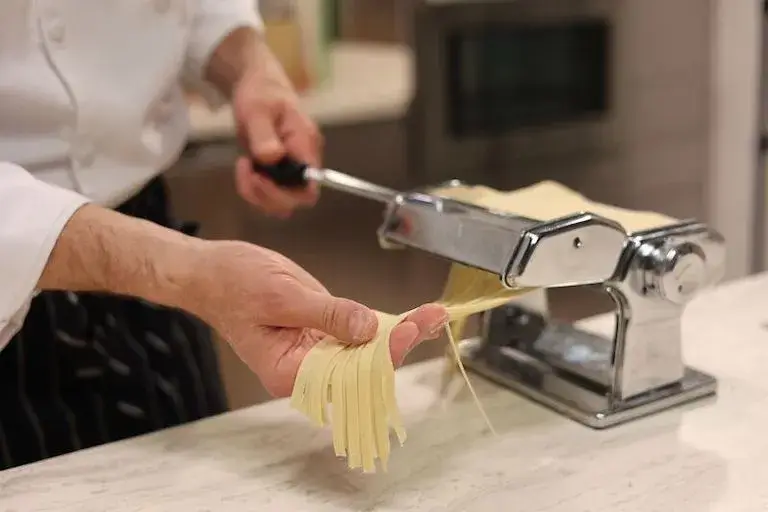
Students can practice professional techniques, such as pasta-making, through structured weekly assignments.
What Veterans Should Know Before Enrolling
Online programs can give you flexibility, but they’re not autopilot. Before you enroll, it can help to know what’s expected of you.
Attendance and Academic Requirements
Attendance means completing assignments, joining discussions, attending live sessions, and finishing your externship hours. Students typically must maintain 80% attendance throughout the program, and falling below that threshold without addressing it through an academic plan can result in dismissal.
Beyond attendance, Satisfactory Academic Progress (SAP) requirements also apply. You’ll need to maintain a minimum GPA and finish a certain percentage of your courses to stay eligible for financial aid and keep progressing through the program.
The Externship Requirement
Every Escoffier program (online or on-campus) includes an externship component. You’ll complete one to two hands-on industry externships, each 160 to 180 hours (depending on the program), working in an approved foodservice establishment.
The externship can put you in a real professional kitchen. You’ll have the chance to apply what you’ve learned in class while getting a real sense of what it’s like to work a dinner rush, coordinate with a team, and meet industry standards.
The externship can be completed near their current location. Escoffier’s externship coordinators can work with students to identify approved sites, which might include restaurants, hotels, catering companies, bakeries, or other food service operations.
If you’re moving into a civilian culinary career, the externship can help you build connections in your local food scene and test out different kitchen environments before you commit to a path.
Technology and Equipment Needs
You’ll need a desktop or laptop with reliable internet. A smartphone or tablet with a camera is also required for submitting photos of completed cooking and baking assignments.
Escoffier provides a toolkit with essential culinary tools as part of your total program cost, but you’ll still need access to a functional kitchen and basic equipment. You’ll also be responsible for purchasing ingredients.
Financial Support for Veterans and Active Duty
VA benefits and military grants can cover a big chunk, or in some cases all, of the cost of culinary school.
VA Benefits and Military Tuition Assistance
Escoffier’s Boulder campus (including all online programs) is approved by the Colorado Office of Veterans Education and Training to administer VA education benefits. If you’re a veteran, active duty servicemember, or family member, you may qualify for several programs:
Post-9/11 GI Bill (Chapter 33)
Chapter 33 may cover tuition, a monthly housing allowance, and funds for books and supplies for veterans who served at least 90 days on active duty after September 11, 2001. Benefits can also be transferred to eligible dependents.
Montgomery GI Bill Active Duty (Chapter 30)
Chapter 30 provides a monthly education payment paid directly to the student. Eligibility generally requires honorable discharge, a high school diploma or equivalent, and at least two to four years of continuous active duty service.
Yellow Ribbon Program
Veterans who qualify for 100% Post-9/11 GI Bill benefits may be eligible for this additional support. Escoffier participates in the Yellow Ribbon Program, which may help cover costs that exceed the standard GI Bill tuition cap.
Military Tuition Assistance
Active duty servicemembers in the Army, Navy, Air Force, Marine Corps, and Coast Guard (including National Guard and Reserves) may be eligible for Tuition Assistance, which can cover up to $167 per quarter credit hour. Servicemembers should check with their Education Officer to confirm eligibility and see how TA works with online programs.
Dependents Educational Assistance (DEA, Chapter 35)
Chapter 35 may be available to spouses and children of veterans who died in service, are permanently disabled due to service, or are missing in action.
MyCAA for Military Spouses
Military spouses of active duty servicemembers in specific pay grades may qualify for up to $4,000 in financial assistance through MyCAA.
A member of Escoffier’s financial aid department can walk you through the process and help you figure out which benefits you qualify for.
Escoffier Grants for Military-Connected Students
Beyond VA benefits, Escoffier offers several scholarships and grants specifically for military-connected students:
- Military Grant: Up to $1,000 for active duty servicemembers, including those in the Drilling National Guard and Drilling Reservist programs.
- Veterans Grant: Up to $1,000 for honorably discharged veterans of the U.S. Military.
- Veterans Spouse or Dependent Grant: Up to $500 for spouses and dependents of honorably discharged veterans.
- Student Veterans Scholarship: You can stack this scholarship with other institutional scholarships, but the total can’t exceed $7,500 for diploma programs or $15,000 for associate degree programs. You don’t need to complete a FAFSA to qualify, which makes it accessible for veterans who don’t qualify for need-based federal aid.
To apply, you’ll need to complete the admissions application, verify your military status, and demonstrate financial need. Keep in mind these grants can’t be combined with other institutional grants or scholarships. Escoffier’s financial aid team can walk you through which funding sources work together and help you maximize what’s available.
Military Friendly® School Designation
Escoffier’s Boulder campus, including its online programs, was recognized as a Military Friendly® School designation for 2025-2026. The designation is granted to schools that follow Department of Defense and VA best practices and stay compliant with GI Bill regulations.
Schools with this designation have systems in place to help veteran and military-connected students succeed, from financial aid to academic support.
Success Stories: Veterans Who Chose Online Culinary School
Online programs have helped veterans build culinary careers while managing military commitments. Here are three of their stories*:
Tiffany Moore: Veteran Restaurant Owner
Tiffany Moore sustained a spinal injury during a deployment in the U.S. Army that changed her life. Doctors told her she’d never be able to work in a professional kitchen.
The VA turned down Tiffany’s request to attend culinary school in person because of the physical demands of on-campus programs. But she wasn’t done yet. While scrolling social media in a VA parking lot, Tiffany discovered Escoffier’s online options. She enrolled within 48 hours.
She graduated with honors in 2019 and gave the commencement speech at Escoffier’s graduation ceremony. She now leads Lola Pecan, her upcoming farm-to-table restaurant, and has built a growing culinary brand.
Tiffany’s advice to other veterans: “Don’t stop your dreams. If you want to go back to school, go back to school. And you can definitely do that after you retire or separate from the military. Because your life does not stop.”*
Lance McWhorter: Balancing Work and School
Lance McWhorter served in both the Army and Navy before working as a firefighter, EMT, and security contractor. When he decided to pursue culinary training at age 39, Lance was already working as an executive chef.
He enrolled in Escoffier’s online program while working 80 to 100 hours per week. About a third of the way through the program, Lance moved from Central Texas to East Texas and started building a new restaurant concept: designing the kitchen, creating the menu, and preparing for opening day
“I couldn’t have [gone to culinary school] if it wasn’t online,” he says. The flexibility allowed him to continue working full-time while building culinary skills and business knowledge.
Lance now owns Heritage East at Culture ETX, has competed on Food Network’s Chopped, and won Cochon 555, a prestigious heritage pork competition.
Mason Snyder: Using GI Bill Benefits Strategically
Mason Snyder spent years as a cryptologic fusion intelligence analyst in the U.S. Air Force. After his military service, he worked as a professional rodeo athlete before deciding to pursue culinary education.
Mason used his military benefits strategically.
“My choosing Escoffier was very intentional,” he says. “I had my GI bill from the military, which is a great benefit. Anybody getting out of the military should definitely make sure they take advantage of that.”
He’s been on the reality TV show “Chefs vs Wild” (Season 1, Episode 6), and now works as Executive Chef at Bar Pazzo.
A Chef’s Perspective on Military-to-Culinary Transitions
Chef Chad White, a Navy veteran who competed on “Top Chef” and now operates Trail Feast, describes the connection between military and culinary careers: “The kitchen in general runs parallel with the military. From a brigade standpoint, a rank standpoint, discipline. You’re in a high-stress environment, a high-stress environment where things are happening around you rapidly.”
For White, attention to detail matters just as much in the kitchen as it did in the Navy. In his kitchen, he trains staff to cut tape instead of tearing it: “It’s not about how it looks; it’s about a standard,” he says. “If I can trust that you’ll cut the tape properly, I can trust that you won’t mess up a recipe that has fifteen steps to it.”
Is Online Culinary School Right for You?
Online culinary programs call for self-discipline, reliable internet, and the ability to manage your own time. But if online fits your situation, it can provide access and flexibility that works around your specific circumstances.
Online Culinary School Might Be Right for You If…
- You have unpredictable military obligations: Weekly deadlines with flexible completion times could help you work around shift changes, duty requirements, and deployments.
- You’re balancing work and school: Veterans who transition into full-time civilian jobs can complete coursework in the evenings and on weekends without commuting to campus.
- You have service-related mobility issues: Online coursework may allow you to adapt your learning setup while preparing for a range of culinary and hospitality careers—including roles beyond physically intensive kitchen work.
- You live far from Boulder or Austin: If relocating isn’t feasible, online programs provide access to Escoffier’s curriculum without the move.
Online Culinary School Might NOT Be Right for You If…
- Your internet connection is unreliable: Online programs require broadband internet for live sessions, streaming video demonstrations, and submitting assignments.
- You need daily in-person accountability: There’s no chef instructor standing next to you during lab work. You’ll need the discipline to practice techniques independently.
- You don’t have kitchen access: You’ll complete hands-on assignments in your own kitchens, which requires space and the ability to purchase ingredients and equipment.
- You prefer a fully self-paced format: Online doesn’t mean self-paced. Approximately 15-23 hours per week is spent on school related activities depending on program, credential and personal pace. As long as students meet their program deadlines, they can complete this coursework at a time when it’s convenient for them.
Take the Next Step in Your Transition
Online education can offer a way to pursue culinary training that works around active duty and veteran life. VA benefits and military-specific grants may help cover costs, and the flexible format allows you to complete coursework when your schedule permits.
Interested in Escoffier’s online programs? Start with a conversation. Contact a member of our Admissions team to talk through program options and timelines. Staff in the financial aid office can help you navigate VA benefits, verify what grants you’re eligible for, and map out how to pay for tuition.
More information about Escoffier’s programs, admissions requirements, and resources for military-connected students is available at escoffier.edu.
WANT TO FIND OUT MORE ABOUT CULINARY SCHOOL OR CAREER OPPORTUNITES FOR VETERANS? TRY THESE ARTICLES NEXT:
Military to Culinary: Why Veterans Can Excel in Professional Kitchens
How to Apply to Culinary School as a Veteran
Cowboy Chef Mason Snyder: A Journey from Rodeo Rider to Culinary Visionary