


Every chef’s journey is different—but where you choose to build your career can shape more than just your paycheck. While skill and experience matter, your location can dramatically impact your salary, lifestyle, and career trajectory.
This guide breaks down state and regional pay differences, cost-of-living impacts, and career insights to help chefs make informed decisions about where to live and work.
Quick Chef Salary Insights That May Surprise You
- Living in the right state might double your income: The average chef in Hawaii earns more than 2.5 times what a chef earns in Oklahoma ($99,520 vs. $39,130).
- But not all high-paying states stay on top: After adjusting for cost of living, Rhode Island beats Hawaii and Massachusetts for real-world chef pay.
- Chef pay is closely correlated with metro location: In Kahului, HI, chefs earn an average of $104,180, while in Manhattan, NY, average pay is $70,060.
- Cost of living changes the picture: Though a chef in Honolulu makes nearly 77% more than one in Decatur, IL, the Decatur chef’s paycheck has 30% more real spending power after adjusting for local costs.
- Some cities strike a balance: Nashville’s $67,700 average salary adjusts to $70,600 in real terms, while Cleveland’s $55,520 becomes $61,800—offering strong pay alongside affordability.
- High wages aren’t just in big cities: Nonmetro areas like West North Dakota pay chefs an average of $78,020, showing that rural or remote regions can offer competitive salaries too.
- Salary negotiation is expected: Wherever you decide to pursue a career as a chef, remember that salaries are often negotiable. 84% of employers anticipate applicants will negotiate offers, and over half intentionally leave room for negotiation in their initial salary proposals.
The Best & Worst States for Chef Pay
While skill and experience matter, where you live can significantly influence your earning potential as a chef. Some states offer average wages that exceed $99,000, while others fall below $40,000. In this section, we explore the states where chefs are earning the most—and the least—based on U.S. Bureau of Labor Statistics data.
Top 10 Highest-Paying States for Chefs
The following states report the highest average chef salaries in the country. These top-paying regions often benefit from strong economies, destination dining scenes, or a high concentration of luxury restaurants and resorts. But keep in mind: high wages frequently come with a high cost of living.
| Rank | State | Hourly Avg Wage | Annual Avg Wage | Location Quotient (LQ) |
|---|---|---|---|---|
| 1 | Hawaii (HI) | $47.84 | $99,520 | 0.83 |
| 2 | Rhode Island (RI) | $39.03 | $81,190 | 0.90 |
| 3 | Massachusetts (MA) | $37.08 | $77,120 | 1.08 |
| 4 | District of Columbia (DC) | $36.31 | $75,520 | 2.22 |
| 5 | New Jersey (NJ) | $34.18 | $71,100 | 1.33 |
| 6 | North Dakota (ND) | $34.10 | $70,920 | 0.26 |
| 7 | Arizona (AZ) | $33.72 | $70,130 | 0.73 |
| 8 | Colorado (CO) | $33.71 | $70,130 | 1.30 |
| 9 | New York (NY) | $32.89 | $68,410 | 1.28 |
| 10 | Washington (WA) | $32.39 | $67,360 | 1.13 |
(Source: “Occupational Employment and Wage Statistics,” U.S. Bureau of Labor Statistics: HI, RI, MA, DC, NJ, ND, AZ, CO, NY, WA)
Hawaii tops the list with average chef salaries approaching six figures, thanks in part to its tourism-driven economy. Other strong performers like Rhode Island, Massachusetts, and the District of Columbia benefit from dense urban dining ecosystems and institutional demand. Interestingly, several high-paying states—like North Dakota and Arizona—have relatively low location quotients (LQ), suggesting that in markets where trained chefs are scarce, wages may rise to attract talent.
What is a Location Quotient?
Location Quotient (LQ) reflects how concentrated a job is in a given state compared to the national average (LQ = 1). A higher LQ signals stronger presence or demand for chefs; lower values often suggest fewer roles overall, but potentially higher competition for available talent.
10 States with the Lowest Average Chef Pay
Not every state offers lucrative pay for chefs. In regions with less tourism, more casual dining, or a surplus of culinary labor, average wages tend to lag behind. In some cases, chefs in these states earn, on average, less than half of what their peers make in top-paying states.
| State | Hourly Avg Wage | Annual Avg Wage | Location Quotient (LQ) |
|---|---|---|---|
| Oklahoma (OK) | $18.81 | $39,130 | 0.897 |
| Iowa (IA) | $22.20 | $46,180 | 0.90 |
| Kentucky (KY) | $22.73 | $47,280 | 0.92 |
| South Dakota (SD) | $23.56 | $47,840 | 0.31 |
| Idaho (ID) | $23.56 | $48,010 | 0.57 |
| Louisiana (LA) | $23.52 | $48,930 | 0.84 |
| Mississippi (MS) | $24.92 | $51,830 | 0.54 |
| Montana (MT) | $25.50 | $53,040 | 0.93 |
| Texas (TX) | $25.46 | $52,950 | 0.89 |
| Ohio (OH) | $25.87 | $53,800 | 0.72 |
(Source: “Occupational Employment and Wage Statistics,” U.S. Bureau of Labor Statistics: OK, IA, KY, SD, ID, LA, MS, MT, TX, OH)
The lowest-paying states in the country range from Oklahoma and Iowa to Montana and Texas, with annual averages between $39,000 and $53,800. Several of these states also show very low LQs (e.g., South Dakota at 0.31 and Idaho at 0.57), which indicates that chefs are underrepresented in the labor force. While this might suggest fewer opportunities, it can also signal an opening for experienced professionals to fill niche needs in healthcare, institutional kitchens, or emerging restaurant scenes—especially in underserved rural areas.
U.S. Map: Annual Mean Wages by State
To help visualize the national picture, the map below highlights the average annual wage of chefs and head cooks by state. Darker shades indicate higher average wages, while lighter regions reflect lower-paying states.
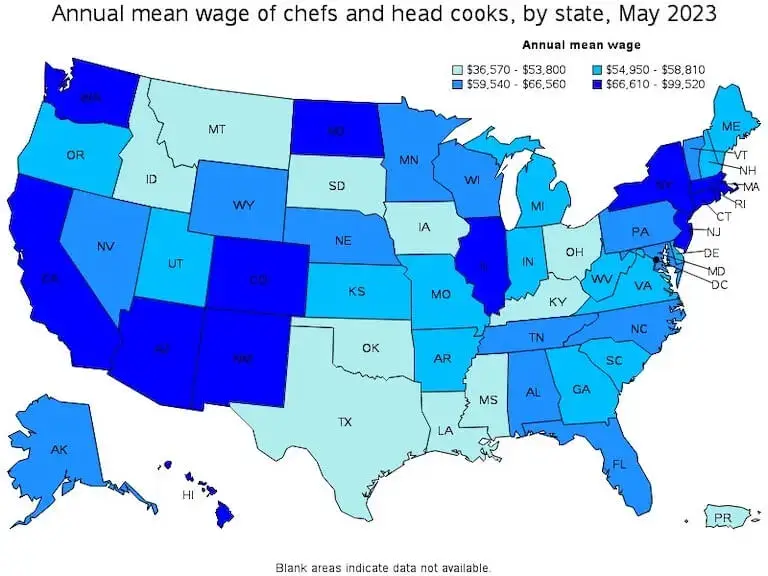
(Source: “Occupational Employment and Wage Statistics,” U.S. Bureau of Labor Statistics)
Of course, a six-figure salary in Hawaii or New York might not stretch as far as you think. That’s why it’s essential to compare raw wages against local cost of living. In the next section, we’ll look at how much chef salaries are really worth after adjusting for rent, groceries, and day-to-day expenses. This more nuanced information could help you make smarter decisions about where to build your culinary career.
Cost of Living & Wage Adjustments
When evaluating chef salaries, it’s not just about the paycheck—it’s about how far that paycheck stretches. A six-figure income might feel generous in one state but barely cover basic expenses in another. That’s where the Cost of Living Index (COLI) comes in.
COLI compares the average cost of living in each state (or city) to the national average, which is set at 100. The higher the index, the more expensive it is to live there. Understanding this index helps you determine how much buying power your salary actually provides.
Tip: How to Calculate Your COLI-Adjusted Salary
Use this formula to estimate real-world earning power:
COLI-adjusted salary = (Salary ÷ COLI) × 100
Example:
If you earn $50,000 in an area with a COLI of 125:
(50,000 ÷ 125) × 100 = $40,000
Your salary would feel like $40,000 in an average-cost area.
Top 10 States by COLI-Adjusted Chef Salary
Some states with modest average salaries end up offering better spending power than their high-paying counterparts, once cost of living is factored in.
Below are the 10 U.S. states where chefs enjoy the strongest COLI-adjusted salaries through the first quarter of 2025:
Top 10 States by COLI-Adjusted Chef Salary, through Q1 2025
| State | Unadjusted Salary | COLI | COLI-Adjusted Salary |
|---|---|---|---|
| North Dakota | $70,920 | 90.8 | $78,106 |
| Rhode Island | $81,190 | 109.3 | $74,282 |
| New Mexico | $66,610 | 94.2 | $70,711 |
| Illinois | $66,610 | 94.7 | $70,338 |
| Colorado | $70,130 | 104.0 | $67,433 |
| Ohio | $53,800 | 95.1 | $56,556 |
| Texas | $52,950 | 91.8 | $57,687 |
| Montana | $53,040 | 96.4 | $55,033 |
| Kentucky | $47,280 | 91.7 | $51,549 |
| Louisiana | $48,930 | 93.2 | $52,481 |
(Source: “Cost of Living Data Series,” Missouri Economic Research and Information Center)
These numbers offer a more realistic picture of where your culinary career might stretch furthest, especially if affordability and quality of life are key priorities.
What About the Nominally Highest Paying States?
Some states appear at the top of the raw salary list—but how do they hold up after cost-of-living adjustments? Here’s how the top 3 highest-paying states on paper compare when adjusted for COLI:
Top 3 Highest-Paying States (COLI-Adjusted)
| State | Unadjusted Salary | COLI | COLI-Adjusted Salary |
|---|---|---|---|
| Rhode Island | $81,190 | 109.3 | $74,282 |
| Massachusetts | $77,120 | 145.1 | $53,150 |
| Hawaii | $99,520 | 182.3 | $54,591 |
(Source: “Cost of Living Data Series,” Missouri Economic Research and Information Center)
Even though Hawaii and Massachusetts boast high unadjusted salaries, their high costs of living significantly reduce take-home purchasing power. Rhode Island, by contrast, offers a better blend of strong wages and more manageable living expenses.
Regional Differences Within States Matter Too
While these state-level comparisons are helpful, they don’t tell the whole story. In reality, cost of living can vary dramatically within the same state.
Cost of Living Comparison: Dallas vs. Manhattan
A $30,000 salary in Dallas, TX has the same purchasing power as $66,868 in Manhattan, NY—a 123% cost difference, largely due to housing, but also food, transportation, and healthcare.
(Source: “Cost of living calculator,” Nerdwallet)
Comparing the Cost of Living in Several U.S. Cities
For a closer look, here’s how chef salaries compare across select metro areas, once adjusted for local COLI:
Chef Salaries vs. Cost of Living in Select Cities
| City | Unadjusted Salary | COLI | COLI-Adjusted Salary |
|---|---|---|---|
| Manhattan, New York | $70,060 | 225.2 | $31,111 |
| Honolulu, Hawaii | $90,910 | 180.3 | $50,427 |
| Seattle, Washington | $74,100 | 144.6 | $51,243 |
| Harlingen, Texas | $39,980 | 78.5 | $50,923 |
| Decatur, Illinois | $51,340 | 77.9 | $65,902 |
(Sources: “Occupational Employment and Wage Statistics,” U.S. Bureau of Labor Statistics, “2023 Annual Average Cost of Living Index Released,” The Council for Community and Economic Research)
As you can see, a chef earning $51K in Decatur, Illinois may actually enjoy more real-world purchasing power than a chef earning $90K in Honolulu.
Big numbers on paper might not buy the life you want. A thoughtful cost-of-living analysis just might.
What Drives Regional Differences in Chef Pay?
Chef wages can vary significantly depending on where you live. Factors like local demand, tourism, cost of living, and labor supply all play a role in shaping how much chefs earn across the country.
Local Demand and Dining Economies
From world-famous metropolises to sun-soaked getaways and vineyard retreats, certain U.S. cities consistently attract travelers seeking high-end culinary experiences. Destinations like New York City, Napa, and Miami cater to affluent tourists, business travelers, and food-savvy locals—creating intense demand for exceptional dining.
With that demand comes fierce competition among chefs and a high concentration of luxury establishments. Here’s a glimpse into the high-caliber, ultra-competitive landscape of U.S. tourism hubs, as reflected in their number of Michelin-starred restaurants and five-star hotels.
Luxury Tourism Markets Also Attract Top Culinary Talent
| City | Number of Michelin-Starred Restaurants | Number of Five-Star Hotels |
|---|---|---|
| New York City, NY | 72 | 9 |
| Napa, CA | 5 | 3 |
| Miami, FL | 14 | 5 |
(Sources: Michelin Guide, Forbes Travel Guide)
These prestige-heavy markets create fertile ground for culinary professionals aiming to work at the highest level, where excellence is expected and rewarded.
These regions show what happens when affluent diners, destination dining, and culinary prestige converge. Napa, home to world-famous wineries and fine dining, sees average chef salaries above $80K despite its modest size. In places like Kahului and urban Honolulu, salaries surpass $97K annually thanks to strong tourism, high-end dining, and the need for top culinary talent.
High wages aren’t limited to the Pacific coast, either. Providence, Rhode Island—close to Boston and home to a thriving food scene—also ranks among the top-paying metros, with chef salaries topping $78K. Even mid-sized Terre Haute, Indiana, joins the list with comparable earnings.
Several of the highest-paying metro areas for chefs are located in or near luxury tourism corridors.
Note: The salaries in the following charts are not adjusted for cost of living. These metro and nonmetro regions pay chefs well on paper, but expenses can vary widely. For a more accurate sense of purchasing power, refer to the COLI-adjusted rankings earlier in this guide.
Top 5 Metro Chef Salaries (Unadjusted)
| Metro Area | Hourly Avg Wage | Annual Avg Wage |
|---|---|---|
| Kahului-Wailuku-Lahaina, HI | $50.09 | $104,180 |
| Urban Honolulu, HI | $47.22 | $97,220 |
| Napa, CA | $38.62 | $80,320 |
| Providence-Warwick, RI-MA | $37.70 | $78,410 |
| Terre Haute, IN | $37.67 | $78,360 |
(Source: “Occupational Employment and Wage Statistics, May 2023” U.S. Bureau of Labor Statistics)
Surprised by Terre Haute and Providence? Here’s Why They Made The List
At first glance, these cities may not seem like high-paying culinary markets, but their numbers add up:
- Providence, RI: A strong New England food culture, proximity to Boston, and competitive dining scene—bolstered by local institutions like Johnson & Wales University—push wages higher to attract and retain skilled talent.
- Terre Haute, IN: A classic supply-and-demand scenario. With fewer trained chefs in a smaller market, experienced professionals can command higher wages, especially in healthcare, university, or institutional kitchens where specialized talent is in demand.
Unexpected High-Paying Regions
While luxury hotspots often dominate salary headlines, some of the highest-paying areas for chefs aren’t bustling cities—they’re remote or rural regions. From oil-rich North Dakota to scenic parts of Hawaii and Colorado, these nonmetropolitan areas reveal how regional demand, limited labor supply, or niche economies can drive up wages.
Top 5 Nonmetro Areas by Average Chef Salary (Unadjusted)
| Nonmetro Area | Hourly Avg Wage | Annual Avg Wage |
|---|---|---|
| Hawaii / Kauai nonmetropolitan area | $47.47 | $98,740 |
| West North Dakota nonmetropolitan area | $37.51 | $78,020 |
| Northwest Colorado nonmetropolitan area | $36.23 | $75,360 |
| West Arkansas nonmetropolitan area | $35.66 | $74,160 |
| Massachusetts nonmetropolitan area | $35.61 | $74,060 |
(Source: “Occupational Employment and Wage Statistics, 2023” U.S. Bureau of Labor Statistics)
Whether they’re serving affluent tourists off the beaten path or filling high-skill roles in underserved markets, chefs in these locations can command top-tier compensation, sometimes even exceeding that of big-city peers. In places like Hawaii’s outer islands or Northwest Colorado, wages may be driven up by factors like limited local talent, isolated resort or healthcare facilities, or specialized food service needs.
But before packing up for West Arkansas or West North Dakota, it’s important to consider job availability. Chef roles in these regions are relatively scarce. For example, chefs and head cooks account for just 0.62 jobs per 1,000 in West Arkansas—compared to 2.95 per 1,000 in Napa, where culinary demand is dense and sustained.
Is West Arkansas a Good Place to Live for Chefs (Beyond the Paycheck)?
Perhaps surprisingly, yes! Northwest Arkansas ranks among the top 10 U.S. places to live for the eighth year in a row (U.S. News & World Report). With Ozark trails, craft breweries, and a growing culinary scene in cities like Fayetteville and Bentonville—and a cost of living far below major metros—chefs can find both strong earnings and a laid-back lifestyle. Just note: the job market is smaller, so research openings before relocating.
(Source: “250 Best Places to Live in the U.S. in 2025-2026,” U.S. News & World Report)
In short: high average pay doesn’t necessarily mean plentiful opportunities. Chefs exploring these regions should dig deeper into local job markets, industries, and lifestyle fit.
Underrated Cities with Strong Culinary Scenes
Not every chef needs to chase sky-high salaries in expensive metros to build a rewarding career. Some cities hit a sweet spot, offering solid wages, a lower cost of living, and a thriving culinary scene. These underrated foodie hubs could provide opportunities for career growth, a better work-life balance, and more purchasing power.
3 Underrated Foodie Cities Offering Great Pay and Lifestyle Balance
Here, we compare these cities to Atlanta, Georgia, which has a cost of living close to the U.S. average.
- Nashville, TN: Average chef salary: $67,700. Atlanta is about 2% cheaper than Nashville, so you’d need to earn about $66,600 in an average U.S. city to match Nashville’s lifestyle. In practical terms, you’re only paying a little extra to access a fast-growing food scene and strong career networking opportunities.
- Raleigh, NC: Average chef salary: $60,720. Raleigh’s cost of living is about 1% lower than Atlanta’s, meaning that salary stretches slightly further—about $61,500 in real spending power. Combined with its thriving regional dining scene, Raleigh offers a balance of career growth and affordability.
- Cleveland, OH: Average chef salary: $55,520. With a cost of living about 9% cheaper than Atlanta, that paycheck feels more like earning $60,600 in an average city. For chefs who value work-life balance and lower living costs, Cleveland can offer surprising financial breathing room alongside a revitalized culinary scene.
(Sources: “Cost of Living Calculator,” Nerdwallet, “Occupational Employment and Wage Statistics, May 2024” U.S. Bureau of Labor Statistics)
What Chefs Should Consider Before Making a Move
Questions to Ask Before You Relocate
Before packing your bags, it’s important to look beyond the paycheck. Consider these key questions when weighing a potential move for a culinary job:
- Am I prioritizing higher income, or is gaining experience and career growth more important right now?
- Does this city or region have a strong demand for my culinary specialty, whether pastry, fine dining, casual dining, or resort/hospitality kitchens?
- How competitive is the local market for chefs with my skill level and background?
- What is the cost of living like here compared to my current location, and how will that affect my overall quality of life?
- Are there opportunities for advancement or skill development in this market, or will I risk plateauing?
Taking the time to thoughtfully evaluate these factors can help you make a move that supports both your financial goals and long-term career success. Relocating isn’t just about the salary. It’s about finding the right environment where your skills are in demand, your lifestyle is sustainable, and your culinary career can flourish.
How to Use Salary and Cost-of-Living Data to Negotiate
Many culinary professionals hesitate to negotiate salary or benefits, fearing it might make them appear demanding or even risk having an offer rescinded. However, data shows that employers often expect negotiation and even prepare for it when making initial offers.
Doing your homework beforehand can make all the difference. Use resources like the U.S. Bureau of Labor Statistics (BLS) to research typical salaries in your target region, and cost-of-living calculators to understand how far your paycheck will really go. When you approach salary discussions armed with realistic, localized benchmarks, you can demonstrate professionalism and show that you’ve thoughtfully considered your worth.
Employer Attitudes Toward Salary Negotiation (across industries, not limited to culinary)
| Question | Percent Who Answered Yes |
|---|---|
| Do you expect to negotiate after the initial offer? | 84% |
| Do you intentionally reduce salary on the offer to leave room for negotiations? | 50%+ |
| Would you ever withdraw offers just due to salary or benefit negotiations? | 13% |
(Source: “Salary Negotiations,” Yale University)
The takeaway: Most employers anticipate negotiation and factor it into their offers. Negotiating is not only acceptable, it’s expected. And it rarely results in lost job opportunities.
Making Location Work for Your Culinary Career
There’s no one-size-fits-all answer to where chefs should build their careers. While salary matters, understanding how geography impacts pay, cost of living, and opportunity is key to making smart, sustainable choices.
With Auguste Escoffier School of Culinary Arts’ online degree and diploma programs, students can access a nationally accredited culinary education from the same locations where they hope to build their careers. That flexibility means you don’t have to relocate just to obtain your education—you can learn from where you are, start building local connections, and lay the groundwork for your future in your own community.
Contact us today to explore our online and on campus programs and take the next step toward a career in food.