
Listen to This Article:
What makes one chef’s resume stand out while another gets passed over?
The difference often comes down to specifics. Hiring managers want to see measurable accomplishments, relevant skills, and clear evidence of what you can bring to their kitchen. Your resume also needs to work for applicant tracking systems (ATS)—software that many restaurants and hospitality groups now use to filter candidates before a person reviews your application.
Whether you’re applying for your first line cook position or pursuing an executive chef role, this guide covers the essential elements of a strong chef resume, from highlighting your education and externships to formatting for both ATS and human readers. Here’s how you can create a resume that could help you move forward in the interview process.
What to Include on Your Chef Resume
| Resume Section | What to Include | Why It Matters |
| Contact Information | Phone number, professional email, mailing address, LinkedIn profile URL, and portfolio link (or professional Instagram/social media links). | Makes it easy for employers to reach you, and a visual portfolio allows hiring managers to see your plating style and consistency; LinkedIn is now expected by many hiring managers. |
| Education & Certifications | Culinary degree or diploma, ServSafe certification, ACF credentials, culinary school name and graduation year. | Differentiates you from candidates without formal training; shows a commitment to food safety and industry standards. |
| Work Experience | Job titles, restaurant names, and dates in reverse-chronological order. Focus on specific accomplishments (e.g., managed a $2M food budget, reduced waste by 15%). | Demonstrates your impact and capabilities beyond just listing daily duties. |
| Externship | Culinary externship treated as work experience—include establishment name, your role, and what you accomplished | Shows real kitchen experience, especially valuable for recent graduates with limited work history |
| Skills | Kitchen: Butchery, P&L. Tech: POS (Toast), Inventory/Scheduling apps. Soft: Mentorship, composure under pressure. | Combines technical ability, digital literacy, and leadership to show you are a modern, well-rounded candidate. |
Highlight Your Education and/or Certifications
Not all cooks and chefs have a degree or diploma from a culinary arts program. So if you have an educational credential, make sure to call it out. It can be a valuable differentiating factor in your application.
For recent graduates with very little work experience, adding some details from your time in school can help fill in your resume. For example, if you won an award or scholarship or made the dean’s list, that could be valuable information to include.
If you’re further out from graduation and have lots of experience, you can simply list your degree or diploma, the culinary school you attended, and the year you graduated.
You should also list any chef certifications. Many cooks and chefs have Food Handler certifications through ServSafe or other training providers. This may be required by some foodservice establishments or by city/state regulations. So it could help to check that box before you’re even hired.
You could also list certifications from trade groups like the American Culinary Federation. These credentials can help show that you’re serious about improving your skills and growing in the industry.

Share your culinary education on your resume to show that you’re invested in the industry.
Include Your Work Experience and Externships
A new cook who doesn’t have much work experience may worry that their resume will be too short. But if you graduated from any Escoffier program, you already have at least one relevant job to include—your hands-on industry externship.
All Escoffier programs include at least one externship as part of the curriculum. This experience can show the hiring manager that while you’re new to the industry, you’re not completely green.
For resume purposes, treat the externship just like a job. What did your department or station excel in? What kind of additional responsibilities did you earn during your time in the role?
Oscar Beltran found that his externship at Moon Palace Resorts in Cancun demonstrated the practical value of his Escoffier training.
“The skills that I transferred from Escoffier to the hotel really helped me move up the ranks, because they saw that I knew what I was doing,”* Oscar says.
That kind of credibility is exactly what you want to convey on your resume.
Everyone has to start somewhere, but the externship can show that you’ve put in the effort to put your education into practice.
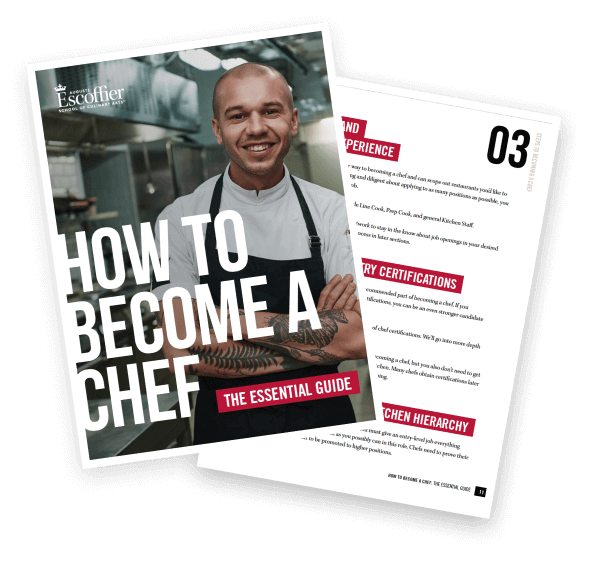
How to Become a Chef: Get the Career guide!
Have your sights set on wearing the chef’s hat? Discover the steps that may be required to start your culinary career and earn the title of ‘chef’.
Customize Your Resume for Each Job
Most job applicants write their resumes once and distribute them to many potential employers. But a much smarter approach is to customize your resume for each job that you apply for.
Fortunately, for job applicants, the job posting can act as a handy how-to guide to help. Employers often list exactly what they’re looking for in an applicant. So you can use the posting details to reverse-engineer your resume.
For example, let’s say you are applying for a cook or chef position at a farm-to-table restaurant that highlights a “nose-to-tail” approach to each animal they cook. The job posting specifies that they need a chef who knows the different cuts of beef, pork, lamb, and chicken, and the best uses for each. And perhaps you have experience in butchery. This is highly relevant. Your resume should highlight this skill, as it fits right into the restaurant’s ethos.
Now let’s say you’re also applying for a position at an Italian restaurant that specializes in fresh pasta. Your butchery experience may not be as relevant here. But if you were in charge of making fresh pasta at your previous job or took a pasta course, that is relevant. You have limited real estate on your resume, so make the most of it by highlighting the most relevant details for each position you apply for.
Yes, it’s more work. But it’s also much more likely to help get you that dream job.
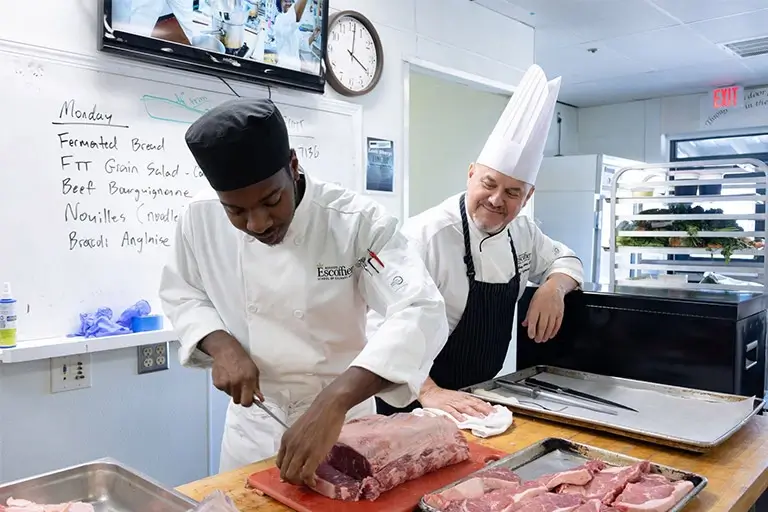
Butchering techniques learned in culinary school demonstrate specialized skills that hiring managers look for when reviewing resumes.
Emphasize Accomplishments, Not Just Tasks
We often think of our work experience in terms of day-to-day tasks, rather than the big picture. But the “big picture” is exactly what we want on our resumes. Hiring managers now expect to see measurable accomplishments, not just responsibilities.
Help the employer to envision your potential contributions to their business by sharing specific accomplishments. For example, did you put a new dish on the menu at your last restaurant? Did you spearhead an upgraded inventory system that helped reduce waste? Did the restaurant get any awards while you were on the team?
It can also help to tie your work experience to numbers. Instead of saying, “Executed menu in a high-volume environment,” get specific. How many covers did you serve each night?
Instead of a general statement about a fast-paced environment, you could say “Worked with a team to meet tight time standards (6 min for appetizers, 12 min for entrees, 5 min for desserts).”
If you had private events onsite, what kind of details can you share? Did you serve private parties of up to 500 guests? Did you serve any big-name clients?
To sell yourself, you need to bring the proof. So skip the generalizations and get specific.

Highlight the specifics to make your resume stand out and get you closer to the interview.
Create a Strong Skills Section
Hiring managers increasingly look for specific skills when evaluating chef and cook candidates. A well-crafted skills section highlights your areas of expertise and can make it easy for hiring managers to quickly see what you bring to the kitchen.
For a new cook, your skills may be more general topics that you studied in culinary school, like “food safety and sanitation” and “food cost analysis.”
But when you have some experience, you may have more skills to draw on. For example, if you’re a whiz at a specific POS system like Toast or TouchBistro, you may wish to include that. These systems can be complex, and there is value in having someone on the team with that technical skill.
You could also include proficiency with any specialty equipment, like dehydrators or smokers. If you worked somewhere that combines customer service with cooking, like a sushi counter or hibachi grill, you could highlight your multitasking and customer service skills alongside your culinary abilities.
The skills section is a great place to include valuable knowledge that may not fit within the experience section, so take advantage of it.
Zackery Glass, an Escoffier Online Food Entrepreneurship graduate, added food photography to his resume.
“Through the food photography class (shout out to Chef Shaffer) I was able to level up my photography skills of my food and adding them to my resume led to me getting a better-paying sous chef job,”* Zackery says.

Specialized skills, like preparing sushi at a customer-facing counter, can highlight both technical ability and multitasking experience on a resume.
Keep Your Resume to One Page
There’s a famous quote by Blaise Pascal (often incorrectly attributed to Mark Twain): “I would have written a shorter letter, but I did not have the time.”
It’s a challenge to keep our thoughts succinct. But in a resume, that’s just what you should do.
For some positions, a hiring manager could see dozens of resumes. And they’re looking for reasons to weed out some of the applicants. A four-page, single-spaced resume in 10-pt font is just such a reason.
For most cook and chef positions, one page is the target length. Edit ruthlessly. Cut any jobs from more than 10 years ago. And for roles that are more recent but not as relevant, keep the details brief. There’s no need to explain every aspect of every job you’ve ever had.
Only get into detail about your most recent jobs and those that most closely match the job description.

Include Complete Contact Information
Back in the day, resumes were distributed by mail or by hand. But today, they’re usually sent by email or as an attachment to an online application form. You may think that electronic submission negates the need to include your contact information on the resume itself.
This is a mistake.
Resumes are often printed out and may be separated from a cover letter or cover email—and from the contact information that you included. So make sure to include a phone number, email address, and mailing address on your resume itself to make it easy to contact you.
Beyond the basics, consider adding your LinkedIn profile URL. Many hiring managers now expect to find candidates on LinkedIn, where they can see recommendations, a fuller work history, and connections within the culinary industry.
“As far as LinkedIn goes, make sure you have a vibrant LinkedIn page,” Brian Blum, a recruiter with Gecko Hospitality, says on the Ultimate Dish Podcast. “Any time you cook something, take a picture of it. Pop it on your LinkedIn page. Make a post. Explain: This is the dish; this is who I made it for. I was catering a party of 400 today and here is some of the food we presented. Put it all up there. Let the world know what you’re doing.”
You can also include links to a professional website or portfolio where you showcase your work. For chefs, this might be a personal website featuring your signature dishes, menu designs you’ve created, or events you’ve catered. A social media account, like Instagram, can serve a similar purpose; just make sure your profile maintains a professional image and is appropriate for a potential employer.

Don’t put any barriers in the way of that interview! Share your contact information in an easy-to-spot place on your resume.
Format for Applicant Tracking Systems (ATS)
Many companies, including restaurants, are now using Applicant Tracking Systems to assist in the hiring process. According to the National Restaurant Association, restaurants are increasingly adopting ATS technology to streamline hiring and reduce time-to-hire.
These systems scan and filter resumes before a hiring manager ever sees them, searching for specific keywords and qualifications that match the job posting.
This means even if you’re a talented chef with extensive experience, you may not make it through to the interview phase if your resume isn’t formatted properly for ATS to read.
Here’s how you can optimize your resume for these systems:
- Use standard section headers: Use conventional headings in your resume, like “Work Experience” instead of more creative headings like “My Culinary Journey.” ATS software searches for standard terminology and may not recognize the more creative section headers.
- Include relevant keywords from the job posting: Read the job posting carefully to see what skills and qualifications appear multiple times. Your goal is to match your experience to their job description. If they say “high-volume kitchen operations” and you have that experience, use those words in your resume.
- Keep formatting simple and clean: Complex layouts, multiple columns, and graphics can confuse ATS software and potentially cause it to misread your resume. A single-column format works best.
- Skip images and tables in the main content: Visual resumes can look appealing to the human eye, but ATS may not be able to read text that is embedded in an image or table. Keep your resume text-based and easy to scan.
Following these ATS guidelines can help make your resume easier for hiring managers to read quickly as well. A clean, keyword-rich, organized resume helps both ATS and humans.
Bonus: Save and Send Your Resume as a PDF
Don’t send your resume out in a word processing format, like Microsoft Word or Google Docs. The device or program that the manager uses to open the document may tweak your resume’s format, making you appear messy and unprofessional.
Instead, always share your resume as a PDF. This is a static format that will display exactly the same way on every device, no matter what kind of PDF reader or hardware the manager is using.
Your Resume Is Your First Contact, So Make It Count
Creating an effective chef resume means being strategic about what you include and how you present it. From highlighting specific skills and measurable accomplishments to formatting for applicant tracking systems, each element plays a role in helping you get noticed by hiring managers.
If you need guidance refining your resume or preparing for your job search, Escoffier students and graduates can access Career Services for resume writing assistance and interview preparation.
Not an Escoffier student yet? Contact our Admissions Department to find out how our programs can help you work toward your culinary career goals.
TO LEARN MORE ABOUT CULINARY CAREERS AND GETTING THE JOB, TRY THESE ARTICLES NEXT:
- How You Can Become a Personal or Private Chef
- How to Become a Food & Beverage Director
- Is Culinary School Worth It in 2026?
This article was originally published on February 22, 2023, and has since been updated.
FAQs
A strong chef resume typically includes culinary education and certifications, work experience with specific accomplishments rather than generic task lists, a skills section highlighting specialty techniques or equipment, and complete contact information.
Quantifying your experience—covers served per night, event sizes, time standards met—can help employers envision your contributions more concretely than general descriptions alone.
Relevant skills vary by experience level. Newer cooks might highlight food safety and sanitation, knife skills, and cost analysis. More experienced candidates can include proficiency with POS systems, specialty equipment like smokers or dehydrators, specific cuisines or techniques, and customer-facing skills if applicable. The skills section is an effective place to highlight valuable knowledge that doesn’t fit neatly into your work history.
A chef resume should fit on a single page. Hiring managers reviewing many applications may appreciate concise, well-organized resumes; lengthy documents can work against you.
Edit ruthlessly, cutting jobs from more than ten years ago and keeping details brief for less relevant positions. Reserve the most detail for recent roles and those that most closely match the position you’re applying for.
Start by including your culinary education, any certifications (like ServSafe), and your industry externship—which counts as relevant work experience and demonstrates real kitchen exposure. Be sure to highlight accomplishments from school, like awards or any formal recognition.
Even with limited work history, a well-organized resume that showcases your training and externship experience can potentially make an impression on hiring managers.
A culinary degree or diploma can be a meaningful differentiator, particularly when competing against candidates without formal credentials. It signals investment in the craft and may indicate a broader skill set that could require less onboarding time.
Escoffier graduates also complete at least one hands-on industry externship, giving them verifiable professional kitchen experience to include on their resume even at the start of their careers.