

Listen to This Article:
What if the career you thought you’d retire from isn’t actually your final chapter? Many people are discovering that the skills and wisdom they’ve built in one field can become advantages somewhere completely different.
The culinary world is one such industry that illustrates how career changers can transition successfully from one field to another, bringing skills from their former workplaces into a wide range of new jobs.
Many Auguste Escoffier School of Culinary Arts graduates switched careers in their 30s, 40s, and 50s, chasing a passion or a hunch about what their next move would be. Keep reading to find out more about who they are and why culinary school wound up a good fit.
Why Career Change is Normal (and Actually Smart)
Recent data shows about 2.6% of workers switch jobs monthly, with about 64% of those people also changing their occupation. Millions of people are reinventing their work lives.
At the same time, chef jobs are expected to grow 7% through 2034, according to the U.S. Bureau of Labor Statistics, a rate that’s faster than most occupations (as of October 2025). Median pay for chef and head cooks reached $60,990 annually in 2024.
Your life experience doesn’t make you less qualified for a new career; it makes you differently qualified. The problem-solving, perspective, and hard-earned wisdom you’ve developed can become valuable advantages in ways you may not yet anticipate.
“With culinary, you’re able to create your own pathway,” says Mike Carrillo, Escoffier Online Plant-Based Culinary Arts Graduate. “Yes, you’re going to work under some people to get experience—but that experience is helping you create your own pathway.”
The Many Paths in Culinary Arts
“Culinary arts” doesn’t mean one job, like chef. The field branches out in directions that can match almost any interest or lifestyle.
For example, teaching lets culinary pros share what they know in schools, private lessons, or online content. These roles mix technical skills with communication and may offer more flexible hours than restaurant work.
Food media keeps growing and encompasses writing, photography, video content, all areas in need of people who understand food and can tell good stories.
Entrepreneurship can mean restaurants, catering, specialty products, bakeries, food trucks, and more. These businesses often benefit from the business insight that career changers bring.
Beyond Traditional Chef Roles
A culinary background opens doors to careers that go well beyond traditional kitchen roles—many of which people don’t realize exist until they start exploring the industry:
- Food stylist for magazines, commercials, and cookbooks
- Recipe developer creating dishes for brands and publications
- Culinary consultant advising restaurants on operations and menu design
- Food photographer capturing stunning culinary images
- Nutritionist helping clients reach wellness goals through food
- Event planner specializing in catering and food experiences
- Food writer/blogger sharing culinary stories and expertise
- Culinary travel guide leading food-focused tours
- Artisan food producer crafting specialty items like chocolates or cheeses
- Food scientist developing new products and ensuring safety standards
Whether you’re drawn to pastry precision, menu creativity, business operations, or teaching, there’s probably a path that works with your interests and circumstances.

Food photography represents one of many creative career paths available to culinary professionals.
Real Escoffier Stories: It’s Never Too Late to Cook Up a New Career
Numbers and job lists tell part of the story, but real experiences show what career change actually looks like. These Escoffier graduates came from military service, finance, therapy, architecture—completely different worlds.
When Life Forces a Pivot
Sometimes you don’t choose career change—it chooses you. Mike Carrillo’s life-threatening health crisis became the push he needed for transformation.
A former oil field worker living with diabetes, Mike developed a severe infection during the pandemic that landed him in the hospital for 10 days, with doctors warning that poor blood sugar control could cost him limbs.
That wake-up call changed everything. Mike embraced a plant-based diet that eliminated the need for his diabetes medications in three months. That stunning health transformation got him interested in food as medicine, and at 50, he enrolled in Escoffier’s plant-based program, where he earned an associate degree.
A local college administrator who had been watching Mike’s journey on social media called on a Saturday with what Mike thought would be a simple interview about commuting to Odessa. After he arrived for a campus visit, that casual meeting turned into a series of impromptu interviews, and just two hours later, Mike had a job as department chair—a process that usually takes four months.
*Information may not reflect every student’s experience. Results and outcomes may be based on several factors, such as geographical region or previous experience.

Mike Carrillo celebrates his culinary graduation at age 50, proving it’s never too late to pursue your passion
Marc Mole worked for 20 years as an architect in Paris before his wife’s World Bank job brought them to Washington, D.C., in 2011. His PhD wasn’t recognized in the U.S., so a career reset was required.
Marc started with a French produce company, selling to restaurants and meeting chefs. When his wife was diagnosed with breast cancer in 2014, Marc went back to cooking from scratch, skills he had picked up during his Eastern European childhood. Through his produce industry connections, Marc met Francis Leon, an executive chef who became his mentor. Marc completed Escoffier’s online program while working as an unpaid apprentice, and eventually became the pastry chef at a beloved French bistro in D.C.
Following Long-Held Passions
Christopher Marhevka‘s move from mental health therapy to culinary arts was more gradual. Christopher was burning out as a crisis intervention specialist during the pandemic, working at Cleveland Clinic’s ER.
He still loved social work but needed more balance and lightness in his life. At 31, he felt the urgency to explore his cooking passion instead of letting it stay unexplored. “I didn’t want any sort of aspirations to go unspoken and unexplored,” he says. “I figured now is the time to put it into action.”
Chris enrolled at Escoffier’s Boulder campus while keeping 10-12 therapy clients part-time. The experience humbled him as he studied alongside much younger students and discovered that restaurant cooking was nothing like home cooking. After his externship at La Marmotte in Telluride, Colorado, Chris set his sights on food media, inspired by shows like Padma Lakshmi’s “Taste the Nation.”
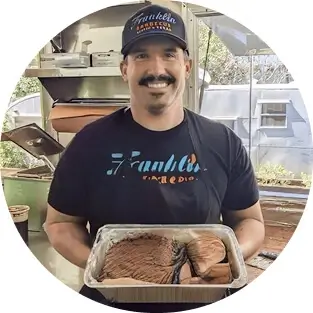
Michael Fields was dealing with what he calls a “quarter-life crisis, almost midlife crisis.” Michael was working in finance in Los Angeles while caring for his mother, who had stage 3 esophageal cancer. His mother saw his lifelong passion for cooking and pushed him toward culinary arts. “You only live once,” she told him.
At almost 40, Michael and his wife packed everything and moved to Austin so Michael could enroll at Escoffier’s Austin campus. He missed only two days when his mother died and was never late to class. During Michael’s externship at Uchiko, instructors noticed his work and set up a meeting with Aaron Franklin of Franklin Barbecue.
Franklin doesn’t usually take resumes, but hired Michael after a brutal heat test. In one year, Michael moved from night shift fire control to “cutter,” the front position where he serves customers who’ve waited three to four hours and traveled from around the world.
*Information may not reflect every student’s experience. Results and outcomes may be based on several factors, such as geographical region or previous experience.
Discovering Hidden Talents
Some career changes happen by accident. Trenin Nubiru retired from 20 years of military service and was “walking around aimlessly looking for something to do.” A help wanted sign in a cookie shop window changed his life.
“I was like, I have to restart my life. And I don’t care what it is. I just did not want to go back to the government,”* Trenin says. That cookie shop work woke up his artistic side through cookie decorating. Trenin enrolled in Escoffier’s Baking and Pastry program, bringing his experience and drive to a new arena.
*Information may not reflect every student’s experience. Results and outcomes may be based on several factors, such as geographical region or previous experience.
How Previous Experience Can Become Your Advantage
As a career changer, you may worry that you’re starting from zero but in fact, every skill, every challenge, and every insight from your old career can become part of your new toolkit.
Dawn DeStefano went from military fighter jet mechanic to ER nurse to pastry chef and instructor.
“You have to be you,” she says. “You can’t be just one blank person. You need to be able to bring it all to the dance… You’re a byproduct of your baggage—good, better, or indifferent.”
Mike’s military discipline and organization help him run a culinary department and build curricula. Marc’s architectural precision works beautifully in pastry and business planning. Chris’s therapy background—listening, empathy, crisis management—sets him up perfectly for food media that tells human stories.
Michael’s finance experience helps him understand restaurant operations from a business angle that many cooks might miss. Dawn’s medical knowledge shapes how she teaches food safety and nutrition. Trenin’s engineering brain brings efficiency and problem-solving to pastry work.
These are competitive advantages.
Employers see this too. Many want maturity, work ethic, and different perspectives that can help their operations in unique ways.
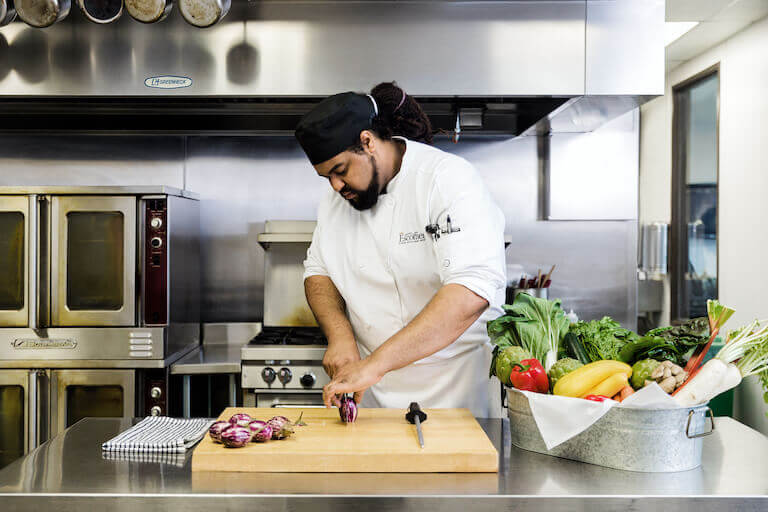
Career changers can bring focus, maturity, and dedication to professional culinary environments
Addressing Common Concerns and How Escoffier Can Help
Career change can bring up real concerns. Here’s how some common fears match up with practical solutions that can make the transition manageable.
“Am I too old to start over?”
Mike was 50 when he graduated and calls it his “crowning moment.” Christopher says you can start anytime, at any age.
“Everyone thinks that in order to be a chef, you have to be a child prodigy. You have to grow up in kitchens … But it doesn’t have to be that way,” he says. “You don’t have to feel like you need to start as a child or not at all.”
Older students can bring focus, dedication, and life skills that help them excel. Escoffier’s online format draws many adult learners, so you can be around peers with similar circumstances. Many Chef Instructors changed careers themselves and understand what adult learners face. They focus on the “why” behind techniques, not just the “how”—which may click with adults who want to really understand their craft.
“I have no professional kitchen experience.”
Escoffier’s hands-on industry externship requirement can help students build experience. Even those who come in with zero professional kitchen background can build real industry experience that can bridge the gap.
Career services can help students with their externship search as they seek positions that can fit their goals and location. Marc worked as an unpaid apprentice, and Michael went straight from the classroom to an externship at a high-end Japanese restaurant. The externship can help you prove to yourself and future bosses that you can handle real kitchen pressure.
Sometimes, the externship becomes your career launch pad. Michael’s externship at Uchiko led to his meeting Aaron Franklin. Marc’s apprenticeship with Francis Leon turned into almost two years as pastry chef. Some students get job offers right from their externship site.
“I can’t afford to stop working while going back to school.”
In Escoffier’s online programs you can fit coursework around your current schedule instead of choosing between current income and future goals. You can complete classes at night, on weekends, or whenever your schedule allows, as long as you meet weekly assignment requirements.
The online format can also cut costs like commuting and campus housing. Christopher kept his therapy practice part-time during school, and Marc continued his produce sales throughout his program. Programs take about 15–23 hours per week depending on program, credential, and personal pace.
Financial aid is available for those who apply and qualify, including grants, scholarships, and loan options that could help make culinary education more accessible. Consider your situation and resources to determine what is affordable for you.
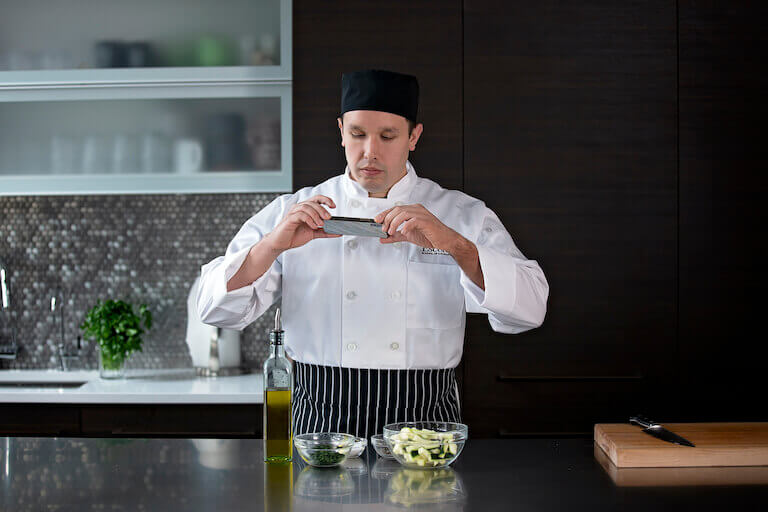
Escoffier’s online programs allow students to balance culinary education with work and family commitments.
“How do I know if this is the right decision?”
Escoffier offers both diploma and associate degree options, so you choose the commitment level that feels right for you. The curriculum can help prepare students for diverse career opportunities in restaurant work, catering, food media, food instruction, entrepreneurship, and more. The foundation can provide you with the flexibility to explore different directions as you figure out where your interests and skills match best.
“If you’re on the fence about going to culinary school, sit down, not five minutes at most, and imagine what culinary school would be like,” Trenin says. “If you get nothing in return, then don’t go … But you know, if ideas come to mind and you instantly get that spark, if you see that light when you sit, then in fact go.”*
“Will I feel supported during this transition?”
Online programs draw students from all backgrounds. This can create peer groups of people who understand the unique challenges of career transition. These connections often last beyond graduation. Students can share job leads, give encouragement during busy externship days, and celebrate each other’s wins.
Many graduates become mentors themselves. Mike now hires Escoffier graduates at his college program because he understands their training and mindset. Instead of starting over alone in unfamiliar territory, you’re joining a network of people who understand your journey.
Taking the First Step
Career change takes courage and practical planning, but it doesn’t have to be overwhelming.
Start by evaluating your current situation and what’s driving your interest in culinary arts. Want more creativity? A chance to help others through food? Understanding your motivation can help guide your decisions and keep you going through challenges.
Try experimenting before committing fully. Cook more at home, take a local cooking class, volunteer at food events. Pay attention to what energizes you and what feels like work.
If you’re ready to explore formal education, research programs carefully. Look at curriculum, talk to admissions counselors, and ask about support systems for adult learners. Remember that career change is a process, not one decision. You don’t need everything figured out before starting. Mike didn’t know he’d become a department chair when he enrolled. Your existing skills plus new culinary knowledge could create opportunities that you haven’t even imagined.
Your Culinary Journey Can Start Now
Career change isn’t about erasing your past, but about building on what you’ve learned to create something new. Your experience in healthcare, finance, military service, could be the foundation that makes your culinary career unique and valuable.
The culinary industry needs people with unique perspectives, a good work ethic, problem-solving skills, and life wisdom.
Want to learn more about how Escoffier’s programs could support your career transition? Contact us today to find out more.