

Listen to This Article:
Five years ago, Kara Merchant arrived in Charleston, West Virginia, with one suitcase and no one waiting for her. She had just gotten sober and was starting over completely, with no real plan beyond finding work in the only industry she’d ever known.
Today, Kara’s the pastry chef and garde manger at Paulie’s Fine Italian, owned by Chef Paul Smith, West Virginia’s first James Beard Award winner.
She got there through long shifts, late-night studying, a culinary degree earned in her forties from Auguste Escoffier School of Culinary Arts, and a front-row seat to the night West Virginia was placed on the culinary map by Chef Paul and his team.
She’ll tell you none of it was inevitable. She’ll also tell you none of it was an accident.
From a Single Suitcase to a Shared Kitchen
Kara grew up in West Virginia with two parents who had college degrees and clear expectations. She says her childhood was great, filled with sports, family … and food.
“That’s how my family as a child would always come together,” she said. “All the cousins and all the families and the grandmas would be cooking, the kids would be running in and out and all the things. The togetherness that brings is what I love. Food brings people together.”
But things got harder as she got older.
“I went down some avenues that were pretty dark,” she said, “and I spent some time there for a while.”
Kara found a way to support herself in the food industry, working both front and back of house for nearly twenty years. At that time, it felt like just a job. But in the process of getting sober about five years ago, she decided to start over fresh and landed in Charleston, West Virginia, where both her personal and professional lives would take a turn for the better.
“I literally came here with just a suitcase,” she says. “I had no idea, no nothing.”
In Charleston, Kara stayed in the food service industry, but she started finding a new sense of community, belonging, and meaning.
“It’s just like Anthony Bourdain says: a kitchen is normally filled with a bunch of misfits and rejects, and a lot of us have histories and things of that nature,” she said. “But you find a family in all that.”
The kitchen gave her something else, too.
“I never thought I was creative at all growing up,” she said. “I thought my mom and my sisters got all those genes. But I learned through cooking that it’s my creative outlet.”
“One Day That’s Gonna Be Us”
In June 2024, Kara was part of the team working the James Beard Awards watch party at Capitol Market in Charleston, catering hors d’oeuvres alongside Chef Chase Collier, whom she was working under at Ristorante Abruzzi.
Chef Paul Smith, one of West Virginia’s most celebrated chefs, was up for Best Chef: Southeast. When they started announcing the award category, Kara says the whole place went silent as everybody held their breath.
“When they announced he won, I had never felt such a moment in my life,” she said. “It was pure excitement, pure joy, ecstatic. People were screaming. It was a really cool moment to be part of. I can’t even verbalize it, to be honest with you. It brought tears because we knew that this, as much as it was for Chef Paul and his team, it was also for the state.”
Afterward, she found Chef Collier in the chaos.
“I looked at him and said, ‘One day that’s gonna be us.’ And he just kinda giggled and was like, ‘Yeah, right, whatever.’”
She added, “Watching (Chef Paul’s) first nomination journey, I learned, if I want to be taken seriously, then I’ve got to do things seriously.”
Women in the Industry
Kara points to Chef Mary Ellen Diaz of Alma Bea in Shepherdstown, West Virginia, a recent James Beard semifinalist, as exactly the kind of recognition worth celebrating. “To see that there’s a woman from our state nominated like that really, really made me want to achieve more, do better, and work harder,” she said.
“Many women I have worked beside over the years have inspired me in so many ways,” says Kara. Some of her greatest role models to this day include Julia Child and Irma S. Rombauer, author of The Joy of Cooking.
Sauté Stations and Midnight Study Sessions
The very next year after Chef Paul Smith’s historic award, Kara was working as sous chef when Chef Collier received a James Beard semifinalist nomination for Best Chef: Southeast at Ristorante Abruzzi.
She was enrolled at Escoffier at the time, pursuing her Associate Degree in Culinary Arts online while continuing to work full-time. Starting school in her forties wasn’t something she’d planned on, but the online format made it possible. It was still challenging, but possible.
“You want to do something like go to school, but you realize that’s not going to work for you—you have to go to work every day,” she said. “You can’t be in a classroom; you have bills to pay. Not all of us have traditional situations. Escoffier allows for the non-traditional student to find a way to do this.”
It wasn’t always easy to work while in school, but Kara was determined.
“In my past, I had started a lot of things and never finished,” she said. “It was important to me to finish this and see it through.”
Why Culinary Veterans Should Consider School
Coming to the program with professional kitchen experience helped in a lot of ways, but it also shone a light on the things Kara didn’t know.
“I had to break a lot of bad habits that I had picked up from doing things the wrong way for so long. By not having those foundational skills, something as simple as standing correctly at a cutting board, or keeping my elbow in when I cut instead of having it flared out. Those little things showed me how important a foundation is.”
The Day-to-Day of Putting Your Head Down
Kara’s days at Abruzzi started around 11 am. She’d run prep, work the sauté station through dinner service, come home smelling like fish at eight or ten at night, shower, and sit down to study.
“I would do my reading, my research, watch lectures, take my notes—all after work,” she said. “Sundays and Mondays were my days to get assignments in. I literally had to tell a lot of people ‘no.’ I learned and cultivated a lot of discipline.
“There were several times I contemplated to myself, ‘I’m just so exhausted, I’m just going to go home and crash. I’m going to take the point deduction.’ But something inside of me wouldn’t let me.”
And this was all happening at the same time Chef Collier was working through a James Beard nomination, which was itself an immense pressure and responsibility for everyone at Abruzzi.
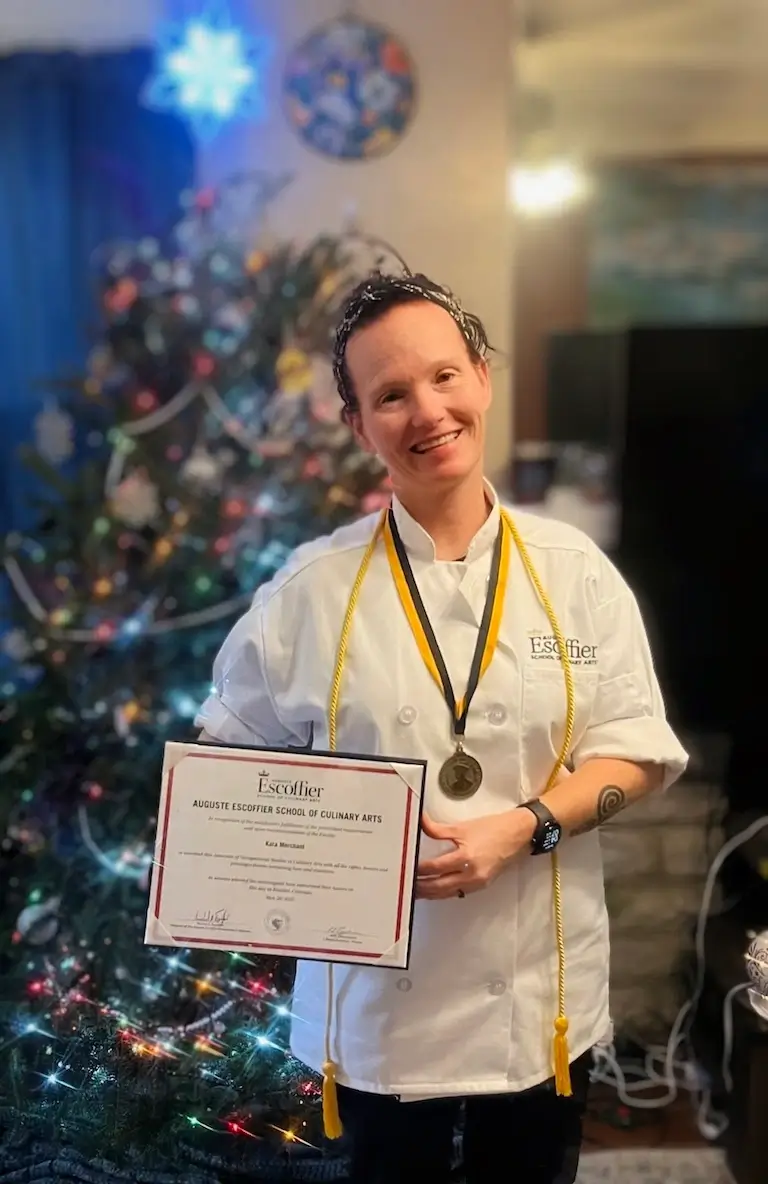
Kara Merchant celebrates a milestone in her culinary journey, graduating from Escoffier’s Culinary Arts Associate Degree program in 2025.
The Soft Skills Nobody Talks About
Kara believes online programs require skills that mirror what’s required in professional kitchens.
“You do not have an instructor there with you in real time who is acquiring your ingredients for you, who is having part of the prep done,” she said. “So it teaches you to be forward-thinking. It’s a skill that is often overlooked that I don’t think a lot of people have.”
Every course in the program pushed that same muscle, she said, across cooking labs, the business classes, the world cuisines class, and everything in between.
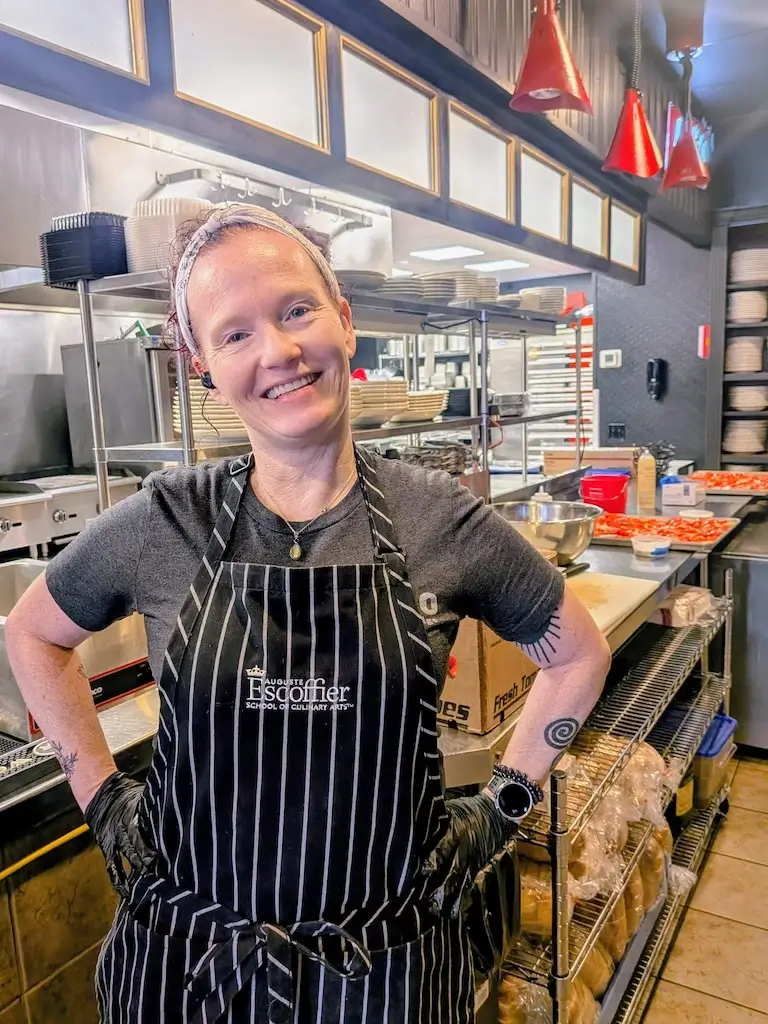
Kara in the professional kitchen, wearing her Escoffier apron.
“All those days I was so frustrated, because I’m up late at night after working long shifts trying to do my work and order ingredients (for school assignments) to get here for the next week and manage this week at the same time,” she said. “All that right there teaches you how to be successful in the kitchen. Soft skills that nobody really talks about: organization, planning, prioritizing, holding yourself accountable to get things done. That’s what the instructors in this program do for you that nobody really talks about.”
Across the program, she said, “The [Chef Instructors] built a confidence and a strength in me that I didn’t know was occurring, even on all those days that I was so frustrated.”
A Pivot to Pastry
Kara graduated in 2025, then took a job with Chef Paul Smith as pastry chef and garde manger at his new restaurant, Paulie’s Fine Italian.
Why pastry when she’d spent her entire career on the savory side?
“I knew that to be more well-rounded,” she said, “I had to put myself outside my comfort zone and try something new.”
Moving from savory to pastry did exactly that.
“Baking is a whole other beast,” she said. “It’s an exact science. You have so many variables. When you’re savory cooking, you have a little bit more wiggle room where you can fix things. With baking, it doesn’t work that way.”
She sees the challenge the same way she approached pursuing her degree while working professionally.
“My time at Escoffier really showed me how, if I just put my head down and focus on the task at hand, it will start coming naturally,” she said. “That’s what I did at Escoffier, and that’s what I did here.”
To Inspire, Not Impress: Mentoring the Next Generation
Kara is a mentor for Escoffier alumni and guides externs and new cooks at Paulie’s. She loves teaching now, though she’ll admit she didn’t always.
“I used to hate it, honestly,” she said. “I had the whole mentality of, well, I had to work hard to earn it. But the whole Escoffier experience kind of opened me up to it. It’s our obligation as veterans in this industry to hand down our knowledge, our skills, and the practical application of this. I cannot stress that enough.”
Her guiding principle as a mentor and role model is simple: “I want to inspire people to find their own greatness.”
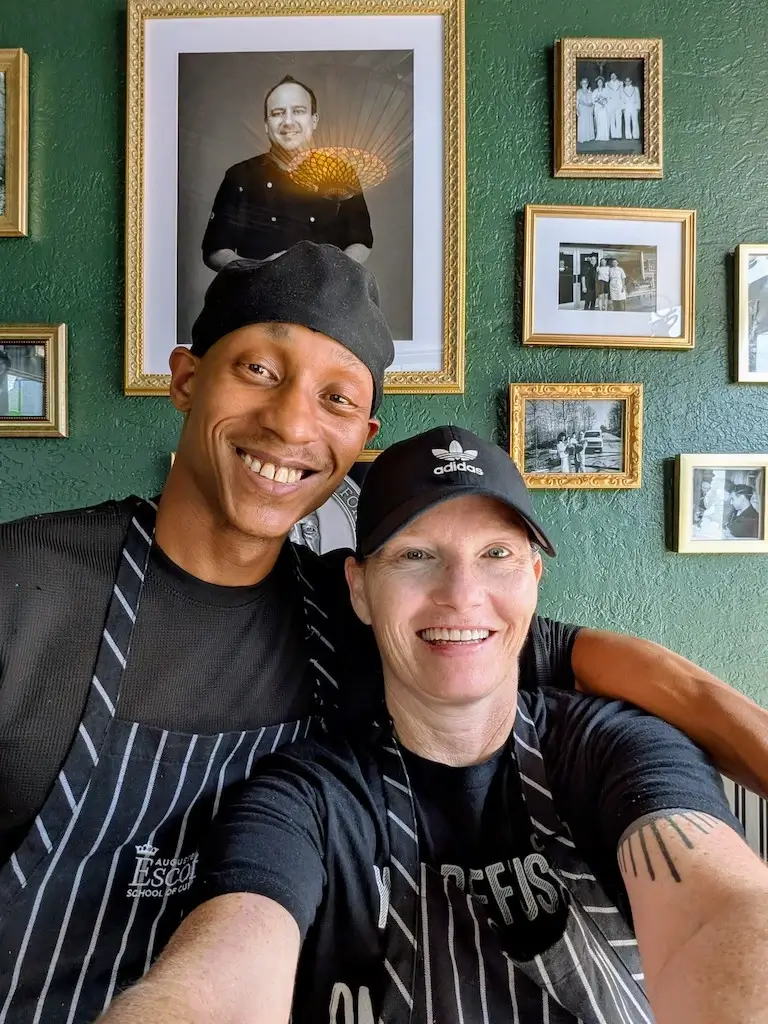
Kara with Tay, an Escoffier Culinary Arts Diploma graduate who completed his externship at Paulie’s Fine Italian under Chef Paul, with Kara as an informal mentor.
When people ask her about culinary school, she tells them to do their research first. Talk to chefs, line cooks, managers, and family, and sit with that before deciding because it’s a commitment.
She’s also frank about the day-to-day realities of the job.
“You have to be okay with doing a lot of things you don’t want to do all the time. Scrubbing walls, mopping, cleaning floors, doing the same thing over and over.”
And you need to learn to accept failure. “I fail constantly,” Kara says. “But failure has been one of my greatest teachers. I don’t let failure defeat me. That’s the difference.”
The key to longevity, she said, comes down to why you’re there.
“I don’t cook for the likes; I cook for the love of cooking,” she said.
Gravitate Toward Joy
At age 48, still on her feet all day in a professional kitchen, Kara’s made a point of figuring out what sustains her.
“You can’t do all these things you want to do if you don’t choose you,” she said. “Listen to your body. Your body will let you know that you have pushed too hard and you need to rest. And rest isn’t just physical. It’s emotional and mental and spiritual too.”
For Kara, that means being intentional about what she returns to outside the kitchen.
“Gravitate toward joy, things that bring you joy,” she said. “As simple as it sounds, for me, what brings me joy is being home in a clean house, where my surroundings are organized, filled with lots of laughter with family and friends. Find your own unique joy.”
She’s watched the industry slowly catch up to that way of thinking.
“When I first started, it was definitely just grind, grind, grind, grind,” she said. “But now, mental health, physical health, and emotional health have become a big deal. I’ve got to see that transition over the years and how far this industry has come.”
She reminds young chefs that, “What we do for a living is temporary. Life is not.”
Making Space in the Industry
For Kara, the culinary world only benefits from opening its doors wider. The more people who find their way in—traditional, non-traditional students, industry veterans, women stepping into leadership roles, people from all backgrounds—the better it gets for everyone.
“My journey is proof that if you believe in yourself, work hard, and refuse to give up, the possibilities are truly endless,” she said. “Write your own unique story. Don’t let age, background, sex, demographic, or socioeconomic status stop you. If I can do it, so can you.”
If Kara’s story has you thinking about what the next step in your culinary career could look like, you can connect with an admissions representative at Auguste Escoffier School of Culinary Arts to learn more about our online degree and diploma programs.
ENJOYED THIS SPOTLIGHT ARTICLE? TRY THESE NEXT:
- Matty Edgell: From Great British Bake Off Winner to Culinary Educator
- From Culinary School to Food Science: Ellen Doerr’s Career Reinvention
- The Power of Saying Yes: Chef Marion Lancial’s Journey Across Three Countries