
Listen to This Article:
Wondering if becoming a chef is something you can learn on the job?
The answer is yes—and no. Every chef learns by doing, but not every kitchen gives you the chance to understand why things work the way they do. On the job, you might rotate through a few stations or memorize a handful of recipes. In culinary school, with time and practice on your side, your understanding can go deeper. You can start to see how ingredients behave, how flavor develops, and how timing and technique shape every plate that leaves the kitchen.
School can prepare you for more than your first job. It can build the foundation for a career. It is where chefs can gain depth, perspective, and creative confidence, the kind that is hard to develop when the clock is ticking and the goal is to get food to the pass.
Here are six skills you can learn in culinary school that can be difficult to develop on the job.
Becoming a T-Shaped Chef
The concept of “T-shaped” professionals comes from the business world, but it describes exactly what culinary education aims to create.
The Vertical Line (Depth): Deep expertise in core culinary skills, such as knife techniques, cooking methods, flavor development, and technical execution. This is the craftsmanship that makes you a strong cook.
The Horizontal Line (Breadth): Wide-ranging knowledge across multiple domains, like food science, business management, global cuisines, nutrition, sustainability, and professional soft skills. This is the versatility that makes you a leader.
Why it matters: On-the-job training can sometimes create “I-shaped” cooks, or chefs with deep technical skills in one cuisine or concept, but limited broader knowledge. They’re specialists in a narrow lane. Culinary school builds both dimensions at once. You can develop the depth of a skilled cook and the breadth of someone who can adapt to any kitchen, manage a team, and eventually run the operation. That combination is what makes you promotable, entrepreneurial, and valuable in an industry that’s constantly evolving.
Skill #1: Understanding the “Why” Behind Cooking Techniques
On the line, you learn that searing a steak at high heat creates a flavorful crust. In culinary school, you can learn why it does. The Maillard reaction, a chemical process that occurs when proteins and sugars are exposed to heat, creates hundreds of new flavor compounds. Understanding that process is the difference between following instructions and knowing how to adapt when something goes wrong.
The Maillard reaction is just one example of what happens when you learn and understand the science behind cooking. In culinary school, you can learn why emulsions like hollandaise break and how to fix them. You can explore how pH affects the texture and color of vegetables, why certain ingredients pair well together, and how heat transfers through different cooking methods. This foundation in food science can cover everything from caramelization to the role of acids in tenderizing proteins. It becomes a toolkit for problem-solving that goes beyond any single recipe.
In culinary school, instructors don’t just teach what’s required—they encourage students to dig deeper. During his time in Escoffier’s pastry program, Wes Duckworth found that his Chef Instructors inspired students to ask questions that sometimes go beyond the curriculum.
“I had Chef Dan [Widmann] for three of my four blocks, and his knowledge was insane,” Wes recalled. “But he was very much like, if you kept asking him questions, he would keep giving you more information.”
This willingness to go beyond the standard curriculum made a strong impression on Wes, who appreciated having access to that additional expertise. His instructors could also share insights about different operations, whether hotels, restaurants, or catering, because they had worked in various settings. This meant students could “practice through some of their mistakes without having them,” as Wes puts it.
Today, Wes owns two successful businesses, including scratch kitchen operations at two major athletic stadiums, where he applies the same curiosity and drive to keep learning that his Chef Instructors instilled in him.
In a busy restaurant, there is rarely time to explain the “why” behind a technique. More often than not, chefs need execution, not education. You might make a beurre blanc a hundred times by following the steps exactly, but without understanding emulsification, you will not know how to save it when it splits during service.
Chef Instructor Miguel Olmedo emphasizes the importance of making these mistakes during culinary school, not on the line. “If you break a Hollandaise sauce, I’m going to teach you how to fix it,” he explains.
These mistakes can help you learn all the possible scenarios that can go wrong and give you the knowledge to either fix them or avoid them in the future.
“Make those mistakes now so when you’re in the street, you don’t make those mistakes later,” chef Miguel says.
That knowledge gained in culinary school can separate cooks who simply replicate dishes from chefs who can innovate, troubleshoot, and create.
Inside Escoffier’s teaching kitchens, students can learn culinary techniques, leadership skills, and the professional standards that prepare them for the industry.
*This information may not reflect every student’s experience. Results and outcomes may be based on several factors such as geographical region or previous experience.
Skill #2: Deliberate Practice in a Low-Stakes Environment
In a professional kitchen, every movement matters. There is no pause button when tickets are printing and orders are stacking. On the line, repetition comes fast, but it is often driven by urgency. In culinary school, you have the space to slow down and focus on precision. You can repeat a task, such as knife cuts, whisking a meringue, or reducing a sauce until the motion becomes instinct.
This kind of deliberate practice can build confidence through structure. You work through techniques in a progression, with Chef Instructors who can guide and correct in real time. Mistakes are expected, even encouraged as Chef Olmedo suggested earlier, because each one becomes part of the learning process. It is a safe place to experiment, to see what happens when you push a technique too far or test a flavor combination that might fail.
Restaurants, on the other hand, depend on speed and consistency. There is rarely time to perfect or revisit a sauce for the sake of understanding. Culinary school shifts that balance, giving you a low-stakes environment to refine your skills until they feel natural.
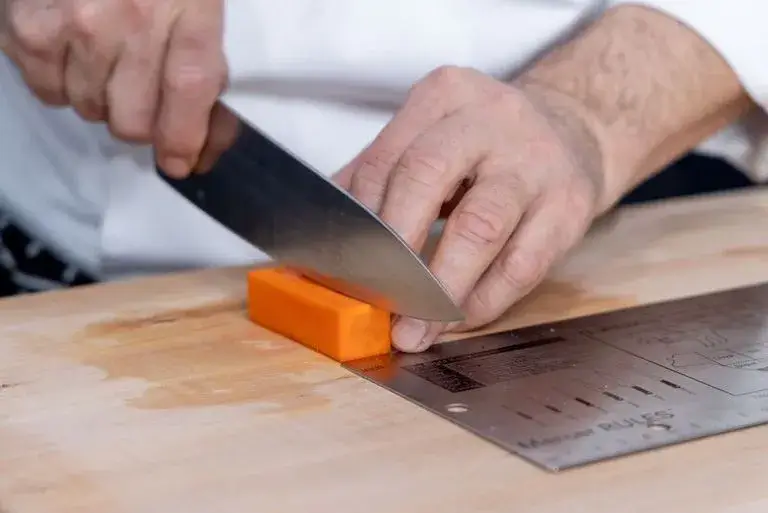
Foundational, consistent knife skills can become second nature through training and repetition in culinary school, preparing students for the pace of professional kitchens.
In addition to refining motor skills and techniques, you are also introduced to the language of food.
“There are certain French terms that we use regularly, certain Italian terms that we use regularly, that somebody off the streets wouldn’t necessarily know,” explains Chef Instructor Albert Schmid. “When somebody asks for a julienne, for example, they’re looking for a very specific knife cut. So a quarter by a quarter by two inches, and that’s difficult to produce if you’ve never done it before.”
Now imagine you’re on the line in a busy restaurant, and the executive chef asks you to chiffonade the mint, oblique the cucumbers, and Brunoise the carrots for prep. The middle of service is definitely not the time to Google these cuts. With culinary school, you can gain both the understanding of what the chef is asking and the practiced movements to perform these tasks confidently in a high-pressure environment.
To Restaurant Life—or Not to Restaurant Life?
That’s the question many students ponder. What if they want to attend culinary school but not work in a restaurant? “My advice would be to jump in,” says Chef Albert. Culinary skills, he explains, translate across so many avenues beyond restaurant life. One of his former students, now a real estate agent, bakes cookies before open houses so the scent fills the home and makes visitors feel welcome. Some students pursue culinary school for a career shift, while others simply want to learn a skill that brings them joy and meaning in everyday life.
Skill #3: Business and Management Fundamentals
Most line cooks never see a P&L statement. They don’t price menus, manage labor costs, or make purchasing decisions. That knowledge stays in the office, reserved for those already in leadership. By the time you’re promoted to a position where you need to understand food cost percentages or how to schedule staff efficiently, you’re expected to learn on the fly with real money on the line. Or maybe without this experience, you’re not promoted at all.
Culinary school, on the other hand, can often integrate business training into the curriculum. You can explore how to calculate recipe costs, account for waste, and price dishes for profitability. You can study inventory management, vendor negotiations, and how labor percentages affect the bottom line. Courses can cover the fundamentals of marketing, leadership principles, and the hiring process. You can see how a restaurant operates as a business, not just as a kitchen.
From the Field
Will Guidara, former co-owner of Eleven Madison Park (which held three Michelin stars under his leadership), contends in his book Unreasonable Hospitality that there are two sides to running a successful restaurant: being “restaurant-smart” (creativity, human connection, hospitality) and being “corporate-smart” (systems, controls, efficiency, financial management). Balancing both, he argues, is what separates restaurants that merely survive from those that thrive.
Line cooks can absolutely work their way into management, and many do. But learning cost control through trial and error is expensive. Culinary school can give you the chance to understand these systems before you’re responsible for them, which means you can step into leadership roles with confidence rather than learning as you go.

Business and management fundamentals, from cost control to customer service, can equip chefs to lead beyond the line.
*This information may not reflect every student’s experience. Results and outcomes may be based on several factors such as geographical region or previous experience.
Skill #4: Comprehensive Culinary Exposure Across Cuisines and Techniques
Most cooks learn within the boundaries of a single restaurant. If you work in an Italian kitchen, you become skilled in Italian cuisine. If you work the grill, you get very good at the grill. Culinary school widens that view. It can offer structured exposure to cuisines, ingredients, and techniques from around the world.
Chef Miguel encourages new students to start by focusing on one cuisine before expanding outward. “I tell them to begin with French classical cuisine,” he says. “That’s where the foundations are. Once they learn that, it is [easier] to understand and adapt and cook different cuisines.
From there, students can move through regional and global lessons, from American barbecue and shrimp and grits to the flavors of Mexico, Morocco, India, and Japan. Along the way, they can develop their palate, exploring not only how to cook diverse foods but how to recognize balance and authenticity in flavor.
That range of experience can build versatility. When you understand multiple cuisines and methods, you can adapt quickly, communicate more effectively with other chefs, and bring fresh ideas to the table. It is a kind of culinary fluency that can make you valuable in any kitchen and can give you the confidence to keep learning long after graduation.
And that continued learning is important.
“I’m still learning!,” says Chef Albert, Escoffier Chef Instructor.
The culinary world is rich and full of depth, and the more you know, the more you realize you don’t know.
“One of the great things about culinary school or being in the culinary industry is that there is absolutely no way that you can absorb everything from every single cuisine,” he says. “I mean, it’s difficult enough to absorb a single cuisine, much less multiple. And so the ability to learn and adapt is probably the best quality in somebody that is going to be in this industry and especially somebody new.”
*This information may not reflect every student’s experience. Results and outcomes may be based on several factors such as geographical region or previous experience.
Skill #5: Building Professional Networks & Mentorship From Day One
In professional kitchens, your network is who’s around you: your chef team, a few regular contacts, and maybe a sous chef who takes you under their wing. In culinary school, your network can start expanding from day one. You gain access to chef instructors who can serve as mentors, classmates who could become future colleagues, and structured externships that can connect you directly to hiring kitchens.
Because instructors often maintain relationships with industry associations, hotels, and restaurants, your school network can extend across cities and even internationally. Through alumni associations and career services, students may tap into opportunities they might never reach through cold applications.
That kind of support can be life-changing, sometimes literally. Already dealing with multiple cervical spine surgeries from a military injury, Tiffany Moore was working toward her culinary goals when she received devastating news.
“I got my MS diagnosis while I was going through school, and I almost quit,” Tiffany says. The idea of handling multiple sclerosis on top of her existing challenges felt overwhelming, especially since it happened while she was practicing knife skills for her coursework. But Tiffany decided to reach out to her Chef Instructor for guidance.
“She just encouraged me, and she told me of a chef by the name of Paul Prudhomme who ran his kitchen from a wheelchair,” Tiffany says. “My instructor told me that I didn’t have to stop, and checked on me all the time through text and email.”
That level of mentorship, personal, ongoing, and genuinely invested in a student’s success, is harder to find on the job. In professional kitchens, chefs are focused on service and may not have time to teach in depth, and your network is limited to that one kitchen’s ecosystem. Without a built-in support system, access to next steps depends heavily on luck.
This is where a culinary school can provide a strategic advantage. By requiring structured, hands-on industry externships (like Escoffier does) and mentorship, those connections can become bridges. These network effects can also compound: your first hiring contact can lead to your next role, and the next.
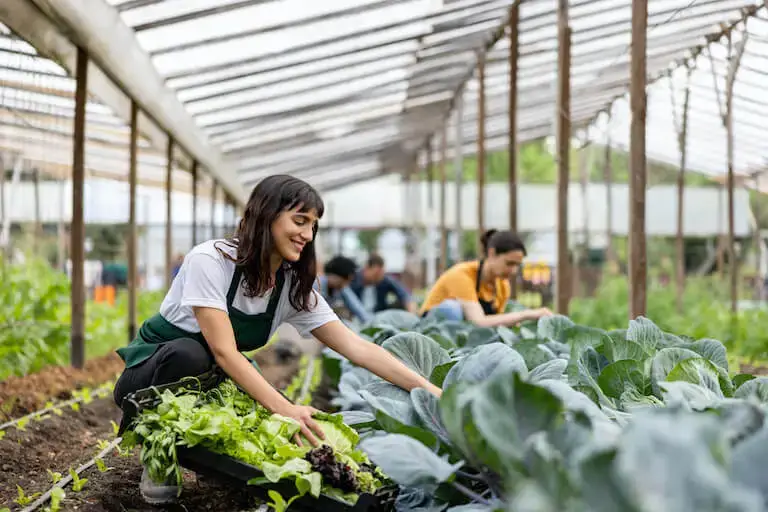
At Escoffier, students also complete hands-on industry externships from kitchens and bakeries to local farms, building connections and deeper knowledge of regional food systems.
*This information may not reflect every student’s experience. Results and outcomes may be based on several factors such as geographical region or previous experience.
Skill #6: Professional Standards, Soft Skills, & Industry Credentials
In culinary school, professionalism isn’t assumed; rather, it’s taught, evaluated, and practiced every day. You can explore how to communicate in a fast-moving kitchen, manage your time, and work as part of a team. You can also take on leadership roles in labs and group projects, where collaboration and adaptability count as much as technical skill. These habits can become the foundation of how you show up in any kitchen.
Your coursework can include food safety principles that could position you to more readily earn food safety credentials that many employers look for. Topics such as the essentials of food safety and sanitation in a professional kitchen are built into the curriculum, helping you understand why proper labeling, storage, and temperature control matter—not just for passing inspections, but for protecting your guests and your reputation.

Food safety and organization are essential habits reinforced through daily practice in culinary training.
In restaurants, these standards are often taken for granted. Managers expect you to arrive with soft skills already in place, and there’s little time to teach them during service. Credentials must usually be earned on your own time and expense.
By developing professionalism as part of your education, you can graduate with skills that can signal readiness from day one. Employers see a candidate who understands the rhythm of a kitchen, can communicate under pressure, and meets industry standards without extra training. Those certifications and habits stay with you wherever your career takes you.
*This information may not reflect every student’s experience. Results and outcomes may be based on several factors such as geographical region or previous experience.
From Line Cook to Leader: Building the Full Picture
You can absolutely learn to cook without formal training, and many talented chefs have. But here’s what’s harder to learn on the fly: why an emulsion breaks at the worst possible moment, how to price a menu so your restaurant stays profitable, or how to build the kind of network that opens doors you didn’t even know existed.
Culinary school isn’t just about learning to cook. It’s about understanding the why behind every technique, gaining the confidence to lead a team, and building a foundation that can carry you through every stage of your career, whether that’s your first day on the line or the moment you open your own doors.
These six skills—the science behind techniques, structured practice, business literacy, global culinary exposure, professional connections, and industry credentials—can separate cooks who execute well, from chefs who can lead, innovate, and create careers that last.
Maybe you’re dreaming of leading a bustling kitchen. Maybe it’s opening a neighborhood bakery. Or maybe you simply want to hone a craft that’s always called to you. Whatever your vision, culinary school can be the bridge between passion and profession. If you’re ready to take that next step, contact us to start your journey.