

If you dream of working in a professional kitchen, you don’t need to wait until culinary school to get started. Some of the best practice for future chefs happens in places you might not expect: a weekend job washing dishes, a volunteer shift at a food bank, even your algebra class.
Math is how you scale a recipe from 4 servings to 40 and figure out what each plate costs. English and communication skills can help you give clear directions when the kitchen gets loud. Science explains why your cookies spread or your sauce broke, and art class can teach you how to make a plate look as good as it tastes.
If your school offers electives like culinary arts, home economics, business, or a culinary career program like ProStart, especially, even better. Escoffier offers scholarship opportunities for competing at ProStart competitions.
Below, we’ll look at which classes and electives could give you a head start, how they connect to real kitchen work, how to get hands-on experience early, and projects you can try at home.
Planning Your High School Schedule for a Culinary Career
| Category | Recommended Options | Why It Matters for Future Chefs |
| Core academics | English, algebra, speech, art, foreign language, general chemistry/biology | Builds communication skills, recipe math, and a foundation for understanding why cooking techniques work. |
| Culinary Electives | Culinary Arts, FACS (Family & Consumer Sciences, or home economics), ProStart, Business, Agriculture, Catering, Baking & Pastry | Provides hands-on kitchen training, knife skills, food safety fundamentals, and potential college credit. |
| Extracurriculars & Real-World Experience | Restaurant jobs, chef shadowing, student orgs (DECA, FCCLA, SkillsUSA), culinary competitions, volunteering in community kitchens | Can develop real-world stamina, teamwork, and time management; teach kitchen culture; build industry contacts; and unlock scholarship opportunities. |
| Portfolio Projects | Independent recipe testing, pop-up dinners, digital culinary portfolio | Creates tangible proof of your skills to show prospective employers, and could help on scholarship applications. |
| Alternative Pathways | District CTE (Career & Technical) centers, dual-enrollment college courses, summer bootcamps | Can help fill the gap with professional training if your high school lacks dedicated culinary programs. |
Which Core High School Classes Can Help Most With a Culinary Career?
You’re probably already taking chemistry, biology, math, English, foreign languages, art, and economics to graduate, so why not think about how these core subjects can double as culinary career prep?
None of these classes are prerequisites for culinary school or a kitchen job. Plenty of chefs learn the science and math of cooking on the job. But when you see how classroom concepts connect to kitchen work, school can feel more relevant, and you could pick up certain skills faster later.
How Your High School Classes Can Connect to the Kitchen
| Class | How It Translates to Kitchen Work |
| General Science (Chemistry, Biology, Physics) | Explains how ingredients behave, how heat cooks food, and the basics of food safety and fermentation. |
| Algebra & Math | Powers practical kitchen tasks like scaling recipes, calculating yields, and menu costing. |
| English/Language Arts | Builds skills for writing menus and recipes, leading a team, and working in food media. |
| Foreign Language | Can help you build rapport in multilingual kitchens (Spanish is especially common in the U.S.) and recognize classical culinary terms (French). |
| Art | Teaches the composition principles and color theory often used in plating and food styling. |
Science and Math: Understanding the “Why” Behind Cooking
Science and math classes aren’t going to teach you how to cook, but they can explain the principles behind how cooking works. That background can make it easier to troubleshoot a failed dish or scale a recipe later on.
If you have a choice, lab-heavy science courses are worth considering. Following strict lab protocols, measuring precisely, and recording observations mimic the habits you’ll use in a professional kitchen.
- Chemistry: Understanding basic chemical reactions, acids, and bases helps you grasp why ingredients behave the way they do, and a little physics explains why meat keeps cooking after it leaves the heat. Both can make baking ratios and recipe development easier to learn later on.
- Biology: Microbiology is the foundation of food safety certifications like ServSafe, which many students can earn in high school. It also explains fermentation, the process behind sourdough and yogurt.
- Algebra: You’ll use proportions to scale recipes, calculate yield after trimming, and price dishes against a target food cost.
“Baking is chemistry,” says Wes Duckworth, Escoffier Boulder Baking and Pastry graduate and pastry chef. “[When] you understand what each component does down to the molecular level, it’s a lot easier to change recipes or figure out how it’s going to work.”*
English and Communication: Skills Every Kitchen Needs
High school English class is where you learn to express ideas clearly and concisely. Professional chefs use these kinds of writing skills every day to craft appetizing dish descriptions, draft standardized recipe cards, and lead kitchen staff.
Communication goes beyond writing. In a busy kitchen, cooks call out orders, confirm timing, and give and take feedback quickly. Speech, debate, group projects, and leadership roles in clubs can all help you practice speaking clearly under pressure, which is one of the most valuable skills you can bring to your first kitchen job.
Writing is also the foundation for becoming a food writer, food critic, recipe developer, or content creator.
“I started writing for anybody and anyone who would allow me to write stories for them,” says food journalist John Lehndorff, who has covered Colorado’s food scene since the 1980s. A school newspaper, yearbook, or creative writing elective is a good place to do the same.
Foreign Language: Communicating in Multilingual Kitchens
Studying a second language in high school could help you navigate real-world kitchens, where there’s a good chance you’ll work alongside people from all kinds of cultures and traditions. You don’t need to be fluent. Even basic conversational Spanish or familiarity with French kitchen terms can help you feel more confident on day one.
“Everybody [in the kitchen comes from] different backgrounds. You might have three different languages going on in that kitchen,” says chef and stand-up comedian Jon-Paul Hutchins on Escoffier’s The Ultimate Dish podcast.
According to the National Restaurant Association’s Restaurant Employee Demographics data brief, 46% of chefs and 39% of cooks speak a language other than English at home, most often Spanish. That makes Spanish one of the most practical languages a future chef can study.
French is useful because much of classical culinary vocabulary is French. You’ll learn these in culinary school, but it helps to recognize them early.
French Kitchen Terms You’ll Hear in Culinary School
| Term | Meaning |
| Mise en place | “Everything in its place” — Prepping, measuring, and organizing all ingredients and tools before you start cooking. |
| Brunoise | Precision knife cut — A very fine dice measuring about ⅛ inch on all sides. |
| Roux | Sauce base — Equal parts flour and fat cooked together to thicken soups, gravies, and classic sauces. |
| Saucier | Station chef — The cook responsible for preparing sauces, warm hors d’oeuvres, and sautéed dishes. |
| Garde manger | Cold kitchen station — The area and chef responsible for cold dishes, including salads, dressings, charcuterie, and appetizers. |
Art: Learning the Principles of Plating
Art class teaches the visual principles chefs use every time they plate a dish. Concepts like focal points, color contrast, texture layering, and negative space work the same way in culinary presentation as they do on a canvas.
If you’ve learned how a painting guides the viewer’s eye, you already understand how to guide a diner’s attention around a dish.

Plating is an exercise in visual composition.
“Less is more,” Michelin-starred chef Sergio Herman explained in an interview with Cool Hunting. “Focus on clean lines and use white space on the plate.”
Drawing and design classes can be especially useful, since many chefs sketch a plate before they build it. Beyond the restaurant, these skills could lead into careers in food styling or food photography.
Which High School Electives Should Aspiring Chefs Take?
High school electives can give you a direct head start on your career, offering hands-on experience, industry certifications, and potential college credit before you even graduate. If your school offers them, these key areas can build practical skills that translate directly to professional kitchens and restaurant management.
High School Electives for Future Chefs
| Elective | How it Connects to a Culinary Career |
| Culinary Arts & FACS (Family and Consumer Sciences) | Covers knife safety, fundamental techniques, and sanitation standards in a practical kitchen environment. |
| ProStart Program | Offers structured culinary and restaurant management training that can unlock college credit and scholarships. |
| Business & Marketing | Can prepare you to calculate food costs, market a menu, manage staff, or launch a food enterprise. |
| Agriculture & Food Systems | Explains seasonality, soil health, and sourcing to help you maximize flavor and reduce kitchen waste. |
Culinary Arts and ProStart
Culinary arts and Family and Consumer Sciences (FACS), often called home economics, classes are often the closest thing to a professional kitchen in high school. They typically cover knife skills, recipe execution, and food safety.
Some schools also offer ProStart, a two-year culinary arts and restaurant management program developed with the National Restaurant Association Educational Foundation (NRAEF). Students who pass two national exams, demonstrate mastery of foundational skills, and complete 400 mentored work hours can earn the ProStart National Certificate of Achievement. This credential can unlock scholarships and course credit at participating colleges.
At Escoffier, certificate holders who enroll within 12 months of high school graduation may be eligible for the ProStart® National Certificate of Achievement Scholarship, which may include credit for a Culinary Foundations course and a scholarship of up to $1,500, depending on the program.
Business and Marketing
High school business and marketing classes can teach you how to manage a budget, make data-driven choices, and promote a brand. Every one of those tools comes in handy when working in a professional kitchen or running a food business.
“Having a business degree is a huge part of who I am today,” says Jesse Ito, co-owner of Royal Sushi & Izakaya. “You need to understand business principles to be a chef, more so to have a restaurant. You need to understand marketing. You need to understand financials.”
Programs like DECA can help you start thinking like an entrepreneur: pitching ideas, building a budget, and marketing a concept. That mindset can open up career paths beyond the line, like launching a food truck, starting a catering company, working as a personal chef, or eventually opening your own restaurant.

Agriculture and Food Systems
Agriculture, horticulture, and environmental science classes cover how food is grown, raised, and sourced.
“[A lot of people have] never pulled something off of a vine. They don’t understand that a good tomato right off the vine is like candy,” says Robyn McArthur, Director of Culinary Operations at Escoffier Austin. Growing food yourself, even in a school garden or greenhouse, shows how much flavor depends on variety, soil, and timing.
Chefs who understand the whole plant tend to use more of it, too.
“Don’t just throw those carrot tops away, or those beet tops away; find a way to turn those into a value add scenario,” says Steven Nalls, owner of Three Sisters Farm & Ranch.
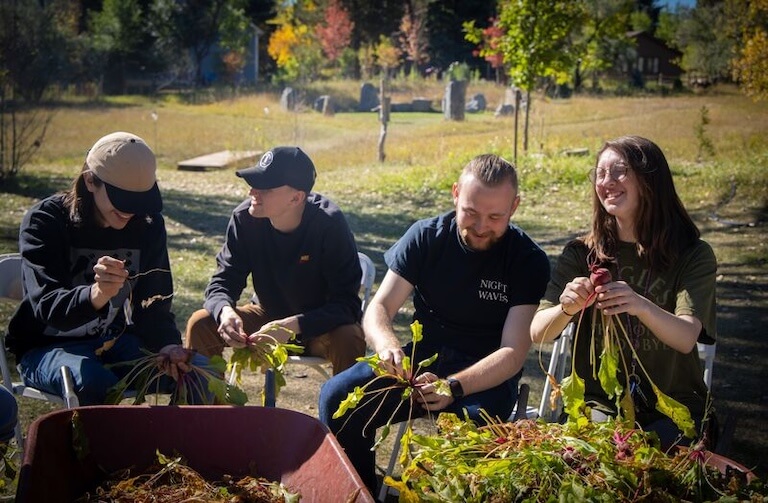
Escoffier students at the Farm to Table® Experience
What If Your High School Doesn’t Offer Culinary Classes?
Don’t worry if your high school lacks a dedicated cooking program—you still have plenty of ways to build real kitchen skills before graduation. You can gain hands-on experience through nearby programs, college courses, or self-directed projects.
- Career and technical education (CTE) centers: Many districts have CTE centers that serve students from several high schools, and culinary arts is a common program. Ask your school counselor whether one is available to you.
- Dual enrollment: Some high schools let students take community college courses for credit. If a nearby college has a culinary program, an intro course may count toward both your diploma and a future degree.
- Independent study: With a teacher as your advisor, you can design a culinary project for credit, like researching a regional cuisine or planning and costing a menu for a school event.
- Summer and community programs: Look into local culinary camps, community education programs, and recreational cooking classes to build skills during school breaks.
- Volunteering: Food banks, soup kitchens, community meal programs, and church or school fundraisers often need kitchen help. Volunteering is a way to practice prep work, food safety, and teamwork, and it can lead to references.
Cooking at home can be a great way to gain experience, too. Document your best dishes in your culinary portfolio, keep the recipes you develop, and note the techniques you practice.
Which Extracurriculars and Competitions Help Future Chefs?
Student organizations, culinary competitions, and part-time restaurant jobs let you practice outside the classroom, meet people in the industry, and in some cases earn scholarships before you graduate.
Student Organizations
Several national student organizations offer culinary competitions, skill-building workshops, and leadership development. Check which ones have a chapter at your school.
| Organization | What it Can Offer Future Chefs |
|---|---|
| FCCLA (Family, Career and Community Leaders of America) | Offers hands-on culinary and baking competitions, leadership training, and scholarship opportunities. |
| SkillsUSA | Hosts competitive events in culinary arts and commercial baking for trade and technical students. |
| DECA (Distributive Education Clubs of America) | Focuses on hospitality management, restaurant marketing, and business strategy competitions. |
| FFA (formerly known as Future Farmers of America) | Covers food science, agricultural sustainability, ingredient sourcing, and farm-to-table supply chains. |
Culinary Competitions
Competitions usually put you in a timed kitchen with judges watching, and many come with scholarships.
Options include the ProStart Invitational, FCCLA and SkillsUSA culinary events, and Escoffier’s own Young Escoffier and Escoffier Crown scholarship competitions. Many qualifying competitions can lead to scholarships for students who enroll within 12 months of high school graduation.
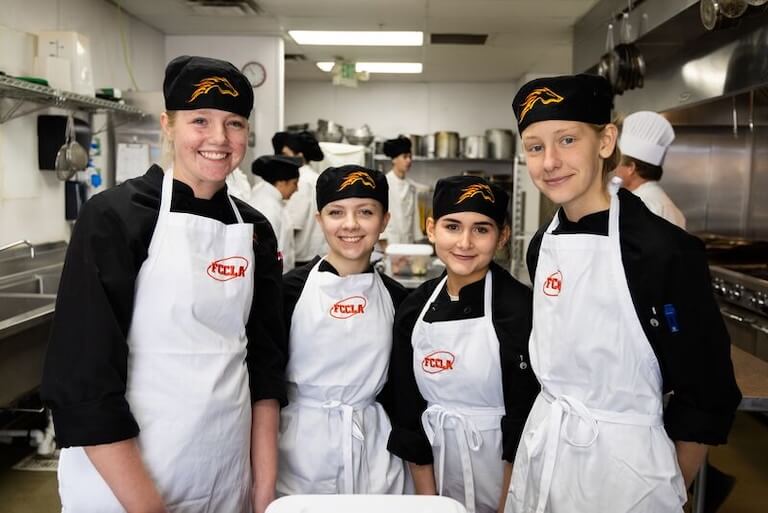
High school culinary competitors at a Young Escoffier Boulder campus event. It’s one of several competitions that can help students develop skills in the kitchen before culinary school.
How Can High School Students Get Real Kitchen Experience?
One of the most practical ways to prepare for a culinary career is to get into a kitchen early. Shadowing, volunteering, and part-time jobs can show you how a professional kitchen runs, which no classroom can fully replicate. Many chefs follow this path: gaining experience first, then attending culinary school to refine their technique and fill in the fundamentals.
Shadow a Chef
Ask a local restaurant, caterer, bakery, or hotel kitchen if you can observe a shift. You’ll see how stations are organized, how the team communicates during service, and what a typical day looks like. Come prepared with questions, dress appropriately, and send a thank-you note afterward.
Volunteer in a Kitchen
Community kitchens, food banks, and event fundraisers are often welcoming to teens with no experience. You can practice prep work, safe food handling, and working as part of a team.
Get a Part-Time Restaurant Job
Entry-level roles like dishwasher, busser, prep cook, or counter staff are common first jobs in the industry. Labor rules for minors vary by state, so check which roles and hours are open to you.
“My first job was when I was 15 years old at a Chinese restaurant,” says Escoffier Chef Instructor Christopher Diehl. “I saw the guys back in the kitchen, the whole environment, the hustle of service…and I fell in love with the show of it all.”
What You Can Learn
Kitchen experience can build the soft skills chefs value most: showing up on time, staying calm under pressure, taking feedback, communicating with your team, and managing your time. It’s also a good way to find out whether kitchen life suits you before you commit to culinary school.
What Culinary Projects Can High School Students Do?
Self-directed projects can let you test-drive real kitchen skills. Try running baking experiments, scaling recipe math, designing mock menus, or practicing plate layout at home. Or ask a teacher if you can do them for class credit.
If you want to push your skills further, try reverse-engineering a restaurant meal. Deconstruct the dish, identify the cooking methods, and figure out what makes the flavor and texture work. Working backward from a finished plate is one way great chefs learn and innovate.
| Skill Area | Project Idea | What You Might Learn |
| Kitchen Experience | Shadow a chef for a shift and keep a journal of what you observe | How stations, timing, and teamwork come together during service |
| Teamwork | Volunteer at a food bank or community meal program | Prep work, food safety habits, and cooking for a crowd |
| Organization | Cook dinner for your family for a week, prepping your mise en place and writing a timeline | Time management and planning ahead |
| Business | Plan, price, and run a bake sale or pop-up for a school club | Food costing, marketing, and customer service |
| Math | Scale a family recipe to serve 50 and calculate the cost per serving | How to adjust ingredient quantities for big crowds and budget out a menu |
| Communication | Write a recipe for a favorite family meal, with an enticing headnote and foolproof steps | How to write precise instructional text and craft enticing menu copy |
| Science | Bake red velvet cake with natural vs. Dutch-processed cocoa and compare | How acid and pH levels change a dish’s flavor, color, and texture |
| Presentation | Plate the same dish three ways and photograph each one | How spacing, color, and positioning make a plate look clean and appetizing |
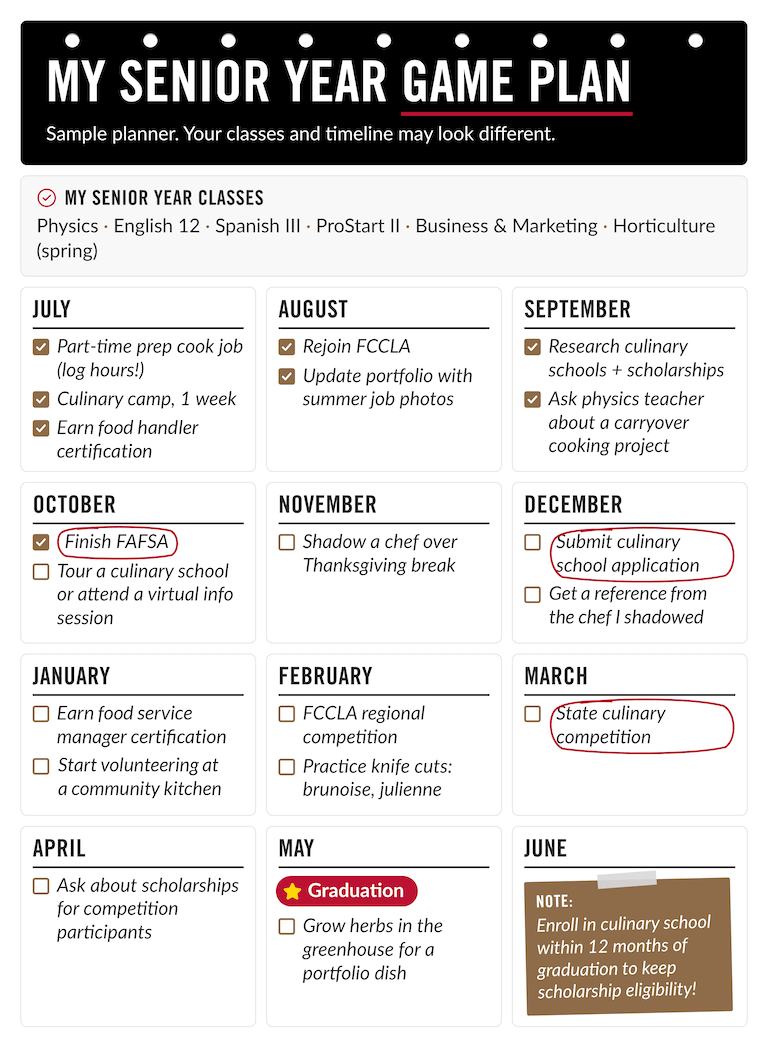
A sample senior-year plan for a future chef. Your classes and timeline may look different.
Start Planning Your Path to Culinary School
The classes you take, the activities you join, and the projects you try in high school can all help you build skills before your first day of culinary school. Culinary arts programs give you the chance to keep developing those skills in a professional kitchen setting.
If culinary school is on your radar, explore what an education at Escoffier could look like for you, including programs, financial aid, and scholarships for high school students. Contact us to learn more.
INTERESTED IN A CULINARY CAREER AFTER HIGH SCHOOL? READ THESE ARTICLES NEXT:
- Am I Too Young To Be a Chef?
- Culinary School Guide For High School Students and Parents
- How To Shadow a Chef While in High School
FAQs
No. There’s no required set of high school classes for becoming a chef or getting into most culinary schools. Classes like math, English, and science can make some concepts easier to learn, but hands-on kitchen experience, a strong work ethic, and good communication skills often matter just as much.
Yes. Many students enroll in culinary school soon after graduating, and some high school scholarships require you to start within a set window. If you plan to go straight from high school, starting your research and applications during senior year will help you take full advantage of those opportunities.
Not necessarily. Culinary programs typically start with fundamentals like knife skills and basic cooking methods, so students come in with a wide range of experience. That said, time in a kitchen before you enroll, whether in a culinary class, a restaurant job, or at home, can help you feel more comfortable from the first day.
Admission requirements vary by school, but many culinary schools focus on whether you’ve earned a high school diploma or equivalent and on your interest in the field rather than a specific GPA. That said, skills from classes like math and English can make culinary coursework feel more familiar.
AP classes can be a great choice if they fit your strengths—especially in relevant subjects like chemistry, biology, or a foreign language. Keep in mind that AP credits don’t always transfer into specialized culinary programs, so the real benefit is the deeper knowledge you build. Be sure to ask admissions reps at your target schools how they handle AP credit.