

Listen to This Article:
Some of the most celebrated names in culinary history started at the bottom of the kitchen brigade while they were still young.
Thomas Keller started washing dishes before he was old enough to cook. Anthony Bourdain got his first kitchen job as a dishwasher at 17. Anne Burrell was a teenage fry cook at McDonald’s. Auguste Escoffier himself—the chef whose name this school carries—began as a kitchen boy at just 13.
If you’re sitting in a high school classroom dreaming of a food career, you share a starting line with those icons: young, entry-level, and eager to get going.
If you want to find out if you have what it takes, you don’t have to wait until after graduation. This guide covers seven culinary jobs you could realistically land right now, including what each one involves, what you can earn, what you can learn, and how that experience can connect to a culinary education and career when you’re ready for the next step.
Why Getting a Culinary Job in High School Matters
Getting a part-time job while you’re still in high school comes with the obvious benefit of a paycheck. But in the culinary industry, there’s often more to it than that.
Unlike some fields where a student internship means sitting in on meetings or doing administrative busywork, entry-level culinary work tends to be the “real deal.” A prep cook and a head chef often clock in at the same time, stand on their feet for the same duration, and feel the same pressure when a busy service hits. That means a high school student working in a kitchen is genuinely working in the field, not doing tasks that only vaguely resemble it.
You Can Find Out if This Industry Is Really for You
Discovering a bad fit can be just as valuable as confirming a good one.
Lauren Kroesser, co-owner of Honeycomb and a culinary school graduate, told Education and Career News that “a kitchen is a very unique work environment and is not for everyone. If you’re uncertain whether or not you want to make food your career, a professional kitchen will help you decide.”
Not to mention that figuring out what career you’re interested in early can help you focus on the education that’s relevant to you. Knowing early on whether you’re interested in studying pastry or hospitality management, for example, could serve you well.

Getting hands-on experience in a professional kitchen, whether savory or pastry, can be one of the fastest ways to find out if a culinary career is the right fit.
You Can Build Skills That Transfer Everywhere
According to the College Board, students who work part-time develop stronger time management and confidence than peers who don’t, and employers in those roles can serve as professional references and recommendation letter writers down the road.
Mark DaCruz, Executive Director of Future Chefs, told Global Business Coalition for Education that paid after-school kitchen work for high schoolers results in “knife skills and life skills,” including teamwork, communication, time management, leadership, and self-expression built directly into the work.
Why Get a Culinary Job in High School?
| The Benefit | What It Can Mean for You |
| Career Clarity | Test-drive a culinary career path before investing time and money into culinary school. |
| Transferable Skills | Learn time management, teamwork, and communication under fast-paced kitchen pressure. |
| Industry Exposure | Gain grit and real-world kitchen experience. |
| Professional References | Earn a powerful recommendation from a chef or manager who can vouch for your work ethic. |
| Early Resume Building | Stack your resume with hands-on history. |
7 Culinary Jobs You Can Start in High School
The food service industry is one of the more accessible fields for first-time job seekers. Many entry-level roles require no prior experience and no formal credentials, just a willingness to learn and the ability to show up on time and ready to work.
The U.S. Department of Labor classifies occupations by Job Zone, a scale from 1 to 5 that reflects how much preparation a new hire typically needs in terms of experience, education, and training. Every role on this list falls into Job Zone 1 or 2, meaning they require very little to some preparation and are generally accessible to first-time job seekers.
Entry-Level Culinary Jobs Summary
| Job Title | Primary Skill Focus | Median Hourly Pay (U.S.) |
| Dishwasher | Kitchen operations, sanitation | $16.19/hr |
| Food Prep Worker | Knife skills, mise en place | $16.45/hr |
| Prep Cook/Line Cook | Cooking fundamentals, station work | $17.71/hr |
| Fast Food Cook | Speed, volume, consistency | $14.50/hr |
| Busser / Dining Room Attendant | FOH/BOH awareness and service flow | $15.71/hr + tips |
| Host / Hostess | Hospitality, communication | $14.61/hr |
| Barista / Café Counter Staff | Coffee craft and customer service | $14.65/hr + tips |
Source: U.S. Department of Labor, Occupational Information Network (O*NET). See individual job sections below for specific profile links.
1. Dishwasher
Ask a working chef how they started, and many will point to the dish pit.
“Every chef should start as a dishwasher because you really start to understand how critical that role is,” says Jesse Ito, co-owner of Royal Sushi and Izakaya. “You develop fundamental organizational skills. You build systems in your mind to be successful instead of getting buried during a busy service.”
Follow Drevon Alston through a full shift as a dishwasher at one of Brooklyn’s oldest restaurants.
In practice, the job means keeping a constant flow of clean plates, pans, and utensils moving back to the line during service and managing a workstation that gets chaotic fast if you fall behind. You can understand what it means to be “in the weeds” before your first week is out.
Role Overview: Dishwasher
| Typical Pay | $16.19/hour median |
| Job Zone | 1-2 |
| Education Requirement | Varies; 43% of positions do not require a HS diploma |
| Credential Required | None |
Source: Dishwashers, O*NET
2. Food Preparation Worker
Before a single ticket prints during dinner service, someone has already spent hours breaking down cases of produce, portioning proteins, washing and spinning greens, and setting every station up with exactly what it needs. That work falls to the prep team, and in many kitchens, this role is accessible to a motivated high school student with no prior experience.
The work can build knife skills, reinforce food safety habits, and introduce mise en place (the discipline of having everything in its place before service begins). Schedules tend to be flexible, and part-time arrangements are common, which can make it a practical fit for students.
Role Overview: Food Prep Worker
| Typical Pay | $16.45/hour median |
| Job Zone | 1-2 |
| Education Requirement | Varies by employer; HS diploma or equivalent required for some positions |
| Credential Required | None |
Source: Food Preparation Workers, O*NET
3. Prep Cook / Line Cook
The distinction between prep cook and line cook matters more in some kitchens than others. In a larger restaurant they are separate roles with different responsibilities. In a smaller operation, the same person might handle both. For a high school student, prep cook is typically the more realistic entry point, though in practice, late-night line hours and state labor laws may put that out of reach until you’re 18.
Either way, this is where cooking actually begins. You are executing recipes, managing heat, and learning the shorthand of kitchen communication you may have only heard on The Bear, like “behind,” “corner,” “sharp,” “hands,” or “all day.”
“Once you start working in a professional kitchen, it becomes a part of you,” Chef Instructor Cesar Herrera says. “You need the adrenaline rush. It’s a different feeling to be behind the line, working as a team and making things happen.”*
Role Overview: Prep Cook / Line Cook
| Typical Pay | $17.71/hour median |
| Job Zone | 1-2 |
| Education Requirement | Varies; 34% of positions do not require a HS diploma |
| Credential Required | None |
Source: Cooks, Restaurant, O*NET
4. Fast Food / Quick-Service Cook
Quick-service restaurants are arguably the quintessential first employers for high school students, and the scheduling flexibility these jobs offer can be more accommodating to high school students than full-service restaurants. The work emphasizes speed and consistency, as you will likely make the same item hundreds of times in a single shift.
Role Overview: Fast Food / Quick-Service Cook
| Typical Pay | $14.50/hour median |
| Job Zone | 1-2 |
| Education Requirement | Varies; 42% of positions do not require a HS diploma |
| Credential Required | None |
Source: Cooks, Fast Food, O*NET
5. Busser / Dining Room Attendant
If the kitchen side of the industry doesn’t feel like the right starting point, the dining room might. Bussers work the floor during service, where they’re kept busy clearing and resetting tables, running dishes to guests, and keeping water glasses full. Particularly during a busy service, this role requires attentiveness and the ability to anticipate what the room needs before anyone asks.
For a student who isn’t yet sure whether they want to be in the kitchen or on the floor, bussing is one of the few entry-level roles that puts you squarely in between. You are close enough to the kitchen to understand what the back of house is managing during a rush, and close enough to the guests to see how the dining room experience unfolds from the other side. That exposure can help clarify which side of the restaurant feels more natural to you.
Role Overview: Busser / Dining Room Attendant
| Typical Pay | $15.71/hour median, plus tip share in many establishments |
| Job Zone | 1-2 |
| Education Requirement | Varies; 22% of positions do not require a HS diploma |
| Credential Required | None |
Source: Dining Room and Cafeteria Attendants and Bartender Helpers, O*NET
6. Host / Hostess
When you call a restaurant to make a reservation or walk in without one on a busy night, you’re talking to the host. They greet guests, manage the waitlist, guide people to their tables, and handle the occasional complaint with a smile (even when the smile takes some effort). It may not be the right role for someone who finds small talk exhausting, but for students who are naturally outgoing and organized, it can be a strong fit.
Unlike kitchen roles, hosting puts communication and composure front and center. For that reason, getting some hosting experience could be particularly useful if you want to pursue careers in hospitality or management.
Role Overview: Host / Hostess
| Typical Pay | $14.61/hour median |
| Job Zone | 1-2 |
| Education Requirement | Varies; 42% of positions do not require a HS diploma |
| Credential Required | None |
Source: Hosts and Hostesses, Restaurant, Lounge, and Coffee Shop, O*NET
7. Barista / Café Counter Staff
Coffee shops and cafés tend to be busiest on Saturday mornings rather than Friday and Saturday nights, which is often ideal for high school students.
Follow a day in the life of Arnaldo Hernandez Mundo, a barista working one of the country’s busiest coffee counters at Grand Central Terminal.
Beyond the scheduling convenience, pulling a quality espresso shot involves understanding grind size, extraction time, water temperature, pressure, and developing knowledge of what a perfect crema looks like. For students who are drawn to food culture, coffee is its own discipline, and working in a café that respects the craft can be an unexpectedly rich introduction to that world.
Role Overview: Barista / Café Counter Staff
| Typical Pay | $14.65/hour median + tips |
| Job Zone | 1-2 |
| Education Requirement | Varies; 57% of positions do not require a HS diploma |
| Credential Required | None |
Source: Baristas, O*NET
How to Land Your First Culinary Job
Most employers understand that a high school student won’t walk in with years of professional experience. What they’re looking for is someone reliable, eager to learn, and honest about their availability.
Where to Look
There are many places to look for a culinary job, including:
- Job boards like Indeed and Snagajob
- Directly on the restaurant’s website or on their social media
- Local Facebook groups
- Job fairs at your high school
- Your network (friends working in the industry, a school counselor, or someone connected to a local culinary program)
You can also bring your resume and walk into local independent restaurants to ask if they’re hiring. One piece of advice: consider going in during slow hours rather than the lunch or dinner rush.
Escoffier graduate Suhalia Gant found her externship placement by walking directly into bakeries and cafés with her resume in hand.
“Some students would say, ‘Oh, I’m still trying to find my externship.’ But they only wanted to reach out to people online,” Gant said. “So I said, ‘You should walk in, take your resume, and talk to people!’”*
What Employers Are Looking For
At the entry level, most culinary employers are hiring for attitude and reliability.
“When I was hiring new line cooks, I would say, ‘I can teach you how to cook. I can’t teach you how to show up early and be excited to be here,” says Chef Luke Shaffer, Escoffier Manager of Content Development and a former hiring manager.
One thing that could set you apart is getting an ANSI National Accreditation Board (ANAB) certified food handler’s permit or certification, like ServSafe, before you apply. Not all states require these, but it can signal to both your parents and potential employers that you’re serious, and it may save your employer the time and cost of getting you certified themselves, which can make you a more appealing candidate.
How Many Hours Can You Work While in School?
About 15 to 20 hours per week is considered the threshold beyond which part-time work can start to affect academic performance. Being upfront with your employer about what you can realistically commit to is better for everyone, rather than pretending you’re more available than you really are.
Resume and Interview Tips for First-Time Applicants
As a high school student, you aren’t expected to have years of professional experience, and that’s okay. Lead with what you do have: school activities, volunteer work, sports or team experience, and any food-related context that’s honest and relevant. Keep the resume to one page, list your availability clearly, and make sure you include a professional email address.
To complement your resume, you can start building your culinary portfolio. You might include class projects, dishes you’ve made for ProStart or FCCLA competitions, and recipes you’ve been testing at home.
For the interview, be specific about why you want to work in a kitchen rather than somewhere else. Saying something like “I’m considering culinary school in a few years and want to learn how kitchens work first” may land better than “My parents told me to get a job.” If you’re a serious foodie, have a family history in the restaurant industry, or fell in love with cooking the first time you made a roux, don’t be afraid to mention it.
What These Jobs Can (and Can’t) Teach You
A part-time kitchen job in high school can show you how a professional kitchen operates, how to work as part of a team under pressure, and whether this environment is one you want to spend your career in. But it’s not necessarily going to give you the skills you need to advance to the upper echelon of the kitchen brigade (think sous chef, executive chef, or restaurant manager), or at least not quickly.
From Part-Time Job to Culinary Career: How This Path Might Look
Part-time kitchen job in HS → Confirm you love the work → Graduate HS → Enroll in culinary program → Hands-On Industry externship(s) → Entry-level professional role → Advancement
Where the Gaps Start to Show
On-the-job experience in a single kitchen tends to be narrow by nature. You learn that specific kitchen’s way of doing things, but you’ll likely have gaps across diverse cuisines and classical technique, food costing and menu pricing, kitchen management, leadership, and the business side of running a food operation.
Restaurant cook roles sit at Job Zone 1-2 according to O*NET, meaning that very little to some preparation is needed. Chef and head cook roles are Job Zone 3, typically requiring an associate’s degree or vocational training, with 54% of people saying an associate’s degree is required for entry. The median pay difference reflects that jump: restaurant cooks earn a median of $17.71/hr, while chefs and head cooks earn $29.32/hr.
Michael Fields, an Escoffier Austin graduate who went on to work at Franklin Barbecue in Austin, has seen peers take both paths.
“I’ve met people who started working in restaurants at 16 and never went to culinary school, and they’re fantastic cooks, but they don’t know what they’re doing,” Fields says. “Going to Escoffier really gives you the confidence you need to get in the door, much easier than if you were just to go work in a restaurant.”*
How Culinary School Can Help Fill Them
There’s a catch-22 that shows up for a lot of people when they start looking to move up in food service. Most management positions require either relevant experience or a formal credential, or both. If you’ve spent years working the line without either, it can feel like a dead end: you need the experience to get the job, but you can’t get the job without the experience.
A culinary degree or diploma can help break that cycle, because it gives you the credential side of the equation while you’re still building the experience side.
It can also be a great way to invest in and scale your own business. When you’re already working for yourself, a structured education could give you tools to take your business to the next level.
“I was already a cook, we already had our catering company, but my education took our catering company to the next level,” said online graduate Ingrid Davis.
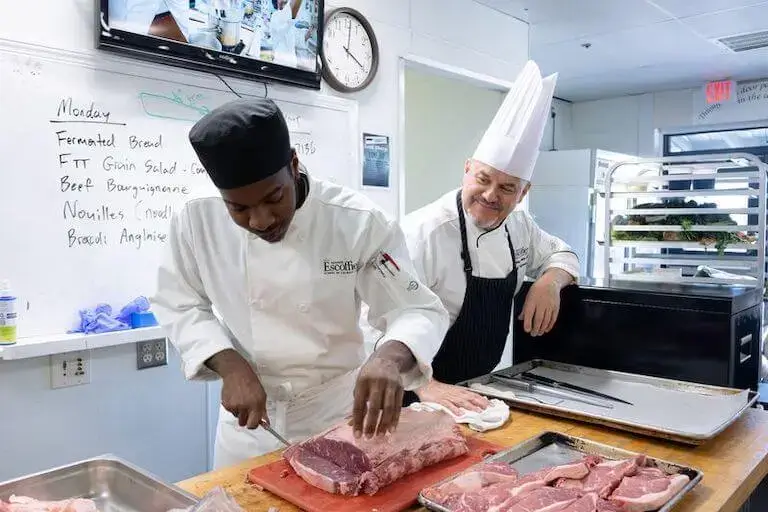
Chef Instructors at Escoffier bring industry experience into the classroom, including hands-on technique work like meat fabrication. Austin Campus Chef Instructor Gary O. Acklerman, shown here, is a Certified Executive Chef® (CEC®) with over three decades’ experience.
Culinary school can expose you to multiple instructors with different backgrounds and specialties, an alumni network, hands-on industry externships, and career support that are harder to access when you’re learning from one kitchen’s way of doing things.
How Escoffier Works for High School Students
| Minimum Age | You can enroll as young as 16 with parental consent and a high school diploma, depending on the program. |
| Enrollment Timing | Apply after your senior year. (Note: You’ll need proof of graduation to finalize enrollment.) |
| SAT Required | No. Test scores are not required for admission. |
| Prior Experience Required | No. You do not need previous kitchen or industry experience to start. |
| Program Length | Diplomas: 30–60 weeks; Associate degrees: 60–84 weeks |
| Industry Externship | At least one is built into every program |
| Career Services | Includes resume building, interview prep, and exclusive access to the EConnect job board. |
| Scholarships | Available for FCCLA, ProStart, and SkillsUSA competitors |
| Financial Aid | Available to those who apply and qualify |
Ready to Take Your First Step?
A part-time culinary job in high school won’t make you a chef overnight, but you can find out whether the pace, the physicality, and the culture of a professional kitchen feel right to you before you’ve committed significant time or money to a culinary education.
For students who get into a kitchen and discover they love it, that experience doesn’t have to stop at graduation. Escoffier’s programs are designed to meet students where they are, whether that means building a foundation from scratch or formalizing skills they’ve already started developing on the job.
If you’re curious about what that path could look like, contact us to find out more or request information about our programs.
WANT TO LEARN MORE ABOUT CULINARY JOBS OR SCHOOL FOR HIGH SCHOOL STUDENTS? TRY THESE ARTICLES NEXT:
- How To Shadow a Chef While in High School
- 6 Ways to Afford Culinary School if You’re a High School Student
- Culinary School Guide For High School Students and Parents
FAQs
Yes. Many entry-level restaurant and food service roles are open to students as young as 14 or 15, depending on state labor laws. Common starting positions include dishwasher, busser, food prep worker, and host. Hours for minors are typically regulated by the state, so it’s worth checking your state’s specific rules before applying.
Most entry-level food service roles require no prior experience. According to O*NET, roles like dishwasher, food prep worker, and busser all fall into Job Zone 1-2, meaning they require very little to some preparation. Employers at this level are generally hiring for reliability and attitude rather than technical skill.
Many entry-level culinary jobs require no prior experience, so the better question is which role fits your interests. Students drawn to cooking might consider dishwasher, food prep worker, or prep cook roles, which put you inside a working kitchen. Bussing or hosting can be a better starting point for students interested in hospitality or restaurant management.
At Escoffier, no prior culinary experience is required for enrollment, but students who have already worked in a kitchen may find that experience helps them choose the right program, whether that’s culinary arts, baking and pastry, hospitality and restaurant operations management, or holistic nutrition and wellness.