Listen to This Article:
In the culinary world, a standard resume only tells part of the story. While a resume outlines your qualifications on paper, a professional culinary portfolio puts your craftsmanship on the plate.
Though it shares a resume’s goal of highlighting your accomplishments, a portfolio transcends the traditional format by allowing you to showcase both your technical expertise and your distinct culinary identity.
Let’s take a look at what makes for a high-quality culinary portfolio.
Culinary Portfolio Essential Elements at a Glance
| Portfolio Element | What to Include | Why It Matters |
| Personal Background & Culinary Philosophy | Professional headshot, cooking philosophy, contact info, social media links (if professional) | Establishes your culinary identity and makes it easy for employers to connect with you. |
| Culinary Education & Professional Experience | Culinary degrees/diplomas, certifications, work history, externships | Demonstrates formal training, foundational knowledge, and hands-on industry experience. |
| Industry Recognition & Career Achievements | Competition wins, awards, media features, testimonials, reviews | Validates your skills and builds credibility with potential employers. |
| Professional Food Photography & Dish Presentation | High-quality images of your best dishes with descriptive captions | Showcases your technical skills and plating creativity. |
| Signature Recipes & Sample Menus | Original recipes, sample menus, evidence of recipe development skills | Proves your culinary knowledge and menu planning abilities. |
| Specialized Culinary Skills & Expertise | Niche techniques (e.g., baking, plant-based), kitchen budgeting, inventory management | Highlights your unique competitive edge and versatility in a professional kitchen. |
| Available Services & Career Goals | Ideal job positions, short-term and long-term career goals, freelance services offered | Aligns your professional aspirations with the right job or business opportunities. |
Digital vs. Physical Culinary Portfolio: Which Format Is Best?
First things first: should you create a physical or digital portfolio? In short, you should probably consider doing both.
In today’s world, the best practice is to create a digital portfolio as well as a physical copy of it. This way, the digital version can live on a website, and you can distribute the physical portfolio as needed. Online portfolios—websites or social media pages—have the advantage of nearly unlimited style choices and the use of non-static flourishes like video. Plus, they can be easily and frequently updated.
The physical copy of your portfolio is handy to drop off during an interview or at a business meeting. You can put photos, menus, brochures, and even your resume in a simple folder or invest in a more polished binder with pages.
How Escoffier’s Career Services Team Supports Your Portfolio
As a student at Auguste Escoffier School of Culinary Arts, the Career Services team can help you get started putting together a portfolio, a high-value tool in a competitive field that values practical skills as well as creativity.
The Career Services team partners with every student and job seeker to create a Customized Marketing Portfolio, or CMP, a professionally assembled package designed to showcase your culinary abilities to potential externship hosts and employers.
The CMP components typically include:
- A sample portfolio of four to ten images representing your core skillset
- An individualized resume tailored to culinary, pastry, or hospitality roles
- A customized Letter of Interest, Externship Factsheet, and cover letter (if needed)
- Externship Agreement and Externship Site Agreement
“A customized marketing portfolio is an important tool soon-to-be graduates can use to demonstrate their skills and build confidence with employers about the quality of their education,” says Jane Jepson, Senior Director of Career Services.
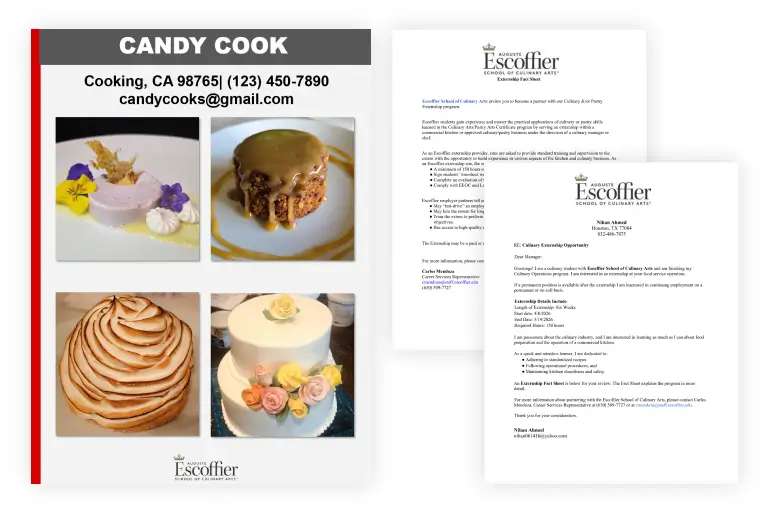
Escoffier’s Career Services team can help students put together a Customized Marketing Portfolio, which can include images of your work, a resume, and more.
Get the Essential Networking Guide for Chefs
Boosting your networking skills can distinguish you in the culinary field. Discover how you can connect with influential industry professionals and unlock new job opportunities!
Food Photography Tips for Your Culinary Portfolio
Because visual elements are imperative to a culinary portfolio, it’s crucial that you spend some time thinking about the photos you’ll use. Cooking is one thing, presentation is another; people build entire careers out of food photography.
You’ll sprinkle photos throughout your portfolio, and if your food doesn’t look good, that might reflect poorly upon you. On the other hand, appealing photos can help nudge you closer to the top of an employer’s or client’s list.
Here are some tips for food styling if you’re taking your own photos:
- Make sure you have good lighting. Natural light is usually best. You want well-lit photos and accurate colors and textures. But don’t use a flash—you don’t want reflections or shadows.
- Think about colors and textures. One tip: use a balance of colors from opposite sides of the color wheel. These complementary colors include reds and greens, blues and yellows, etc.
- Remember your plating skills: clean lines and shapes, a focal point, and the right garnish.
- Learn some basic editing skills. Tools like Canva now include AI-powered background removal and lighting adjustments that require little to no technical knowledge. For more precise control over color and exposure, Adobe Lightroom remains the industry standard. Even smartphone apps like Snapseed (free) offer professional-level editing capabilities right from your phone.
You don’t need to be a graphic design expert, but some layout basics can help your portfolio pop. This includes:
- Effective use of white space, or the empty spaces on a page between text and images. This helps guide the reader’s eyes to certain areas and highlight important points.
- Contrast. Used correctly, a good mix of colors and elements can give your portfolio visual interest.
- Alignment. Be sure your text and any graphics are properly aligned, which reduces clutter.
- Movement. This is the art of giving a page a sense of flow.

Presentation and photography skills can give your portfolio an advantage.
7 Essential Elements Every Culinary Portfolio Needs
1. Personal Background and Culinary Philosophy
This first section includes a summary of your background and experience, any specialties, a description of your cooking philosophy, your goals, and your contact information. You should include a recent photo here too. A professional headshot is good, or a photo of you at work; make sure your face can be seen clearly and that you’re the only person in the photo. No group shots.
Social media information is optional, but be sure to include it if you have a large and engaged following. As for references, consider writing “References available upon request.” You want to be careful not to make names and numbers public, and to protect your and your references’ personal information. Consider setting up a separate email and phone number so you don’t broadcast your personal cell, for example.

Professional photos that showcase both you and your work help potential employers understand your style and capabilities.
2. Culinary Education and Professional Experience
As with a resume, you want to broadcast your relevant education and work experience. A formal culinary school education can make your portfolio stand out and demonstrate expertise. Also list any certifications, like those related to safety, allergens, dietary needs, and the like.
For work experience, list positions with dates and locations. Don’t overlook externships and professional development opportunities; these show you’re actively building skills beyond the classroom.
Take it from Escoffier Online Culinary graduate Waverly Boyce, who says, “What I am most proud of in my Culinary journey is that I went from a nobody to a somebody from my experience here at Auguste Escoffier School of Culinary Arts… I went from only 7 months cooking experience to now 2 years cooking experience and now Sous Chef of my job.”*
Documenting your educational journey and career progression in your portfolio helps potential employers see your growth trajectory.

3. Industry Recognition and Career Achievements
Have you won any cooking competitions, appeared as a podcast guest, or been featured on TV? Here’s your chance to humbly brag. Mention any awards, media, competitions, testimonials, reviews, and published works. If any of these are particularly prestigious and/or impressive, move them higher up in your portfolio.
Ever worked in a Michelin Star restaurant? You want prospective employers and clients to know that right away. Also include relevant photos in this section— winning that competition, working with that celebrity chef, or other accomplishments.
4. Food Photography and Dish Presentation
Time to show off your creations. In the photo section, include pictures of your best dishes along with appealing descriptions. Remember to use good lighting and professional plating. Make the food look as delectable as possible.
If you were a model or an actor, you’d send out glossy headshots that scream Hollywood; do the same here for your food.

Professional plating and thoughtful composition can turn everyday dishes into portfolio-worthy photographs, like this elegant dessert from Escoffier graduate Danny N.
5. Signature Recipes and Sample Menus
Time to demonstrate your know-how. Include your personal recipes along with any menus (sample menus are fine) and brochures. Show off any signature dishes, demonstrate creativity with ingredients, and let them know you understand how to develop recipes.
6. Specialized Culinary Skills and Expertise
If you haven’t already worked this in, now’s the time to highlight any particular culinary skills you honed in school, on the job, or elsewhere. These could include things like plant-based and holistic nutrition cooking techniques, or baking skills, as well as budgeting, technology, and management know-how.
You might want to broadcast skills that are specific to a particular job, or to demonstrate that you understand food entrepreneurship.
7. Available Services and Career Goals
Here’s your chance to describe your ideal job and find your match. This section piggybacks upon your showcased skills to explain what those skills can bring to your work. Perhaps you’re looking for catering jobs or you’d like to become a private chef. List those services here.
Culinary Portfolio Mistakes That Could Cost You the Job
You know what you want to hone in on, but it’s also important to be aware of mistakes to avoid when creating a culinary portfolio.
- Treating a portfolio like a resume—it’s not. Remember, a culinary portfolio is more detailed and visual than a resume. A resume is more like an overview, while a portfolio is like a story.
- Writing too much. Stick to what’s relevant to your goals and the position you’re applying for. Any stories in the “About Me” section should have relevance to your overall theme.
- Including contact info you don’t want to share publicly. This is especially important with your digital portfolio; don’t include your references’ contact information for the whole world to see.
- Inconsistency. Stay on message; if you’re a pastry chef, don’t showcase your tacos (even if they’re delicious).
- Forgetting to pay attention to the layout. Again, consistency is key. In this case, fonts, colors, and overall style should be easy to read and the same throughout. Even if you don’t have a brand identity, your portfolio should have a consistent style to it.
Once you’ve built a strong portfolio and avoided these common pitfalls, your work isn’t quite finished. A portfolio is a living document that should evolve alongside your career.

How and When to Update Your Culinary Portfolio
Your portfolio is a living, breathing document that you’ll continually tweak. This is where the digital portfolio comes in handy, as it allows you to update frequently, practically in real-time. Did you make a TV appearance? Your digital portfolio can reflect that the same day.
Keep abreast of the latest trends so your portfolio can reflect tried and true principles as well as your ability to stay on top of what your audience (and clients) are interested in.
In short, try to update your portfolio when anything significant happens, but also consider revisiting it once or twice a year to update it with new information, assess whether the layout needs a refresh, or add a new headshot.
A culinary portfolio truly shines when it blends experience with your personality and style.
Get Started on a Great Culinary Portfolio
It’s never too early to start building your culinary portfolio. You can start with your chef resume and flesh that out to create a portfolio that shines.
If you need more help with your resume or job search assistance, Escoffier students and graduates have access to Career Services help which can include resume writing assistance and interview preparation, as well as the Alumni Association, an online community of nearly 11,000 members where you can network with mentors, share resources, and ask job-related (or externship) questions.
Contact us today to speak with our Admissions Department and find ways to jump-start your career with education and experience that can make your portfolio shine.
ENJOYED THIS ARTICLE? TRY THESE NEXT:
- How to Become a Chef: The Essential Guide
- How Building a Personal Brand Can Benefit Your Culinary Career
- 10 Common Interview Questions for a Chef Position
This article was originally published on August 10, 2023, and has since been updated.
FAQs
A strong culinary portfolio typically includes an About Me section with your background and cooking philosophy, your education and work experience, professional recognitions and awards, high-quality food photos, sample menus and signature recipes, a showcased skills section, and a description of the services you offer. Consider maintaining a digital version (hosted on a website) as well as a physical copy you can bring to interviews.
The most effective strategy is to maintain both digital and physical versions. A digital portfolio, such as a personal website or professional social media account, allows for easy updates and features like video. It can be ideal for remote applications and networking.
A physical portfolio, like a polished binder or lookbook, is a tactile tool that is especially useful to bring to in-person interviews or business meetings, allowing a potential employer to flip through your work while you discuss your experience.
A culinary resume provides a concise overview of your work history and credentials, while a culinary portfolio typically goes deeper—it’s a visual, detailed showcase of your skills, personality, dishes, recipes, and accomplishments. Think of a resume as an introduction and a portfolio as the full story.
In a field where presentation and creativity matter, a portfolio can carry significant weight with potential employers and clients.
A portfolio isn’t always required, but it can be a meaningful competitive advantage, particularly in higher-end establishments, private chef positions, or freelance and entrepreneurial work.
Employers and clients who can see your food photography, sample menus, and documented accomplishments have a much clearer picture of what you bring to the table than a resume alone can provide.
Good food photography usually starts with good lighting: try natural light and avoid flash, which can create unwanted shadows and reflections. Think carefully about color contrast, plating composition, and garnishes, too. Clean lines, a clear focal point, and attention to textures can elevate even simple dishes into compelling portfolio images.
The earlier the better. Culinary students can begin documenting their work from day one, photographing their dishes, saving instructor feedback, and noting accomplishments like awards or dean’s list recognition. An externship can also be a great opportunity to add professional kitchen experience and documentation to your portfolio.
Collecting these materials and experiences early gives you the opportunity to develop a richer body of work to draw from when you enter the job market.
Strong culinary portfolios often combine professional credentials with a distinctive personal voice. Consider leading with your most impressive accomplishments, using high-quality food photography throughout, and maintaining visual consistency in layout, fonts, and style.
It’s also advisable to avoid common mistakes, such as treating it as a resume, including irrelevant content, or neglecting regular updates. Use your portfolio to tell a compelling story about who you are as a culinary professional, not just what you’ve done.