

Listen to This Article:
Before you ever plate a dish or run a station, there’s a moment many culinary students remember: the first time they put on a chef’s coat. It feels like stepping into something larger than yourself, a tradition that stretches back centuries and carries the weight of every kitchen it’s passed through.
That uniform goes beyond workwear alone. The toque, the double-breasted coat, the apron, the trousers, the shoes—every element was designed with a purpose, shaped by history, and refined by the chefs who wore it before you.
When Chef Auguste Escoffier, our school’s namesake, standardized the uniform in the kitchens he ran across Europe, he was in part establishing a dress code, while also defining what it meant to be a professional. That history is woven into everything you wear.
The Sketch That Changed the Kitchen
The chef’s uniform as we know it today traces back to 1822, when Marie-Antoine Carême, widely regarded as the world’s first celebrity chef, sketched two chefs standing side by side in white hats, double-breasted coats, and waist-tied aprons. The illustration appeared in his work Le Maître d’Hôtel Français and laid out a visual standard that would shape professional kitchens for the next two centuries.
But the uniform didn’t reach widespread adoption immediately. It wasn’t until 1878 that the uniform became en vogue, when the Angelica Uniform Group began manufacturing the design at scale, making it accessible to kitchens beyond the most elite establishments in Paris and London.
Around the same time, chef Auguste Escoffier, the architect of the brigade de cuisine, became the first to make the uniform mandatory. In every kitchen he managed across Europe, his chefs wore it without exception, creating a new standard of professionalism.
While the history of the chef’s uniform has included some changes and modernization, the outfit still closely resembles Carême’s sketch. Today, the uniform consists of a white hat, double-breasted coat, pants, and an apron around the waist. Each of these articles of clothing holds great symbolism and versatile function to the chef wearing it.
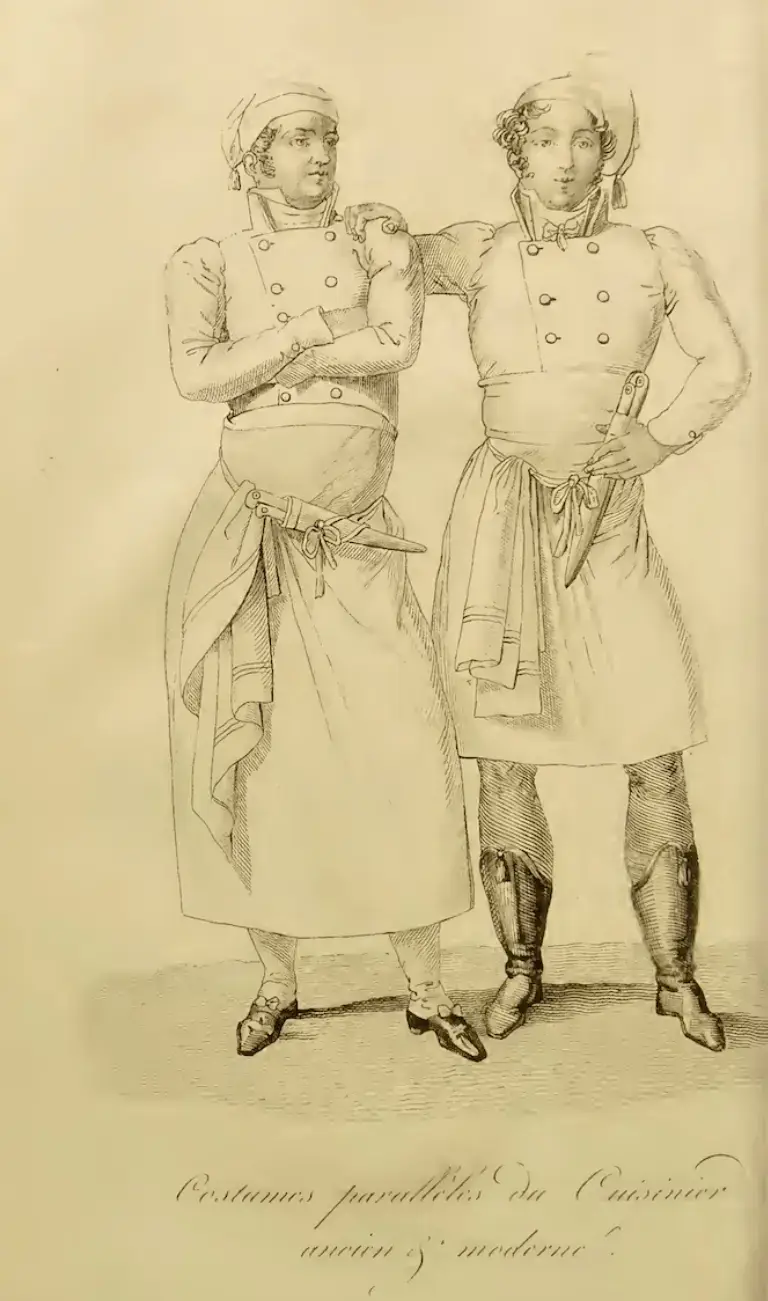
The 1822 engraving from Carême’s Le Maître d’Hôtel Français that set the visual standard for the professional chef’s uniform — still recognizable in kitchens two centuries later. Public domain, via Internet Archive / University of Leeds Library.
The Symbolic Chef’s Hat
Of all the pieces a chef wears, the toque carries the most history. The word blanche is French for white, so toque blanche translates simply as “white hat.” But the origins of the hat itself stretch back much further than the French kitchen.
One of the oldest stories ties the chef’s hat to the royal courts of ancient Assyria, where poisoning was a genuine and common threat to the royal families. Because a cook could be potentially swayed by an enemy of the family, trusted cooks were elevated to the status of court members and rewarded with a cloth crown that echoed the shape of the royal family’s headdress. This, complemented by high pay, of course, was thought to keep them loyal. Some historians believe the crown’s ribs eventually evolved into the pleats of the chef’s hat.
Another account connects the toque to Greek Orthodox priests: when the Byzantine empire fell to invaders, cooks and philosophers who had fled to monasteries for safety adopted the clergy’s tall stovepipe hats as disguise, and continued wearing them afterward as a mark of solidarity.
By the 18th century, French kitchen staff wore colored stocking caps, with different hues denoting rank. It was Marie-Antoine Carême who changed that. In his kitchen, chefs wore hats of different heights rather than colors, with Carême himself wearing the tallest at around 18 inches, supported by cardboard inside. The white toque became a symbol of cleanliness and authority at once.
Auguste Escoffier built on that foundation. He developed the practice of different toque heights to delineate rank in the kitchen, so that anyone entering the kitchen could immediately identify who was in charge and the status of each person working there. Today, traditional toques stand about 8 inches tall, while executive chefs wear them up to 12 inches.

Toque height has long signaled rank in the kitchen, a tradition Escoffier himself codified in the restaurants he managed across Europe.
The pleats carry their own lore. It has long been said that the number of pleats represents the number of recipes or techniques a chef has mastered, with 100 pleats signifying 100 ways to prepare an egg, though there is no hard evidence to confirm this. What is confirmed is the practical value: the tower of air inside the hat helps keep a chef’s head cool during long hours over a hot stove, while keeping hair cleanly out of the food.
When you put on a toque for the first time, you are stepping into a lineage that runs from ancient royal courts through the kitchens of Carême and Escoffier.
The White Double-Breasted Coat
Picture the moment service begins. The kitchen is hot, loud, and moving fast. Pots are on every burner, someone is pulling a sheet pan from a 400-degree oven, and the chef is moving between stations. What you wear in that environment has to work as hard as you do, and the double-breasted jacket has been doing that work since Carême first sketched it.
The heavy cotton construction shields against heat, steam, and splashing liquids. The long sleeves protect the arms from oven doors and open flames, though some modern kitchens have shifted toward short sleeved coats.
The double-breasted front serves a purpose many people might not notice until they’re in a kitchen: if one side becomes soiled mid-service, the flap reverses to present a clean front. A chef can look composed even after hours on the line.
The white carries its own intention as well. In any open kitchen visible from the dining room, white often signals cleanliness and professionalism to the guests watching.
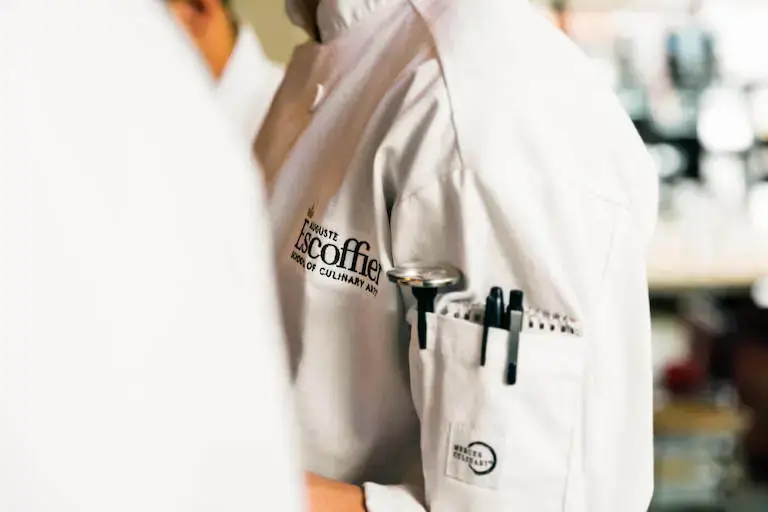
The jacket’s design hasn’t changed much since 1878 — every detail, from the double-breasted front to the long sleeves, still serves a purpose.
The Pants
With ten to twelve hours on hard floors, moving constantly in a confined space, in heat that rarely lets up, the pants, like every other element of the chef’s uniform, have to hold up through all of it.
The houndstooth pattern that defines most chef trousers has a history that predates the kitchen entirely. The pattern originated in Scotland, where its irregular, jagged geometry was used in hunting and outdoor wear to camouflage the wearer against natural surroundings.
When it found its way into professional kitchens, the same visual disruption that made it effective outdoors made it equally effective at concealing the stains and spills that are simply part of working a busy line. In the United States the pattern is typically black and white, while many European chefs favor a blue and white version instead.
The rest of the design follows the same practical logic. A looser fit helps keep hot oil or water from contacting the skin, as tight-fitting fabric in a spill situation could hold heat directly against the body. An elastic or drawstring waist keeps things comfortable across a full shift without restriction. Plus, they’re often finished with side and back pockets that provide convenient storage for essential tools like thermometers, pens, or small notebooks.
The Essential Apron
Of all the pieces that make up a chef’s uniform, the apron has the oldest history. Long before the toque or the double-breasted jacket existed, cooks wore aprons.
In medieval times, aprons were made from linen, hemp, or wool and worn from the waist down. The cook depicted in Chaucer’s Canterbury Tales wears one, placing the garment in the kitchen as far back as the 14th century. The word itself comes from the Old French napron, meaning a small piece of cloth. Over time “a napron” became “an apron,” illustrating a gradual linguistic shift.
The original purpose was simply all about safety. Cooking over open flames meant the apron took the impact of hot splashes and spills before they reached the body and could be pulled off quickly if it caught heat or fire. That function hasn’t changed. When hot liquid spills over a pot being carried across the kitchen, the apron absorbs the main impact and can be quickly removed to protect the legs underneath.

Whether an Escoffier student attends on campus or online, putting on the uniform marks the shift from cook to student of the craft.
By the 19th century, standards around the apron were specific enough to be taught. A record from an 1892 London cookery class for apprentices noted that reversing the apron once during service was permissible, and that adjusting the folds over the waist string could conceal stains, though the instructor warned against folding it so much that it became impractically short.
Today the apron typically ends just below the knee, allowing full range of movement without becoming a hazard. It is the first piece of the uniform that predates the profession as we know it, and is still one of the most essential.

Wear the History
Every chef who has ever stood behind a professional line wore some version of what you have just read about. The toque that signals rank, the jacket designed to reverse mid-service. The apron that predates every other piece by centuries.
When you put on a chef’s uniform for the first time, you are not only getting dressed for class, you’re stepping into that storied lineage.
At Auguste Escoffier School of Culinary Arts, our culinary and pastry programs are taught by professional Chef Instructors who have spent careers earning the pleats in their hats. The uniform you wear here carries the same history it always has—what you do inside it is up to you.
Request more information to explore how Escoffier could help you begin a culinary career.
IF YOU ENJOYED THIS ARTICLE, THEN READ THESE NEXT:
- Your First Job in a Professional Kitchen
- 4 Advanced Cooking Methods for Every Chef
- What Is a Sous Chef?
This article was originally published on February 17, 2016, and has been updated.
FAQs
White was chosen to represent cleanliness, authority, and professionalism in the kitchen. It also serves a practical purpose: white deflects heat rather than absorbing it, which matters in a hot kitchen environment. The double-breasted coat is reversible, allowing chefs to quickly conceal stains during service by folding the front flaps over.
The tall white hat worn by chefs is called a toque blanche, from the Arabic word for hat and the French word for white. Beyond being a recognizable symbol of the profession, the toque serves practical purposes: keeping hair out of food and making the chef easy to spot in a busy kitchen.
Every element of the chef’s uniform carries meaning. The height of the toque traditionally signals a chef’s level of experience, while the number of pleats indicates how many techniques they’ve cultivated. The white coat represents cleanliness and authority. Together, the uniform is a symbol of skill, professionalism, and the discipline required to earn a place in a professional kitchen.
The modern chef’s uniform was originally sketched by Marie-Antoine Carême in 1822, depicting chefs in white hats, double-breasted coats, and aprons. The uniform became widely available after 1878, when it began to be mass produced. Auguste Escoffier later standardized it, requiring all chefs in his restaurants to wear the uniform—cementing it as an industry standard.
Houndstooth patterned pants became a staple of the chef’s uniform primarily for a practical reason: the busy pattern effectively conceals stains and spills that are inevitable in a working kitchen. They’re also typically made from lightweight, breathable material with an elastic or drawstring waist, prioritizing comfort during long shifts.